
Overcoming Doubt: Alex Dean, the heart of communications

Alex Dean once worried that they were not good at life.
Now a communications advisor at the Department of Justice, Alex has struggled with focus throughout their career – sometimes they were completely tuned in, other times adrift.
Alex has ADHD, or Attention Deficit Hyperactivity Disorder, a neurological condition that can present itself in many ways, from complete inattention to being hyper focused. There are a lot of misconceptions around ADHD, one of which is that it is only diagnosed when you are a child.
But that wasn’t the case for Alex.
Getting started
Alex had been studying communications at university. They had always had a knack for taking the overly complicated and making it simple. “I was good at synthesizing information and putting it back out as something people understand, like writing in plain language is a particular strength of mine,” said Alex.
Some university students can apply for coop programs, where they spend entire semesters gathering work experience. Alex was thrilled when they qualified for the program at the University of Ottawa. It was usually reserved for the highest performers and, as Alex was struggling with their still-undiagnosed ADHD, they were not confident that they would qualify. Alex was equally thrilled to get matched with Global Affairs Canada where they got to help with the launch of a new Canadian travel website and work on social media. As a student there, Alex learned a lot and was able to focus their studies, picking course that would help in the working world.
But both at school and at work, Alex could feel their focus drifting.
They tried working in the private sector, marketing for a start-up company, but their heart was not into selling the product. They wanted their communications work to mean something, to be human-centered and compassionate. When Global Affairs asked Alex to come back after graduation, this time as an employee and not a student, Alex didn’t have to think twice. Still, once Alex began working full time, it got even worse.

Alex walking the stage at their University of Ottawa convocation in 2015.
Alex’s tips:
- If you're struggling, there's probably a reason - and a solution: “Early in the process for my ADHD diagnosis, I confessed to a friend that I was terrified there was nothing wrong with me, and that I was "just bad at life”. What she told me has stuck with me ever since: no one is bad at life. If that's how you feel, it's a sign of something more, and it's worth trying to find out what.”
- Work the way you need to - not the way you think you should: “Everyone has different strengths, weaknesses, and learning styles, and it's okay to find new ways to play to them - even if your techniques look different than everyone else's.”
- Living openly creates more open spaces: “Stigma and barriers persist for so many of us, and many people can't safely share their reality. As someone privileged enough to be able to, I've made the choice to do it as often as I can, because I know first-hand the way it can change lives around you.”
Adrift
At first Alex was rejuvenated, back working on exciting files. But, with the travel website launched and excitement surrounding it beginning to wane, Alex’s focus began to drift again. They began to increasingly wonder “Was this normal?”
Alex voiced their concerns to friends. One of them had ADHD and recognized the signs, and he suggested that Alex get assessed. The process to get assessed can be a complicated one, especially for adults, but Alex persevered, doing the questionnaires and declarations, and eventually got a diagnosis: they did have ADHD. Suddenly, so many dots in Alex’s life connected. It was like that moment at the end of a movie where the mystery is finally revealed. Simply understanding a new part of yourself doesn’t instantly equate to happiness - but it can make it easier to figure out how to find it.
Another challenge was Alex’s Ehlers–Danlos Syndrome, a condition that includes hypermobility, making certain motions and everyday activities painful or difficult to do. As they entered their twenties, that pain was growing, and, combined with Alex’s newly diagnosed ADHD, was negatively affecting their mental health. Alex decided to see a psychologist.
They were on the road to finding themselves.
Lost and found
With a greater understanding of what motivated them, Alex realized that their work needed to be anchored in passion – dynamic and interesting files – and compassion, such as supporting and helping others. With this perspective, Alex volunteered as lead social media coordinator for the 2017 Capital Pride Parade. They found it invigorating as they had to take on every component of communicating, from messaging to social media. They also enjoyed being fully open about their non-binary gender identity for the first time in a professional setting. As Alex was looking to make their next career move, they had a lot to consider.
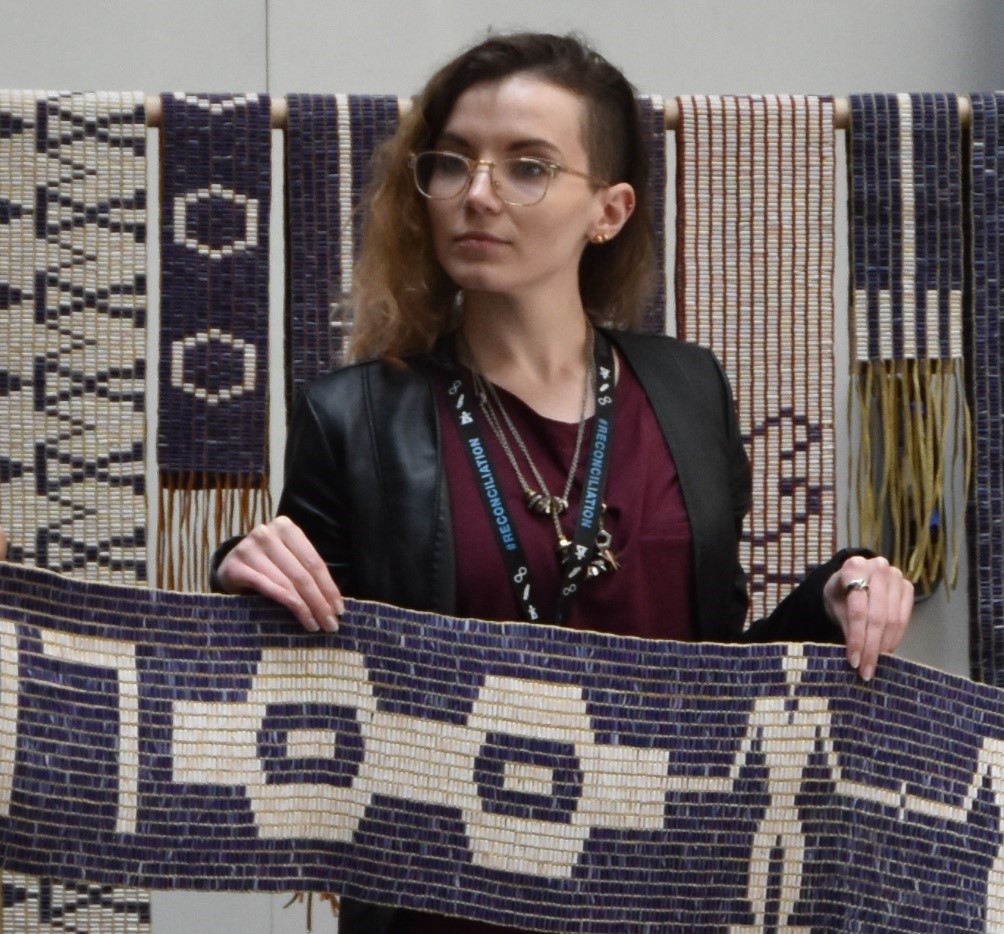
Alex at an Indigenous committee event in 2019 holding up a wampum belt.
This experience aligned with Alex qualifying for a higher-level position in the federal government. As they were looking to make a change, they were contacted by the communications group at the Department of Justice. Alex saw all the interesting files being worked on at Justice, including the implementation of the United Nations Declaration on the Rights of Indigenous Peoples and programs to help victims of family violence. These were files that Alex felt passion for, and they decided to join the team.
Within a year, Alex became part of the employee communications unit where they were responsible for working with the department’s Employment Equity Advisory Committees. These employee-run committees represent the underrepresented, seeking to ensure equity and inclusion throughout the department. Alex’s ability to simplify the complex helped committee members communicate tough subject matter to departmental employees. As they worked with these different groups, Alex began to see parts of themselves reflected, from employees overcoming disabilities to embracing their gender identity at work.
Alex was particularly inspired by one of the counsels that they worked with, Lee Nevens. “Lee has been really influential on a national scale in bringing awareness on pronouns and use of pronoun introductions in courtrooms,” said Alex. “They were at the head of the first movement in Canada to make pronouns a required part of core introductions in British Columbia, which is now kind of spread across Canada.”Alex worked with Lee on publishing a pronoun primer for the department, explaining to staff on how to properly use them and why it was important. This helped Alex become comfortable declaring their own pronouns in the office. “It wasn't until I worked with Lee Nevens in their advocacy non-binary inclusion that I started to think maybe it was worth coming out at work. When I followed those trails, it widened the path even more - and I've watched the way people light up as they realize they can follow it too. The more of us there are, the easier the road, and every new step counts.”
One day a student came up to Alex and said that, before they met them, it had never occurred to them that they could be themselves in the public service. “I was a queer person with a bright blue undercut who came to work looking like an emo kid mixed with a business person, so it meant a lot that I was seen as an inspiration,” said Alex.
Alex began to develop strong relationships with each of the employee groups and networks that they supported. They would embed themselves on each committee, participating both as a communications advisor and a member. Alex met people like them, some even struggling with ADHD, overcoming a disability, or understanding their gender identity, and they talked about things that the department could do as an organization to support its staff.
Members of the committees began to come to Alex with concerns that they felt they couldn’t raise anywhere else, notably about the way the department would speak about their issues. In turn, Alex began to consult with the committee members on communications products that affected them, even if they were going to outside audiences. Alex wanted advice and feedback from people with lived experience.
If there was one thing, above all else, Alex values from that period, it was building strong relationships. Alex explains it like this: “They knew that they could say whatever they thought to me and not have to do the emotional labor that tends to come with providing constructive criticism on something that is sensitive to them. That is what you hear a lot from people marginalized people working in these kinds of spaces - a lot of them rightly feel that they must do extra work to sanitize the way that they express themselves.”
From the time Alex joined the department in 2017 to now, things have changed for the better, as the organization has become more diverse and inclusive. Along with Advisory Committees devoted to informing senior management about issues affecting members of racialized groups, Indigenous peoples, women, and persons with disabilities, new groups have arisen for Black employees, people with different sexual orientations or gender identities, and more; and with a more active role than ever in guiding the Department towards a better future.
Figuring it out

Alex doing photography in the 2023 Pride Parade for the Department of Justice’s Advisory Committee on Sexual Orientation and Gender Identity and Expression.
Alex has been recognized internally multiple times for their work in building relationships and fostering a welcoming community inside the department, one that is growing in its understanding of diversity and inclusiveness. It feels like they have found a place where their focus on compassion in communications is valued. A point of pride for Alex was the moment that the lead of the Black Employees Network introduced Alex as an ally. It was a powerful and meaningful moment for them.
But it is a work in progress, both for the department and for Alex.
Understanding themselves a bit better was a key part of their journey. “In previous jobs, I would regularly be so upset at spreadsheets that I would almost be crying at my desk,” they explain. “The first time I tried ADHD medication, I was working on some of the most complicated ones I'd ever worked on, and I felt great the whole time.”
Understanding their ADHD, getting accommodated for their Ehlers–Danlos Syndrome, these were things that allowed Alex to bring their best self to work.
But it was the work itself that allows Alex to bring their heart to work.
Sometimes it is not about having all the answers but instead being able to lend an ear and having aptitude to grow. From supporting employee networks, to helping the department make the right moves in communicating with its staff, to speaking truth to power when needed – these things make Alex Dean the heart of communications.
- Date modified: