
What We Heard
There is extensive support for the development of the Network. Almost all respondents (72% strongly agreed and 18% agreed) to the online engagement agreed that having a network in Canada would be beneficial to enable research collaboration across sectors. The Network was seen as a way to help facilitate a connection between researchers and practitioners to support translating research into practice, create opportunities to learn and grow as a research community, raise awareness through disseminating and sharing research, including finding creative solutions to address harm and support well-being, enable people to meet others to collaborate on research and data projects, and foster communities of research practice.
The following are key themes that emerged during the multiphase engagement process.
Communication and Collaboration
Although most participants in the engagement process indicated that they are currently accessing restorative justice research and information through websites, open-source publications, journals and webinars, they indicated they would like more interactive approaches to foster ongoing communication and collaboration through the Network. These include in-person and virtual symposiums, conferences, knowledge exchanges and building communities of research practice where information and research projects underway, including challenges and lessons learned can be shared. To facilitate this approach, creating communities of research practice and an online presence with a website were discussed.
Communities of Research Practice
The intention of the communities of research practice is to ensure that the Network is inclusive so that everyone is able to find a space to interact with other researchers and practitioners. This model enables a decentralized approach that reflects the collaborative design of the Network.
The communities of research practice can be based on different topics (e.g., victim-centered restorative justice), geographical areas (e.g., restorative justice in rural/remote areas), or sectors (e.g., restorative justice in the justice or health sector). As long as there is someone to create, lead and organize the community, it can be added.
The communities of research practice that were of most interest through the online engagement include: identifying ways to measure restorative justice in Canada (e.g., identifying indicators, telling restorative justice stories) (62%); building restorative communities, including preventing harm (62%); and restorative justice in the justice sector (61%). Additional topics of interest that were selected by at least half of the respondents include: restorative justice for social justice (59%); restorative justice to address gender-based violence (58%); decolonization in restorative justice (57%); Indigenous restorative justice (54%); translating research to practice (54%); victim-centered restorative justice practices (53%); restorative justice to address identity-based harm (e.g., hate-based or hate-motivated crimes) (53%); anti-racism in restorative justice (51%); and restorative justice in the education sector (50%).
Website
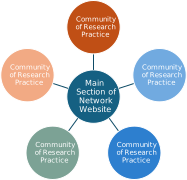
A virtual presence through a website is key for the Network as this would be an on-line platform to enable people to connect and facilitate collaboration across the country. It would also provide a national and international presence. Participants suggested that the website includes: a catalogue of research products and publications; a space to promote new publications, webinars, podcasts, conferences and other awareness-raising events; and interactive collaboration spaces for the communities of research practice. These collaboration spaces would be developed as nodes (emergent hubs of engagement) that are virtually accessible from a main page of the website. Below is a visual representation that was used during the listening sessions to discuss the website and the communities of research practice.
Text version
A circular network diagram showing the structure of the Network Website. In the center is a dark teal circle labeled “Main Section of Network Website.” Five circles surround it, each connected to the center by a thin black line. All outer circles are labeled “Community of Research Practice.” The circles vary in color: top circle is dark orange, upper left circle is peach, lower left circle is sage green, lower right circle is vivid blue, upper right circle is light blue. The layout visually represents five communities of research practice connected to the central main section of the network website.
In the middle is the main website that everyone would visit as a first step. This section would provide information on a national level for the full Network (e.g., events, Network announcements), and identify the different communities of research practice. This structure would enable additional communities of research practice to be added as the Network grows, and interests shift to new emerging topics.
Each community of research practice would have its own webpages, which would be accessed off the main section, that can be designed and maintained based on what the community feels is needed.
Implementation Strategies
Part of the engagement focused on how the Network should be implemented. What was heard is that the Network needs to be inclusive and diverse, accessible, and use an adaptable structure to ensure growth and sustainability.
Inclusive and Diverse
A key consideration in creating an inclusive Network is ensuring that a broad definition of restorative justice is used so that the Network is not solely focused in one sector (e.g., criminal justice) or one type of restorative justice (e.g., mediation). Rather, diverse perspectives of restorative justice are needed to enable an interdisciplinary approach, which brings together government, non-government organizations, academia and Indigenous communities to collaborate and share knowledge.
Restorative justice is relational, which is key to how the Network is to be implemented. A collaborative and relational structure, rather than hierarchical, that is independent but supported by government, non-government, academia, and the private sector is important.
Using a decolonizing, anti-racist, collaborative decentralized approach to implementing the Network will ensure that it is inclusive and welcoming of diverse experiences, expertise, and ways of knowing. In addition to ensuring that people from different backgrounds are invited to participate in the Network, it is crucial to engage with Indigenous leaders to ensure authentic collaboration and decolonized and Indigenous approaches are used.
Accessible
The purpose of the Network is to build relationships and person-to-person connections, which can only be done if it is accessible within different communities (e.g., not just for academia and government) through different mechanisms including opportunities to interact virtually and in-person. Access to the internet in northern and remote areas needs to be considered. The website and knowledge products shared also need to be accessible (e.g., open source, plain language).
There is value in continuously engaging with and reaching out to individuals and groups at different times. Depending on interest, timing, scheduling and other influences, individuals and groups may be able to participate or get involved in different areas at different times.
Adaptable Structure
An important guiding principle for the development of the Network is that it be adaptable to address the changing needs of the community. By using a ground-up rather than top-down approach to development, the Network can have the autonomy and liberty to change and adapt more easily, including addressing the unique needs of different communities/regions, including remote/isolated communities, while still making connections across the country.
Sustainable
Considering approaches to ensure that the Network is sustainable is essential in its development. Dedicated, sustainable funding from multiple sources (e.g., federal and provincial/territorial governments, private sector, academia, non-government, private) is needed to maintain the website and ensure there are resources for a paid steering committee to oversee the Network.
A steering committee, that changes over time, is needed to coordinate the Network, while volunteers can lead the communities of research practice and provide cross-country representation.
Consistent communication, regular sharing of information, and opportunities to connect regularly through annual conferences and events are needed.
Each community of research practice needs to have a leader or an organizing group to create and maintain their own webpages, with the assistance of the steering committee web administrator.
Growth
To ensure that the Network continues to grow, evolve over time and promote diversity it will be important to find those who are passionate and can make connections with others who have the same interest and passion. It will also be important to bring in new people and create new partnerships. The Network can collaborate with educational institutions (e.g., ensure a steady stream of new ideas and students) and foster ongoing connection between researchers, government, policy makers and practitioners to align research priorities (e.g., can open funding opportunities) and collaboratively work on new approaches, projects, and organize forums.
A strong communication plan is needed to keep people informed and involved using innovative strategies, and to help promote the Network to others. The communities of research practice should be encouraged to be in constant dialogue with practitioners to identify practical projects and to help translate research into practice.
Dedicated funding is also essential to enable growth and development. Only so much can be achieved through volunteer resources.
- Date modified: