
Backgrounder – How the new Criminal Code tools in Bill C-22 would work
Department of Justice Canada
Backgrounder
From street crime to national security threats, criminal activity is increasingly being enabled by digital, globalized, and sophisticated crime networks. The Act would make targeted changes to strengthen Canada’s laws and support law enforcement with new tools to investigate serious threats, disrupt organized crime, and protect our communities.
Two new tools, the confirmation of service demand and the subscriber information production order, would help law enforcement investigate threats earlier, act quickly in urgent situations, and confirm whether someone is using a service relevant to an investigation, so they can take the lawful steps needed to protect victims and respond to imminent threats. These two new tools would not enable police to conduct warrantless searches of personal information.
Confirmation of service demand
The confirmation of service demand would be a tool designed to help police determine which telecommunications service provider has information that will assist in the investigation of an offence. This new tool would only apply to telecommunications service providers and could not be used to obtain confirmation from other electronic or web-based services such as websites, electronic marketplaces, and communications and messaging services.
How it would work:
Text version
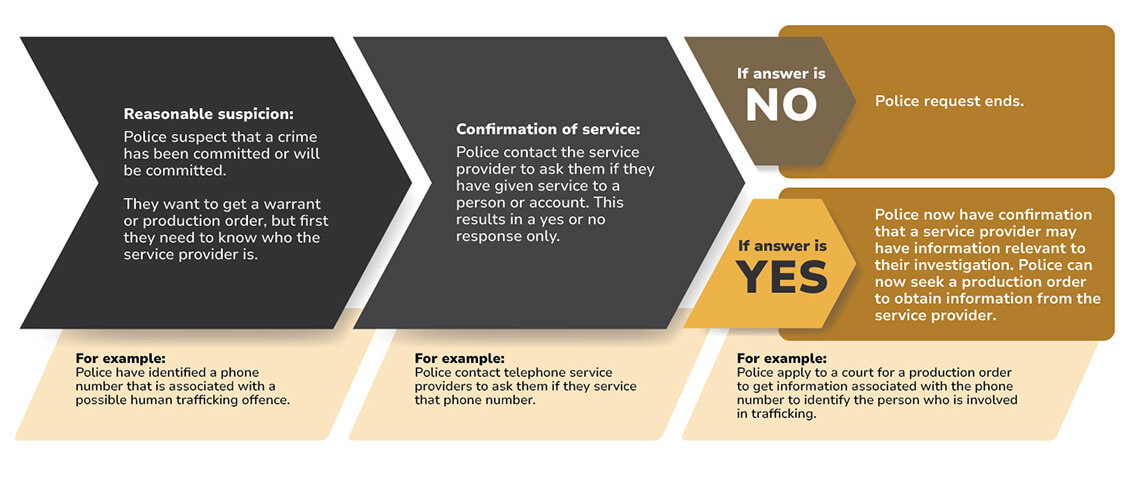
This chart provides an overview of how the confirmation of service demand would work, arranged in a 3-step flow chart:
- Reasonable suspicion: Police suspect that a crime has been committed or will be committed. They want to get a warrant or production order, but first they need to know who the service provider is.
- For example: Police have identified a phone number that is associated with a possible human trafficking offence.
- Confirmation of service: Police contact the service provider to ask them if they have given service to a person or account. This results in a yes or no response only.
- For example: Police contact telephone service providers to ask them if they service that phone number.
- If answer is No: Police request ends.
If answer is Yes: Police now have confirmation that a service provider may have information relevant to their investigation. Police can now seek a production order to obtain information from the service provider.- For example: Police apply to a court for a production order to get information associated with the phone number to identify the person who is involved in trafficking.
Subscriber information production order
The subscriber information production order would be a new tool designed to obtain information that can identify subscribers to a service, such as name, address, and email linked to a particular account. Consistent with the other tools that law enforcement agencies use for their investigations (like other production orders), it would be authorized by a court if police can demonstrate that they have a reasonable suspicion that an offence has been or will be committed and that the subscriber information will assist them in the investigation. This new tool which would be particularly useful at the beginning of an investigation.
How it would work:
Text version
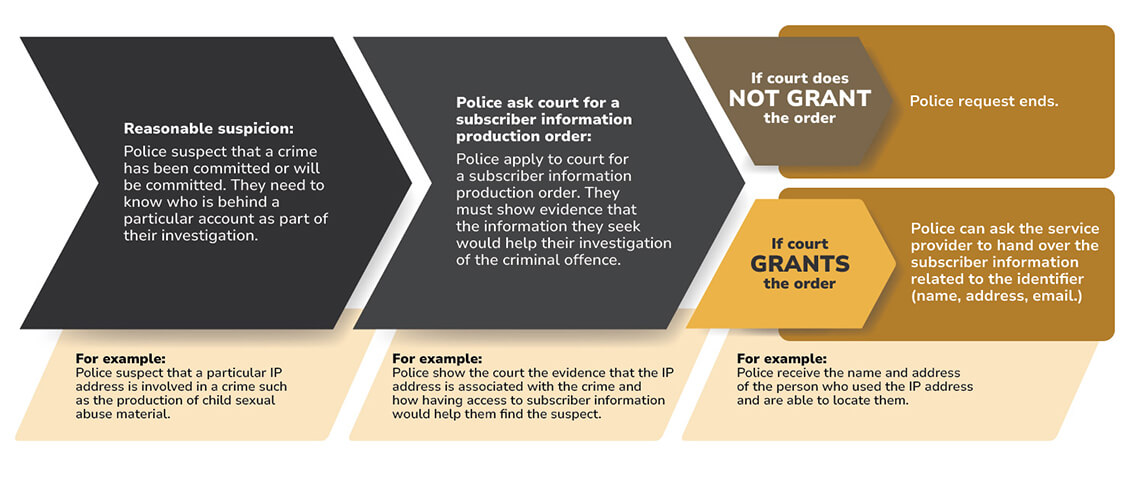
This chart provides an overview of how the subscriber information production order would work, arranged in a 3-step flow chart:
- Reasonable suspicion: Police suspect that a crime has been committed or will be committed. They need to know who is behind a particular account as part of their investigation.
- For example: Police suspect that a particular IP address is involved in a crime such as the production of child sexual abuse material.
- Police ask court for a subscriber information production order: Police apply to court for a subscriber information production order. They must show evidence that the information they seek would help their investigation of the criminal offence.
- For example: Police show the court the evidence that the IP address is associated with the crime and how having access to subscriber information would help them find the suspect.
- If court does not grant the order: Police request ends.
If court grants the order: Police can ask the service provider to hand over the subscriber information related to the identifier (name, address, email).- For example: Police receive the name and address of the person who used the IP address and are able to locate them.
For more information on Bill C-22, please visit: https://www.canada.ca/en/public-safety-canada/news/2026/03/canada-introduces-new-tools-for-law-enforcement-to-investigate-threats-and-keep-canadians-safe.html
For more information on lawful access, please visit: https://www.canada.ca/en/services/policing/police/crime-and-crime-prevention/lawful-access.html
- Date modified: