
Three Years On: Mentoring at the Department of Justice and the Public Prosecution Service of Canada
3. Results
3.1 Who Participates in the National Mentoring Program
Administrative statistics are kept on participants in the NMP for both the Department of Justice (JUS) and the Public Prosecution Service of Canada (PPSC). All information in this section is as of March 31, 2011. At that time, there were a total of 957 individuals who had registered as a participant or member in the NMP, which represents 17% of the total 5,659 JUS employees and managers.Footnote 4 For the PPSC, one tenth (11%) of that organization was participating in the NMP or 104 individuals out of 975.
A total of 448 associates and 341 mentors in JUS had been matched as of March 31, 2011. In the PPSC, 37 associates and 29 mentors had also been matched.Footnote 5 JUS and PPSC both participate in the NMP and so a PPSC mentor might be matched with a JUS associate or vice versa. In addition, it is important to note that many mentors have more than one associate; some have two, three or even four. This is why the survey was sent to a smaller number of associates and mentors than the numbers presented here. To further complicate the administrative data, one individual may be registered (and hence count as one for the purposes of participation), but be both a mentor and an associate.
Table 1 below presents the numbers of members of three of the Employment Equity Groups registered in the NMP for JUS and PPSC. In Table 2, the gender ofNMP members is presented.
| Employment Equity Group | JUS n |
PPSC n |
|---|---|---|
| Aboriginal Peoples | 26 | 2 |
| Persons with Disabilities | 29 | 2 |
| Visible Minorities | 180 | 10 |
| TotalEE members | 235 | 14 |
| Total NMP | 957 | 104 |
| Percentage of EE members in NMP | 25% | 13% |
Source: National Mentoring Program Administrative Database 2011
| Gender | JUS n (%) |
PPSC n (%) |
|---|---|---|
| Male | 277 (29%) | 52 (50%) |
| Female | 680 (71%) | 52 (50%) |
| Total | 957 (100%) | 104 (100%) |
Source: National Mentoring Program Administrative Database 2011
In February 2009, three months after the NMP was launched, the participation rate for JUS was 8.7%. In December 2010, the participation rate had increased to 16.4% (or 923 participants) and in March 2011, the rate was 16.9% or 957 participants. For the PPSC, in March 2011, one tenth (11%) of the organization was participating in the NMP or 104 individuals out of 975. Overall, what is important is that the participation rate has climbed steadily since the launch of the NMP in October 2008 and registration of both mentors and associates continues in both JUS and PPSC.
3.2 Who Participated in this Study
A total of 118 mentors and 160 associates responded to the survey. This represents a participation rate of 36% of all matchedNMP participants. For associates, 152 respondents were from JUS and 8 were from PPSC. For the mentors, 111 respondents were from JUS and 7 were from PPSC. Results for JUS and PPSC are presented together.
Table 3 presents the demographics of mentors and associates who responded to the survey.
| Classification Group | Associates N=154Footnote 7 n (%) | Mentors N=118 n (%) |
|---|---|---|
| AS | 15 (10%) | 6 (5%) |
| CR | 13 (8%) | 2 (2%) |
| CS | 2 (1%) | 0 (0%) |
| EC | 17 (11%) | 15 (13%) |
| EX | 2 (1%) | 7 (6%) |
| IS | 3 (2%) | 0 (0%) |
| LA management | 11 (7%) | 31 (26%) |
| LA non-management | 88 (57%) | 51 (43%) |
| PE | 1 (1%) | 5 (4%) |
| PM | 1 (1%) | 1 (1%) |
| Other | 1 (1%)student | 0 (0%) |
| Region | Associates N=160 n (%) | Mentors N=117 n (%) |
|---|---|---|
| Northern | 7 (4%) | 0 (0%) |
| British Columbia | 26 (16%) | 19 (16%) |
| Prairie | 18 (11%) | 15 (13%) |
| Ontario | 27 (17%) | 24 (21%) |
| National Capital Region | 73 (46%) | 51 (44%) |
| Quebec | 5 (3%) | 5 (4%) |
| Atlantic | 4 (3%) | 3 (3%) |
| Gender | Associates N=159 n (%) | Mentors N=117 n (%) |
|---|---|---|
| Male | 39 (25%) | 42 (36%) |
| Female | 120 (75%) | 75 (64%) |
| Members of Employment Equity Groups | Associates N=150 n (%) |
Mentors N=115 n (%) |
|---|---|---|
| Aboriginal Peoples | 7 (5%) | 4 (3%) |
| Persons with a Disability | 7 (5%) | 8 (7%) |
| Visible Minorities | 40 (27%) | 5 (4%) |
| Years in the Public Service | Associates N=160 n (%) |
Mentors N=117 n (%) |
|---|---|---|
| Less than 1 year | 2 (1%) | 0 (0%) |
| 1-2 years | 19 (12%) | 0 (0%) |
| 3-5 years | 46 (29%) | 6 (5%) |
| 6-8 years | 30 (19%) | 5 (4%) |
| 9-11 years | 23 (14%) | 25 (21%) |
| 12-14 years | 12 (8%) | 12 (10%) |
| 15-17 years | 8 (5%) | 10 (9%) |
| 18-20 years | 8 (5%) | 11 (9%) |
| More than 20 years | 12 (8%) | 48 (41%) |
| Years at JUS and/or PPSC | Associates N=160 n (%) |
Mentors N=118 n (%) |
|---|---|---|
| Less than 1 year | 4 (3%) | 0 (0%) |
| 1-2 years | 30 (19%) | 0 (0%) |
| 3-5 years | 59 (37%) | 11 (9%) |
| 6-8 years | 22 (14%) | 9 (8%) |
| 9-11 years | 17 (11%) | 28 (24%) |
| 12-14 years | 10 (6%) | 18 (15%) |
| 15-17 years | 5 (3%) | 5 (4%) |
| 18-20 years | 4 (3%) | 14 (12%) |
| More than 20 years | 9 (6%) | 33 (28%) |
Source: National Mentoring Program Survey 2011
Out of survey respondents who chose to self-identify (n=150 associates, n=115 mentors), 36% of associates and 15%Footnote 8 of mentors were a member of an Employment Equity group. Selected findings for members of anEE group will be presented throughout the report given that one of the objectives of the NMP is to “create a more diverse and inclusive workplace.”
At the end of the survey, respondents were asked if they were interested in being interviewed and if so, they were prompted to provide their name and contact information. As noted earlier in section 2.2.3, a total of 64 individuals volunteered and ultimately, 24 interviews were completed. Associates and mentors, lawyers and other professionals, senior managers and employees, both new and experienced volunteered for an interview. We tried to ensure that we had a range of experiences and included individuals in Legal Service Units, in regional offices, in both JUS and PPSC, and in as many occupational categories as possible.
In the following sections, we examine results from the survey and interviews on the National Mentoring Program first followed by results about current and ended mentoring relationships. Wherever appropriate, we include results from the interviews with results from the survey to fully respond to the questions.
3.3 The National Mentoring Program
3.3.1 How respondents became aware of the NMP
All respondents were asked how they became aware of the National Mentoring Program and results are presented below in Figure 1.
Figure 1: How respondents became aware of the NMPFootnote 9
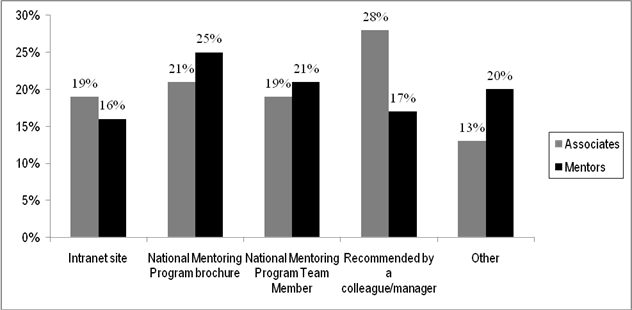
Figure 1 - Text equivalent
This is a vertical bar chart that illustrates how Associates and Mentors became aware of the National Mentoring Program.
The Y axis is measured in percentage and increases in increments of 5 from 0 to 30.
The X axis lists the following options for how the respondent became aware of the National Mentoring from left to right: Intranet site, National Mentoring Program brochure, National Mentoring Program Team Member, Recommended by a colleague/manager, Other. 19% of Associates and 16% of Mentors became aware of the National Mentoring Program through the Intranet site; 21% of Associates and 25% of Mentors became aware of the National Mentoring Program through the National Mentoring Program brochure; 19% of Associates and 21% of Mentors became aware of the National Mentoring Program through a National Mentoring Program Team Member; 28% of Associates and 17% of Mentors became aware of the National Mentoring Program through a recommendation by a colleague/mentor; 13% of Associates and 20% Mentors became aware of the National Mentoring Program through an “other” means. The “other” category includes Employment Equity committees, the new employee orientation, the Justice Leaders of Tomorrow Program, presentations by an Ambassador and automatic emails when mentoring was noted in Individual Learning Plans.
Source: National Mentoring Program Survey 2011; N Associates = 160; N Mentors = 118
In the “other” category, respondents indicated that they were aware of the NMP through Employment Equity committees, the new employee orientation, the Justice Leaders of Tomorrow Program and through presentations by an Ambassador. In addition, some received automatic emails when mentoring was included in Individual Learning Plans. Numerous mentors also noted that they heard about it from managers encouraging them to get involved. It seems that all modes of advertising are working, with social networks (colleagues) playing an important role in matching people. In the end, these numerous avenues remain useful.
3.3.2 NMP Services
Respondents were asked to rank the usefulness of severalNMP services using a 4-point scale with Very useful, Useful, Not very useful, and Not at all useful. The services, the scale and the results can be seen in Figures 2 and 3. The rankings have been combined for ease of reference: Very useful and useful are presented together and not very useful and not at all useful are also presented together. Not applicable is represented as a separate category.
Figure 2: The usefulness of NMP services – Associates
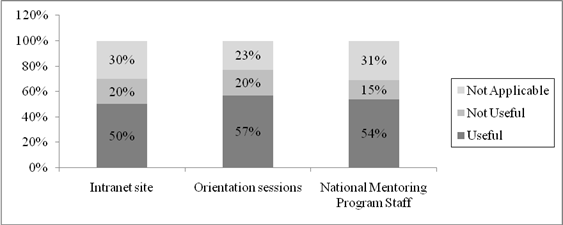
Figure 2 - Text equivalent
This is a vertical bar chart that illustrates how Associates rated the usefulness of NMP services. Each bar is divided into three categories: Useful, Not Useful and Not Applicable.
The Y axis is measured in percentages and increases in increments of 20 from 0 to 120. The X axis is divided into three services.
The X axis lists the following services from left to right: Intranet site, Orientation sessions, and National Mentoring Program Staff. 50% of Associates said they found the Intranet site useful, 20% said they found the Intranet site was not useful, and 30% answered Not Applicable. 57% of Associates said that the Orientation sessions were useful, 20% said they were not useful, and 23% answered Not Applicable. 54% of Associates said that the National Mentoring Program Staff was useful, 15% said not useful, and 31% answered Not Applicable.
Source: National Mentoring Program Survey 2011; Ns range from 158 to 160
Figure 3: The usefulness of NMP services – Mentors
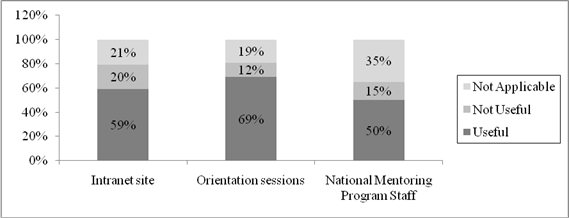
Figure 3 - Text equivalent
This is a vertical bar chart that illustrates how Mentors rated the usefulness of NMP services. Each bar is divided into three categories: Useful, Not Useful and Not Applicable.
The Y axis is measured in percentages and increases in increments of 20 from 0 to 120.
The X axis is divided into three services. The X axis lists the following services from left to right: Intranet site, Orientation sessions, and National Mentoring Program Staff. 59% of Mentors said they found the Intranet site useful, 20% said they found the Intranet site was not useful, and 21% answered Not Applicable. 69% of Mentors said that the Orientation sessions were useful, 12% said they were not useful, and 19% answered Not Applicable. 50% of Mentors said that the National Mentoring Program Staff was useful, 15% said not useful, and 35% answered Not Applicable.
Source: National Mentoring Program Survey 2011; Ns range from 116 to 118
What is most interesting here is the large number of individuals – both mentors and associates - who responded “Not applicable” indicating that the service had not been used. For example, 23% of associates and 19% of mentors indicated that they had not attended the Orientation sessions, while 31% of associates and 35% of mentors had not used the NMP staff. In a follow-up question as to whether there were any other services used, several individuals commented that they had never used the NMP for anything.
Mentors appear to have found the Orientation sessions slightly more useful than associates. This may be because mentors are looking for guidance on their role and responsibilities and associates are most interested in the mentoring itself and the outcomes.
3.3.3 NMP Staff Service Satisfaction
Respondents were asked to rank their satisfaction withNMP staff and the service they may have been provided on a 5-point scale. Figures 4 and 5 present the specific services, and the results. As with the previous question, the rankings have been combined – Very satisfied and Satisfied are presented together, then Neither satisfied nor dissatisfied and finally, Dissatisfied and Very dissatisfied are also presented together. Not applicable is also presented. As with the previous question (see Figure 3) the results indicate that a proportion of respondents, both associates and mentors, did not useNMP services.
Figure 4: Satisfaction with NMP staff service - AssociatesFootnote 10
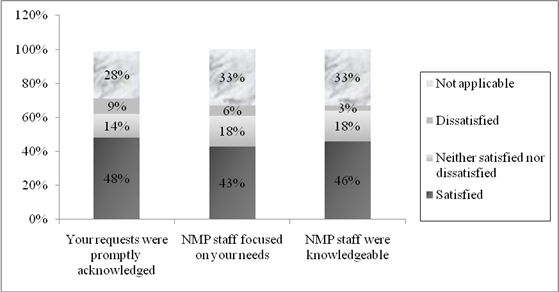
Figure 4 - Text equivalent
This is a vertical bar chart that illustrates Associates’ satisfaction with NMP staff service. Each bar is divided into four categories: Satisfied, Neither satisfied nor dissatisfied, Dissatisfied, Not applicable.
The Y axis is measured in percentages and increases in increments of 20 from 0 to 120. The X axis is divided into three staff services.
The X axis lists the following staff services from left to right: Your requests were promptly acknowledged, NMP staff focused on your needs, NMP staff were knowledgeable. For the category “Your requests were promptly acknowledge”: 48% of Associates said that they were satisfied, 14% said they were neither satisfied nor dissatisfied, 9% said that they were dissatisfied, and 28% answered Not applicable. For the category “NMP staff focused on your needs”: 43% said that they were satisfied, 18% said that they were neither satisfied nor dissatisfied, 6% said that they were dissatisfied, and 33% answered Not applicable. For the category “NMP staff were knowledgeable”: 46% said that they were satisfied, 18% said that they were neither satisfied nor dissatisfied, 3% said they dissatisfied, and 33% answered Not applicable.
Source: National Mentoring Program Survey 2011; N = 160
Figure 5: Satisfaction with NMP staff service – MentorsFootnote 11
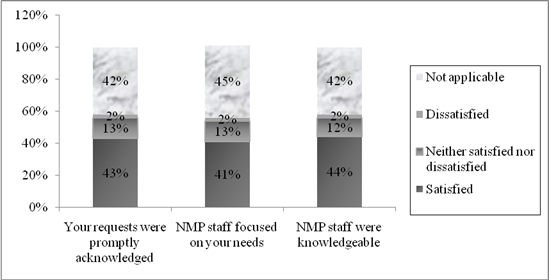
Figure 5 - Text equivalent
This is a vertical bar chart that illustrates Mentors’ satisfaction with NMP staff service. Each bar is divided into four categories: Satisfied, Neither satisfied nor dissatisfied, Dissatisfied, Not applicable.
The Y axis is measured in percentages and increases in increments of 20 from 0 to 120. The X axis is divided into three staff services.
The X axis lists the following staff services from left to right: Your requests were promptly acknowledged, NMP staff focused on your needs, NMP staff were knowledgeable. For the category “Your requests were promptly acknowledge”: 43% of Mentors said that they were satisfied, 13% said they were neither satisfied nor dissatisfied, 2% said that they were dissatisfied, and 42% answered Not applicable. For the category “NMP staff focused on your needs”: 41% said that they were satisfied, 13% said that they were neither satisfied nor dissatisfied, 2% said that they were dissatisfied, and 45% answered Not applicable. For the category “NMP staff were knowledgeable”: 44% said that they were satisfied, 12% said that they were neither satisfied nor dissatisfied, 2% said they dissatisfied, and 42% answered Not applicable.
Source: National Mentoring Program Survey 2011; N = 118
Figures 4 and 5 show that almost one third or more of both associates (28-33%) and mentors (42-45%) did not use the NMP services. For those who did use the services, only a small minority were dissatisfied (associates, 3-9% and mentors 2%). In addition, very few of those interviewed commented on the service provided byNMP staff. One associate felt that there was a lack of support from the NMP and that this should be improved. As an example, the associate indicated that she had never received a reply when she sent an email to the generalNMP mailbox inquiring as to the process of how to end a relationship. In contrast, a mentor who was interviewed spoke warmly about the efficient and excellent responses she had received fromNMP staff to all her queries.
3.3.4 Overall satisfaction with the National Mentoring Program
Respondents were asked to rank their overall satisfaction with the National Mentoring Program on a 5-point scale. Figure 6 presents the results. As with the previous questions, the rankings have been combined – Very satisfied and Satisfied are presented together, then Neither satisfied nor dissatisfied and finally, Dissatisfied and Very dissatisfied are also presented together.
Figure 6: Overall satisfaction with the National Mentoring ProgramFootnote 12
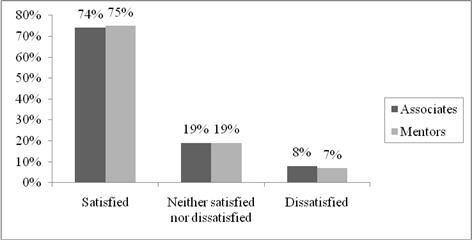
Figure 6 - Text equivalent
This is a vertical bar chart that illustrates the overall satisfaction of Associates and Mentors with the National Mentoring Program.
The Y axis is measured in percentage and increases in increments of 10 from 0 to 80.
The X axis lists the following options to measure satisfaction with the National Mentoring Program from left to right: Satisfied, Neither satisfied nor dissatisfied, Dissatisfied. 74% of Associates and 75% of Mentors were satisfied with the National Mentoring Program; 19% of Associates and 19% of Mentors were neither satisfied nor dissatisfied with the National Mentoring Program; 8% of Associates and 7% of Mentors were dissatisfied with the National Mentoring program.
Source: National Mentoring Program Survey 2011; Associates N = 160; Mentors N = 118
One of the three indicators of success for the NMP is to achieve an overall satisfaction rate of 80% amongst participants. Levels of satisfaction are very similar for both associates and mentors and also for Employment Equity group members which is a positive finding. Almost three quarters of associates (74%) and mentors (75%) responded that they were satisfied or very satisfied with the National Mentoring Program. The levels of dissatisfaction are very low. Amongst associates, 8% responded that they were either dissatisfied (6%) or very dissatisfied (2%). Amongst mentors, 7% responded that they were dissatisfied and no mentors indicated that they were very dissatisfied with the NMP.
Out of Employment Equity group members, 75% of associates and 76% of mentors were very satisfied or satisfied with the NMP.
- Date modified: