
Appendix A – Analysis of Survey Results
As part of the Government of Canada’s consultation on the federal Privacy Act, Canadians were invited to participate in an online survey to share their views on key issues related to privacy. The survey was open to the public from November 16, 2020, to February 14, 2021, and received 1,121 responses. An overwhelming majority of the respondents – 1,029 – chose to participate in English (92%). Only 92 respondents participated in French (8%). Survey results are presented below, starting with voluntary demographic questions and then following the order questions appeared in the survey. Throughout the report, percentages may not add up to 100% due to rounding.
Demographics
Survey respondents were asked what province/territory they reside in. Table 1 shows that the highest proportion of respondents were from Ontario (39%), followed by British Columbia (16%), Quebec (13%), and Alberta (11%). Respondents were also asked whether they lived in an urban or rural area. Almost three quarters of respondents (73%) indicated that they lived in an urban area, while 15% said they lived in a rural area. The remaining 12% did not provide a response.
| n (%) | |
|---|---|
| Newfoundland and Labrador | 7 (1) |
| Nova Scotia | 39 (4) |
| New Brunswick | 14 (1) |
| Prince Edward Island | 4 (0) |
| Quebec | 144 (13) |
| Ontario | 439 (39) |
| Manitoba | 40 (4) |
| Saskatchewan | 33 (3) |
| Alberta | 125 (11) |
| British Columbia | 176 (16) |
| Territories | 6 (1) |
| Prefer not to say/Not sure/skipped | 94 (8) |
| TOTAL | 1,121 (100) |
Familiarity with the Privacy Act
Respondents were asked to rate their level of familiarity with the Privacy Act on a four-point scale. Chart 1 shows that almost three quarters (73%) of respondents had some level of familiarity (extremely, moderately or somewhat familiar) with the Act. Less than half (43%) considered themselves “somewhat familiar,” while 21% felt they were “moderately familiar” with the Act, and 9% felt they were “extremely familiar.”
Chart 1 – Respondents’ familiarity with the Privacy Act
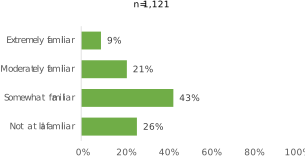
Chart 1 – Respondents’ familiarity with the Privacy Act – Text version
Chart 1- Respondents’ familiarity with the Privacy Act
A clustered bar chart shows survey respondents’ answers to the survey question on familiarity with the Privacy Act. The question had 1,121 respondents. The vertical axis of the chart shows the four response categories and the horizontal axis goes from 0% to 100%. From top to bottom: nine percent of respondents provided a response of “extremely familiar”, 21% “moderately familiar”, 43% “somewhat familiar” and 26% “not at all familiar”.
Respondents who said they had some familiarity (extremely, moderately or somewhat familiar) (n=824) were asked about their main source of knowledge of the Privacy Act. Chart 2 shows that 40% of these respondents considered professional experience to be their main source of knowledge, followed by 20% of respondents who indicated that their main source was media articles and 16% who said it was a Government of Canada website.
Chart 2 - Respondents’ main sources of knowledge of the Privacy Act
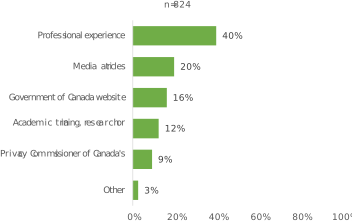
Chart 2 - Respondents’ main sources of knowledge of the Privacy Act – Text version
Chart 2 - Respondents’ main sources of knowledge of the Privacy Act
A clustered bar chart shows survey respondents’ answers to the survey question on sources of knowledge of the Privacy Act. The question had 824 respondents. The vertical axis of the chart shows the six response categories and the horizontal axis goes from 0% to 100%. From top to bottom: forty percent of respondents provided a response of “professional experience”, 20% “media articles”, 16% “Government of Canada website”, 12% “academic training, research or articles”, 9% “Privacy Commissioner of Canada’s website” and 3% “other”.
Respondents were next asked, “To what extent do you trust that the federal government is doing a good job protecting your personal information?” Most respondents fell in the mid-range, with 58% having “some trust” (36%) or “a little trust” (22%) that the federal government is doing a good job (Chart 3). Less than a quarter of respondents (20%) said they had “no trust at all” in the government’s handling of personal information.
Chart 3 - Respondents’ trust that the federal government is doing a good job protecting their personal information
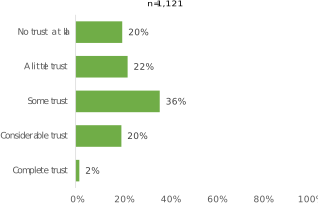
Chart 3 - Respondents’ trust that the federal government is doing a good job protecting their personal information – Text version
Chart 3- Respondents’ trust that the federal government is doing a good job protecting their personal information
A clustered bar chart shows survey respondents’ answers to the survey question on trust with the federal government’s protection of personal information. The question had 1,121 respondents. The vertical axis of the chart shows the five response categories and the horizontal axis goes from 0% to 100%. From top to bottom: twenty percent of respondents provided a response of “no trust at all”, 22% “a little trust”, 36% “some trust”, 20% “considerable trust” and 2% “complete trust.”
When asked about the rules governing the private sector versus the public sector in protecting personal information, almost three quarters of respondents “strongly” (52%) or “somewhat” agreed (20%) that the private sector and federal government should be subject to the same rules (Chart 4).
Chart 4 - Respondents’ level of agreement that the private sector and federal government should be subject to the same rules for protection of personal information
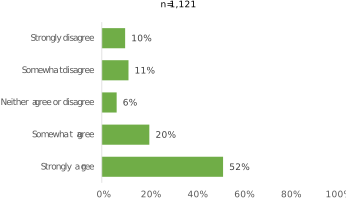
Chart 4 - Respondents’ level of agreement that the private sector and federal government should be subject to the same rules for protection of personal information – Text version
Chart 4- Respondents’ level of agreement that the private sector and federal government should be subject to the same rules for protection of personal information
A clustered bar chart shows survey respondents’ answers to the survey question on agreement that the federal government and private sector should be subject to the same rules. The question had 1,121 respondents. The vertical axis of the chart shows the five response categories and the horizontal axis goes from 0% to 100%. From top to bottom: ten percent of respondents provided a response of “strongly disagree”, 11% “somewhat disagree”, 6% “neither agree or disagree”, 20% “somewhat agree” and 52% “strongly agree.”
Sharing of personal information between federal government departments and agencies
Survey respondents provided their views on the sharing of personal information between federal government departments and agencies without permission. Table 2 shows respondents’ views on personal information being shared between departments and agencies under nine different scenarios. Over two thirds of respondents (68%) were “somewhat comfortable” or “extremely comfortable” with their information being shared without permission when it is to provide a service or benefit that was requested. Fifty-seven percent (57%) of respondents were “somewhat comfortable” or “extremely comfortable” with their information being shared to fulfil the purpose for which it was originally collected or to protect the integrity of a program by minimizing fraud or abuse (56%).
Around half of respondents were “totally uncomfortable” or “somewhat uncomfortable” with their information being shared to propose new or additional services (54%) or to carry out research in the public interest (51%).
| Totally uncomfortable N (%) |
Somewhat uncomfortable N (%) |
Neutral N (%) |
Somewhat comfortable N (%) |
Extremely comfortable N (%) |
|
|---|---|---|---|---|---|
| To fulfil the purpose for which the information was originally collected. | 235 (21) | 155 (14) | 95 (9) | 333 (30) | 303 (27) |
| To provide me with a service or benefit that I have requested. | 153 (14) | 112 (10) | 104 (10) | 378 (34) | 374 (34) |
| To eliminate the need for me to provide the same information again. | 209 (19) | 174 (16) | 145 (13) | 362 (32) | 231 (21) |
| To propose new or additional services I may be interested in. | 346 (31) | 252 (23) | 200 (18) | 243 (22) | 80 (7) |
| To suggest other benefits to which I may be entitled but am not aware of. | 196 (18) | 173 (15) | 160 (14) | 391 (35) | 201 (18) |
| To protect the integrity of a program by minimizing fraud or abuse. | 175 (16) | 144 (13) | 170 (15) | 360 (32) | 272 (24) |
| To analyze the operation of a program or benefit program. | 258 (23) | 230 (21) | 234 (21) | 275 (25) | 124 (11) |
| To carry out research in the public interest. | 340 (30) | 230 (21) | 171 (15) | 260 (23) | 120 (11) |
| To use it for any purpose, but only where the personal information was de-identified. | 270 (24) | 197 (18) | 153 (14) | 318 (28) | 183 (16) |
There was notable support for the use of formal written agreements for sharing personal information. Over three quarters of respondents indicated they “strongly” (51%) or “somewhat” agreed (27%) that federal government departments and agencies should enter into formal written agreements to share personal information with each other (Chart 5a).
Chart 5a - Respondents’ level of agreement that federal government departments and agencies should enter into formal written agreements to share personal information with each other
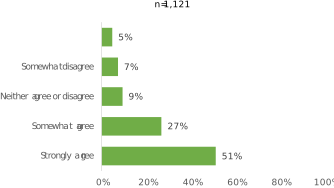
Chart 5a - Respondents’ level of agreement that federal government departments and agencies should enter into formal written agreements to share personal information with each other – Text version
Chart 5a - Respondents’ level of agreement that federal government departments and agencies should enter into formal written agreements to share personal information with each other
A clustered bar chart shows survey respondents’ answers to the survey question on agreement that federal government departments and agencies should enter into formal written agreements to share personal information with each other. The question had 1,121 respondents. The vertical axis of the chart shows the five response categories and the horizontal axis goes from 0% to 100%. From top to bottom: five percent of respondents provided a response of “strongly disagree”, 7% “somewhat disagree”, 9% “neither agree or disagree”, 27% “somewhat agree” and 51% “strongly agree.”
Chart 5b shows respondents’ willingness to change their answer to the question about written agreements under certain scenarios. Overall, a low proportion of respondents indicated they would change their answer to this question in all four scenarios presented. The scenario where respondents were most willing to change their view on the need for formal written agreements was when the reason for sharing the information was for the purpose for which it was originally intended (31%).
Chart 5b - Respondents’ willingness to change their view on the need for formal written agreements for information sharing under certain scenarios
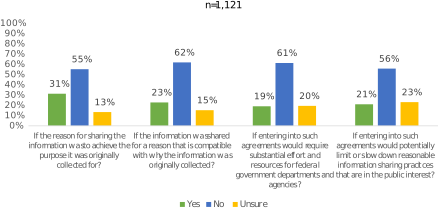
Chart 5b - Respondents’ willingness to change their view on the need for formal written agreements for information sharing under certain scenarios – Text version
Chart 5b - Respondents’ willingness to change their view on the need for formal written agreements for information sharing under certain scenarios
A clustered column chart shows survey respondents’ answers to the survey question on agreement that federal government departments and agencies should enter into formal written agreements to share personal information with each other. The question had 1,121 respondents. The vertical axis of the chart goes from 0% to 100% and the horizontal axis shows the four sub-questions. A legend below the horizontal axis shows the three response categories. From left to right: for the sub-question, “if the reason for sharing the information was to achieve the purpose it was originally collected for?” 31% responded “yes”, 55% “no” and 13% “unsure”; for the sub-question “if the information was shared for a reason that is compatible with why the information was originally collected?” 23% responded “yes”, 62% “no” and 15% “unsure”; for the sub-question “if entering into such agreements would require substantial effort and resources for federal government departments and agencies?” 19% responded “yes”, 61% “no” and 20% “unsure”; for the sub-question “if entering into such agreements would potentially limit or slow down reasonable information sharing practices that are in the public interest?” 21% responded “yes”, 56% “no” and 23% “unsure.”
Chart 6 shows respondents’ views on federal departments and agencies sharing their personal information with different entities when the information is to be used to carry out the purpose for which it was originally collected. The highest proportion of respondents were comfortable with their information being shared with other Government of Canada departments or agencies. Over half (56%) of respondents were “somewhat comfortable” or “extremely comfortable” with this type of information sharing. Information sharing with provincial, territorial or municipal governments was also viewed favourably to some degree, with 42% being “somewhat comfortable” or “extremely comfortable.” More than nine in ten respondents were not supportive of their information being shared with a foreign government (92% “totally uncomfortable” or “somewhat uncomfortable”) or with a private sector for-profit business (92% “totally uncomfortable” or “somewhat uncomfortable”).
Chart 6 – Respondents’ views on federal departments/agencies sharing their personal information with different entities to carry out the purpose the information was originally collected for (n=1,121)
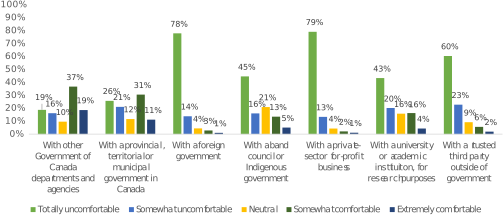
Chart 6 – Respondents’ views on federal departments/agencies sharing their personal information with different entities to carry out the purpose the information was originally collected for (n=1,121) – Text version
Chart 6 - Respondents’ views on federal departments/agencies sharing their personal information with different entities to carry out the purpose the information was originally collected for (n=1,121)
A clustered column chart shows survey respondents’ answers to the survey question on federal departments/agencies sharing their personal information with different entities to carry out the purpose the information was originally collected for. The question had 1,121 respondents. The vertical axis of the chart goes from 0% to 100% and the horizontal axis shows the seven response sub-questions. A legend below the horizontal axis shows the five response categories. From left to right: for the sub-question, “with other Government of Canada departments and agencies?” 19% responded “totally uncomfortable”, 16% “somewhat uncomfortable”, 10% “neutral”, 37% “somewhat comfortable” and 19% “extremely comfortable”; for the sub-question, “with a provincial, territorial or municipal government in Canada?” 26% responded “totally uncomfortable”, 21% “somewhat uncomfortable”, 12% “neutral”, 31% “somewhat comfortable” and 11% “extremely comfortable”; for the sub-question, “with a foreign government?” 78% responded “totally uncomfortable”, 14% “somewhat uncomfortable”, 4% “neutral”, 3% “somewhat comfortable” and 1% “extremely comfortable”; for the sub-question, “with a band council or Indigenous government?” 45% responded “totally uncomfortable”, 16% “somewhat uncomfortable”, 21% “neutral”, 13% “somewhat comfortable” and 5% “extremely comfortable”; for the sub-question, “with a private-sector for-profit business?” 79% responded “totally uncomfortable”, 13% “somewhat uncomfortable”, 4% “neutral”, 2% “somewhat comfortable” and 1% “extremely comfortable”; for the sub-question, “with a university or academic institution, for research purposes?” 43% responded “totally uncomfortable”, 20% “somewhat uncomfortable”, 16% “neutral”, 16% “somewhat comfortable” and 4% “extremely comfortable”; for the sub-question, “with a trusted third party outside of government?” 60% responded “totally uncomfortable”, 23% “somewhat uncomfortable”, 9% “neutral”, 6% “somewhat comfortable” and 2% “extremely comfortable.”
When looking at personal information being shared with other entities for reasons that are different from those for which it was originally collected, respondents were generally uncomfortable. Chart 7 shows that more than nine in ten respondents (96%) were “totally uncomfortable” or “somewhat uncomfortable” with their information being shared with a foreign government to carry out a purpose different from the original one. The same proportion (96%) were “totally uncomfortable” or “somewhat uncomfortable” with their information being shared with a private sector for-profit business.
Respondents were slightly less concerned about this type of information sharing when it involved other Government of Canada departments and agencies (72% were “totally uncomfortable” or “somewhat uncomfortable”) or with provincial, territorial or municipal governments (75% were “totally uncomfortable” or “somewhat uncomfortable”).
Chart 7 - Respondents’ views on federal departments/agencies sharing their personal information with different entities to carry out a purpose different from what the information was originally collected for (n=1,121)
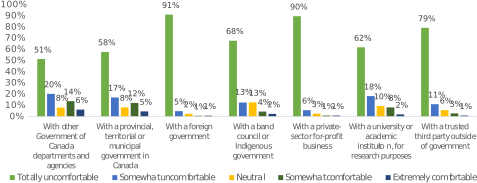
Chart 7 - Respondents’ views on federal departments/agencies sharing their personal information with different entities to carry out a purpose different from what the information was originally collected for (n=1,121) – Text version
Chart 7 - Respondents’ views on federal departments/agencies sharing their personal information with different entities to carry out a purpose different from what the information was originally collected for (n=1,121)
A clustered column chart shows survey respondents’ answers to the survey question on federal departments/agencies sharing their personal information with different entities to carry out a purpose different from what the information was originally collected for. The question had 1,121 respondents. The vertical axis of the chart goes from 0% to 100% and the horizontal axis shows the seven response sub-questions. A legend below the horizontal axis shows the five response categories. From left to right: for the sub-question, “with other Government of Canada departments and agencies?” 51% responded “totally uncomfortable”, 20% “somewhat uncomfortable”, 8% “neutral”, 14% “somewhat comfortable” and 6% “extremely comfortable”; for the sub-question, “with a provincial, territorial or municipal government in Canada?” 58% responded “totally uncomfortable”, 17% “somewhat uncomfortable”, 8% “neutral”, 12% “somewhat comfortable” and 5% “extremely comfortable”; for the sub-question, “with a foreign government?” 91% responded “totally uncomfortable”, 5% “somewhat uncomfortable”, 2% “neutral”, 1% “somewhat comfortable” and 1% “extremely comfortable”; for the sub-question, “with a band council or Indigenous government?” 68% responded “totally uncomfortable”, 13% “somewhat uncomfortable”, 13% “neutral”, 4% “somewhat comfortable” and 2% “extremely comfortable”; for the sub-question, “with a private-sector for-profit business?” 90% responded “totally uncomfortable”, 6% “somewhat uncomfortable”, 3% “neutral”, 1% “somewhat comfortable” and 1% “extremely comfortable”; for the sub-question, “with a university or academic institution, for research purposes?” 62% responded “totally uncomfortable”, 18% “somewhat uncomfortable”, 10% “neutral”, 8% “somewhat comfortable” and 2% “extremely comfortable”; for the sub-question, “with a trusted third party outside of government?” 79% responded “totally uncomfortable”, 11% “somewhat uncomfortable”, 6% “neutral”, 3% “somewhat comfortable” and 1% “extremely comfortable.”
Chart 8 outlines respondents’ views on whether being able to request access to their personal information from a federal government department or agency is an important aspect of privacy protection. Just under nine in ten respondents (87%) either “strongly” or “somewhat” agreed that being able to access their personal data is an important aspect of protecting privacy.
Chart 8 - Respondents’ level of agreement that being able to request access to their personal information from a federal government department or agency is an important aspect of protecting privacy
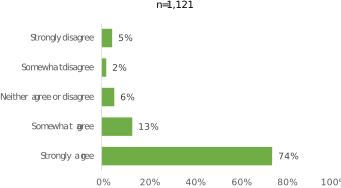
Chart 8 - Respondents’ level of agreement that being able to request access to their personal information from a federal government department or agency is an important aspect of protecting privacy – Text version
Chart 8 - Respondents’ level of agreement that being able to request access to their personal information from a federal government department or agency is an important aspect of protecting privacy
A clustered bar chart shows survey respondents’ answers to the survey question on agreement that the ability to request access to their personal information from a federal government department or agency is an important aspect of protecting privacy. The question had 1,121 respondents. The vertical axis of the chart shows the five response categories and the horizontal axis goes from 0% to 100%. From top to bottom: five percent of respondents provided a response of “strongly disagree”, 2% “somewhat disagree”, 6% “neither agree or disagree”, 13% “somewhat agree” and 74% “strongly agree.”
Use of automated decision making and publicly available personal information
Respondents indicated that they would want to be informed when artificial intelligence is used to make decisions about them. When asked about the use of automated decision making and artificial intelligence, 86% of respondents indicated they “strongly” or “somewhat” agreed that federal departments and agencies should inform people when artificial intelligence is used to make decisions that affect them (Chart 9).
Chart 9 - Respondents’ level of agreement that federal government departments and agencies should inform citizens when they use artificial intelligence to make a decision that affects them
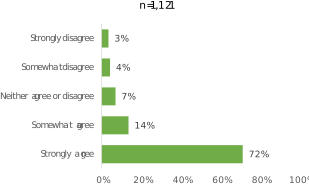
Chart 9 - Respondents’ level of agreement that federal government departments and agencies should inform citizens when they use artificial intelligence to make a decision that affects them – Text version
Chart 9 - Respondents’ level of agreement that federal government departments and agencies should inform citizens when they use artificial intelligence to make a decision that affects them
A clustered bar chart shows survey respondents’ answers to the survey question on agreement that federal government departments and agencies should inform citizens when they use artificial intelligence to make a decision that affects them. The question had 1,121 respondents. The vertical axis of the chart shows the five response categories and the horizontal axis goes from 0% to 100%. From top to bottom: three percent of respondents provided a response of “strongly disagree”, 4% “somewhat disagree”, 7% “neither agree or disagree”, 14% “somewhat agree” and 72% “strongly agree.”
Respondents were asked about the extent to which they agreed with the statement “I should be able to request human involvement in a decision-making process about me that relies on computerized automated processes, such as artificial intelligence.” Chart 10 shows that almost nine in ten respondents either “somewhat” (17%) or “strongly” (71%) agreed that they should be able to request human involvement in this type of decision making.
There was a follow-up question asking if the response about automated decision making would change if the decision would otherwise take longer to make or would entail higher costs. Most respondents indicated they would not change their view. Almost eight in ten respondents (78%) felt their response would not change even if it meant the decision would take longer (11% said their decision would change, and 12% were unsure). Seven in ten (70%) felt their response would not change even if it meant higher costs for them or the government of Canada (14% said their decision would change, and 16% were unsure).
Chart 10 - Respondents’ level of agreement that people should be able to request human involvement in decision-making processes that rely on computerized automated processes
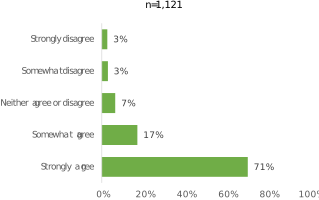
Chart 10 - Respondents’ level of agreement that people should be able to request human involvement in decision-making processes that rely on computerized automated processes – Text version
Chart 10 - Respondents’ level of agreement that people should be able to request human involvement in decision-making processes that rely on computerized automated processes
A clustered bar chart shows survey respondents’ answers to the survey question on agreement that people should be able to request human involvement in decision-making processes that rely on computerized automated processes. The question had 1,121 respondents. The vertical axis of the chart shows the five response categories and the horizontal axis goes from 0% to 100%. From top to bottom: three percent of respondents provided a response of “strongly disagree”, 3% “somewhat disagree”, 7% “neither agree or disagree”, 17% “somewhat agree” and 71% “strongly agree.”
When asked about government use of publicly available personal information, such as that found on social media, there was less consensus among respondents. Almost two thirds (64%) either “strongly” or “somewhat” disagreed that federal government departments and agencies should be free to collect and use personal information that is publicly available, including information on social media (Chart 11).
Chart 11 - Respondents’ level of agreement that federal government departments/agencies should be free to collect, use and share personal information that is readily available to the public, including information from social media
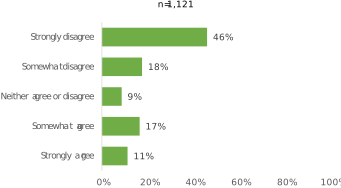
Chart 11 - Respondents’ level of agreement that federal government departments/agencies should be free to collect, use and share personal information that is readily available to the public, including information from social media – Text version
Chart 11 - Respondents’ level of agreement that federal government departments/agencies should be free to collect, use and share personal information that is readily available to the public, including information from social media
A clustered bar chart shows survey respondents’ answers to the survey question on agreement that federal government departments/agencies should be free to collect, use and share personal information that is readily available to the public, including information from social media. The question had 1,121 respondents. The vertical axis of the chart shows the five response categories and the horizontal axis goes from 0% to 100%. From top to bottom: forty-six percent of respondents provided a response of “strongly disagree”, 18% “somewhat disagree”, 9% “neither agree or disagree”, 17% “somewhat agree” and 11% “strongly agree.”
Privacy Act Modernization
In the survey, respondents were informed that a chief privacy officer is responsible for supporting an organization’s compliance with applicable privacy legislation and for helping develop internal privacy guidance and tools tailored to an organization. Chart 12 shows the extent to which respondents agreed that federal departments and agencies should have an internal chief privacy officer. Most respondents were supportive, with eight in ten either “strongly” (56%) or “somewhat” agreeing (24%) that federal departments and agencies should have an internal chief privacy officer.
Chart 12 - Respondents’ level of agreement that each federal government department or agency should have an internal Chief Privacy Officer
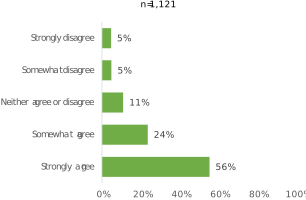
Chart 12 - Respondents’ level of agreement that each federal government department or agency should have an internal Chief Privacy Officer – Text version
Chart 12 - Respondents’ level of agreement that each federal government department or agency should have an internal Chief Privacy Officer
A clustered bar chart shows survey respondents’ answers to the survey question on agreement that each federal government department or agency should have an internal Chief Privacy Officer. The question had 1,121 respondents. The vertical axis of the chart shows the five response categories and the horizontal axis goes from 0% to 100%. From top to bottom: five percent of respondents provided a response of “strongly disagree”, 5% “somewhat disagree”, 11% “neither agree or disagree”, 24% “somewhat agree” and 56% “strongly agree.”
Under the Privacy Act, the Privacy Commissioner is an officer of Parliament who investigates complaints and reports on their findings. Currently, the Privacy Commissioner can make recommendations to federal departments and agencies on their treatment of an individual’s personal information. The Privacy Commissioner can also bring to the Federal Court matters relating to refusals by federal departments and agencies to provide access to personal information.
Respondents were asked whether they agreed or disagreed with various powers that could be granted to the Privacy Commissioner of Canada. Table 3 outlines respondents’ views on this question. There was considerable support for all options, though the highest level of support was for the Privacy Commissioner having the power to provide recommendations to federal departments and agencies on how to address potential privacy risks (91% “strongly” or “somewhat” agreed). The second most frequently chosen option was the Privacy Commissioner having the power to assist federal departments and agencies in assessing privacy risks when designing new programs or activities (90% “strongly” or “somewhat” agreed).
| Strongly disagree N (%) |
Somewhat disagree N (%) |
Neither agree or disagree N (%) |
Somewhat agree N (%) |
Strongly agree N (%) |
|
|---|---|---|---|---|---|
| Providing guidance on how the Privacy Act should be interpreted and applied. | 46 (4) | 54 (5) | 100 (9) | 348 (31) | 573 (51) |
| Providing advance views on how the privacy commissioner might address an issue if someone were to complain about it. | 44 (4) | 50 (5) | 135 (12) | 385 (34) | 507 (45) |
| Assisting federal government departments and agencies in assessing privacy risks when designing new programs or activities. | 36 (3) | 9 (1) | 66 (6) | 289 (26) | 721 (64) |
| Providing recommendations to federal government departments and agencies on how to address potential privacy risks they face. | 30 (3) | 12 (1) | 64 (6) | 281 (25) | 734 (66) |
| Entering into legally binding and enforceable compliance agreements with federal government departments and agencies regarding the handling of personal information. | 48 (4) | 59 (5) | 120 (11) | 295 (26) | 599 (53) |
| Ordering government departments and agencies to provide access to personal information after investigating a complaint. | 63 (6) | 81 (7) | 145 (13) | 253 (23) | 579 (52) |
| Ordering government departments and agencies to stop collecting, using or disclosing personal information after a complaint. | 31 (3) | 32 (3) | 106 (9) | 235 (21) | 717 (64) |
De-identified personal information is data from which personal identifying information has been removed so that the risk of identifying an individual is extremely low. Respondents were asked their views on federal government departments and agencies sharing de-identified personal information to encourage innovation in the public interest. Chart 13 shows that respondents’ views differed depending on where the data would be shared. There was a fairly high level of support (60% of respondents selected either “somewhat agree” or “strongly agree”) for de-identified personal information being shared with other federal government departments and agencies, while only 27% had the same level of agreement for sharing with private sector organizations.
Chart 13 - Respondents’ views on federal government departments/agencies sharing de-identified data to encourage innovation in public interest
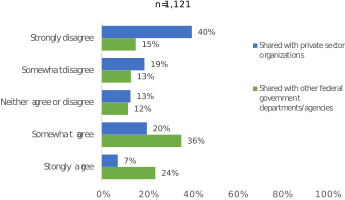
Chart 13 - Respondents’ views on federal government departments/agencies sharing de-identified data to encourage innovation in public interest – Text version
Chart 13 - Respondents’ views on federal government departments/agencies sharing de-identified data to encourage innovation in public interest
A clustered bar chart shows survey respondents’ answers to the survey question on federal government departments/agencies sharing de-identified data to encourage innovation in public interest. The question had 1,121 respondents. The vertical axis of the chart shows the five response categories and the horizontal axis goes from 0% to 100%. A legend to the right of the chart shows the two response sub-questions. From top to bottom: for the sub-question, “shared with private sector organizations?” 40% responded “strongly disagree”, 19% “somewhat disagree”, 13% “neither agree or disagree”, 20% “somewhat agree” and 7% “strongly agree”; for the sub question, “shared with other federal government departments/agencies?” 15% responded “strongly disagree”, 13% “somewhat disagree”, 12% “neither agree or disagree”, 36% “somewhat agree” and 24% “strongly agree.”
Respondents were asked to rate the level of importance of various areas to their understanding of why and how a federal government department or agency collects, uses or shares personal information. Respondents felt that having an accessible, easy-to-find privacy policy was most important, with 96% rating this as “moderately important” or “very important” (Chart 14). The next most important area was knowing that the Privacy Commissioner of Canada had provided advice and recommendations to the federal institution on an activity involving their personal information, with 89% rating this as “moderately important” or “very important.”
Chart 14 – Respondents’ views on the importance of the following areas to their understanding of why and how a federal government department or agency collects, uses or shares personal information (n=1,121)
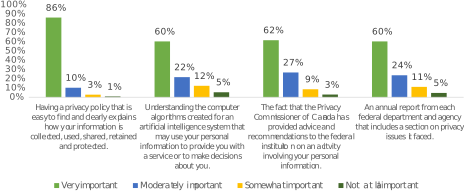
Chart 14 – Respondents’ views on the importance of the following areas to their understanding of why and how a federal government department or agency collects, uses or shares personal information (n=1,121) – Text version
Chart 14 - Respondents’ views on the importance of the following areas to their understanding of why and how a federal government department or agency collects, uses or shares personal information (n=1,121)
A clustered column chart shows survey respondents’ answers to the survey question on the importance of the following areas to their understanding of why and how a federal government department or agency collects, uses or shares personal information. The question had 1,121 respondents. The vertical axis of the chart goes from 0% to 100% and the horizontal axis shows the four response sub-questions. A legend below the horizontal axis shows the four response categories. From left to right: for the sub-question, “having a privacy policy that is easy to find and clearly explains how your information is collected, used, shared, retained and protected?” 86% responded “very important”, 10% “moderately important”, 3% “somewhat important” and 1% “not at all important”; for the sub-question, “understanding the computer algorithms created for an artificial intelligence system that may use your personal information to provide you with a service or to make decisions about you?” 60% responded “very important”, 22% “moderately important”, 12% “somewhat important” and 5% “not at all important”; for the sub-question, “the fact that the Privacy Commissioner of Canada has provided advice and recommendations to the federal institution on an activity involving your personal information?” 62% responded “very important”, 27% “moderately important”, 9% “somewhat important” and 3% “not at all important”; for the sub-question, “an annual report from each federal department and agency that includes a section on privacy issues it faced?” 60% responded “very important”, 24% “moderately important”, 11% “somewhat important” and 5% “not at all important.”
When asked to rate the importance of various aspects of Privacy Act modernization, one area was overwhelmingly rated as important: 99% of respondents felt that proper safeguarding of personal information was pivotal to Privacy Act modernization, with 95% rating it as “very important” and 4% as “moderately important.” The next most important area was knowing what personal information federal departments and agencies have and how they can use and share it, with 96% rating this as “very important” or “moderately important” (Chart 15).
Chart 15 – Respondents’ views on importance of various aspects of Privacy Act modernization (n=1,121)
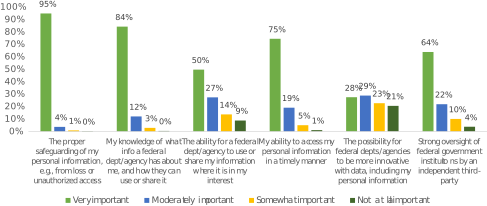
Chart 15 – Respondents’ views on importance of various aspects of Privacy Act modernization (n=1,121) – Text version
Chart 15 - Respondents’ views on importance of various aspects of Privacy Act modernization (n=1,121)
A clustered column chart shows survey respondents’ answers to the survey question on the importance of various aspects of Privacy Act modernization. The question had 1,121 respondents. The vertical axis of the chart goes from 0% to 100% and the horizontal axis shows the six response sub-questions. A legend below the horizontal axis shows the four response categories. From left to right: for the sub-question, “the proper safeguarding of my personal information, e.g., from loss of unauthorized access?” 95% responded “very important”, 4% “moderately important”, 1% “somewhat important” and 0% “not at all important”; for the sub-question, “my knowledge of what information a department/agency has about me, and how they can use or share it?” 84% responded “very important”, 12% “moderately important”, 3% “somewhat important” and 0% “not at all important”; for the sub-question, “the ability for a federal department/agency to use or share my information where it is in my interest?” 50% responded “very important”, 27% “moderately important”, 14% “somewhat important” and 9% “not at all important”; for the sub-question, “my ability to access my personal information in a timely manner?” 75% responded “very important”, 19% “moderately important”, 5% “somewhat important” and 1% “not at all important”; for the sub-question, “the possibility for federal departments/agencies to be more innovative with data, including my personal information?” 28% responded “very important”, 29% “moderately important”, 23% “somewhat important” and 21% “not at all important”; for the sub-question, “strong oversight of federal government institutions by an independent third-party?” 64% responded “very important”, 22% “moderately important”, 10% “somewhat important” and 4% “not at all important.”
The final survey question allowed respondents to share additional comments on elements not covered in the survey. There were 342 comments provided. Several themes emerged from a qualitative review of responses. The most common theme was the importance of including adequate powers and consequences for violations in a modernized Privacy Act. Comments also emphasized that Canadians should have access to their own data as well as the ability to have their data removed or deleted from government databases. Respondents were also concerned that true data de-identification may not be possible, so questions around sharing de-identified personal information should be viewed with this in mind. Finally, the European Union approach to privacy modernization was raised as a model for Canada to follow.
- Date modified: