
Implementing Consultation and Cooperation with Inuit
Notice
February 2026
The following Consultation and Cooperation Guidance is intended to guide the implementation of sections 5, 6 and 7 of the United Nations Declaration on the Rights of Indigenous Peoples Act. The Guidance does not alter the duty to consult or consultation or assessment processes contained in Treaties between Inuit and the Crown.
Information contained in this publication or product may be reproduced, in part or in whole, and by any means, for personal or public non-commercial purposes, without charge or further permission, unless otherwise specified.
You are asked to:
- exercise due diligence in ensuring the accuracy of the materials reproduced
- indicate both the complete title of the materials reproduced, as well as the author organization
- indicate that the reproduction is a copy of an official work that is published by the Government of Canada and that the reproduction has not been produced in affiliation with, or with the endorsement of, the Government of Canada.
Commercial reproduction and distribution are prohibited except with written permission from the Department of Justice Canada. For more information, please contact the Department of Justice Canada at www.justice.gc.ca.
© His Majesty the King in Right of Canada, represented by the Minister of Justice and Attorney General of Canada, 2026
J2-604/2026E-PDF
ISBN: 978-0-662-72288-5
Table of Contents
- Introduction
- Context
- Application
- Description
- Guidance for consultation and cooperation
- Appendix I
- Appendix II
Introduction
Sections 5, 6 and 7 of the United Nations Declaration on the Rights of Indigenous Peoples Act (UN Declaration Act or Act) obligate the Government of Canada to undertake activities “in consultation and cooperation with Indigenous peoples.” The references to “consultation and cooperation” in the Act are themselves drawn from the United Nations Declaration on the Rights of Indigenous Peoples (UN Declaration). The following guidance provides a description of consultation and cooperation and advice for undertaking consultation and cooperation activities in relation to implementing the Act.
There will be times when implementing measures under the UN Declaration Act and associated action plan will also trigger the legal duty to consult and accommodate, and circumstances where other obligations relating to consultation or participation in decision making more generally, including in some cases free, prior and informed consent, may also apply (eg. treaty provisions or other negotiated agreements; specific references in the UN Declaration). The Act itself does not change Canada’s existing duty to consult Indigenous peoples, or other consultation and participation requirements. Consultation and cooperation must respect specific consultation rights and processes provided for in Treaties, Indigenous peoples’ right to self-determination, and Indigenous peoples’ right to participation in decision-making in matters that affect their rights.
The guidance below is not intended to replace, replicate or otherwise alter such existing obligations. Instead, it is intended to provide practical and principled guidance to officials on conducting effective consultation and cooperation processes associated with the UN Declaration Act.
Context
In addition to being used throughout the UN Declaration, consultation and cooperation is a legal standard set out in the UN Declaration Act. The inclusion of both “consultation” and “cooperation” in the UN Declaration Act underscores that the objective of the legislated requirement is not merely to discuss or consult on a Crown proposal after it has already been developed, but to work together towards a shared objective. Implementing the Act in consultation and cooperation with Indigenous peoples outlines a Parliamentary expectation of a fundamental and necessary shift in how policies and laws impacting Indigenous peoples and their rights are developed and implemented. This expectation reflects the spirit of co-development and partnership that led to the development of the Act and the UN Declaration itself.
Sections 5, 6 and 7 of the UN Declaration Act must each be implemented in consultation and cooperation with Indigenous peoples.
Section 5 measures: The substantive obligation of section 5 is to take measures to ensure that the laws of Canada are consistent with the UN Declaration. In terms of process, any measures being developed by the federal government intended to help ensure consistency with the UN Declaration require consultation and cooperation with Indigenous peoples.
Section 6 measures: Implementation of all UN Declaration Act Action Plan measures require consultation and cooperation with Indigenous peoples. Action Plan measures included in First Nations, Inuit, Métis and Indigenous Modern Treaty Partner priorities chapters must be advanced bilaterally with First Nations, Inuit, Métis and Modern Treaty rights holders respectively. Shared priorities may be referred to the Action Plan Advisory Committee for advice on advancing implementation of an action, and how collaboration should be structured.
Section 7 annual reports: Annual reporting required on progress on implementing sections 5 and 6, must also include consultation and cooperation with Indigenous peoples. Such a process is a means for identifying progress and achievements as well as challenges and potential solutions. Adequate time to secure progress updates from federal departments as well as to secure and include input from Indigenous peoples is required.
Application
While the obligations to consult and cooperate set out in the UN Declaration Act apply in relation to Indigenous peoples across Canada, the guidance included in this document was co-developed with Inuit and is intended to apply to consultation and cooperation initiatives undertaken with Inuit. Inuit has the same meaning as in the Inuit Nunangat Policy (see Appendix I: Inuit Nunangat Policy).
Inuvialuit Regional Corporation, Nunavut Tunngavik, Inc., Makivvik, and Nunatsiavut Government are the four Inuit rights holding organizations. Each Inuit Treaty Organization (ITO) has its own distinct governance structure. Consultation and cooperation initiatives that are specific to one or more Inuit regions should be undertaken bilaterally with those regions. The elected Inuit leaders of the four Inuit Treaty Organizations that collectively represent Inuit are also the members of the board of Inuit Tapiriit Kanatami (ITK) and Inuit Circumpolar Council-Canada.
For the purposes of this guidance, ITK may serve as an appropriate point of contact for helping coordinate consultation and cooperation activities, under the direction of Inuit Treaty Organizations, that are applicable to all four ITOs and/or their respective members and territories. This may include coordination through the Inuit-Crown Partnership Committee. Decisions of the ITK Board may be required to advance consultation and cooperation initiatives.
Description
Consultation and cooperation is a procedural standard whose purpose is to identify and meaningfully integrate Indigenous peoples’ rights, perspectives and priorities into legislative and policy options prepared for decision-makers that impact Indigenous peoples and their rights. Implementation of the standard enables Inuit and other Indigenous peoples to influence decision-making processes. The Expert Mechanism on the Rights of Indigenous Peoples has emphasized that effective consultation and cooperation does not occur at a single point in time but is a process of dialogue and negotiation over the course of an initiative or project.
There is no single formula for carrying out consultation and cooperation that applies in all circumstances. International experts, including the Special Rapporteur on the Rights of Indigenous Peoples, have affirmed that the specific characteristics of consultation and cooperation processes “will necessarily vary depending upon the nature of the proposed measure and the scope of its impact on Indigenous Peoples [and their rights]”. Depending on the nature and extent of a proposed measure and its impacts on Indigenous peoples and their rights, the intensity of consultation and cooperation can vary. While the modalities may vary with the intensity of consultation and cooperation, the general principles set out below are applicable regardless of where along the continuum a particular process or initiative falls.
Where implications of federal decisions or actions for Indigenous peoples and their rights are minimal or limited, consultation and cooperation includes notifying implicated Indigenous peoples; ensuring that any public outreach processes are accessible and available to them; sharing information about initiatives and responding to questions that may be asked with the objective of determining whether a dialogue process may be necessary; and otherwise ensuring transparency on such initiatives, their purpose and process, and opportunities that may be available to participate. As the implications or impacts increase, consultation and cooperation processes will need to adapt accordingly.
Federal decisions or actions that may affect Indigenous peoples in ways not felt by others in society call fora dialogue process initiated by the federal government whose objective is to identify and meaningfully include their perspectives, priorities and input into options or proposals prepared for federal decision-makers. This type of deeper engagement may take place over an extended period of time and is aimed at achieving mutually acceptable arrangements between the federal government and Inuit. Such processes should go meaningfully beyond consultations or engagements intended solely to provide information to Indigenous peoples about decisions already made or in the making and enable Indigenous peoples to influence and inform the decision-making process.
For federal decisions or actions, in whole or in part, exclusively impacting Inuit and their rights, consultation and cooperation will usually take the form of co-development. Co-development requires parties to agree to co-develop an initiative, with either the Crown or Inuit initiating co-development. Co-development requires the federal government and Inuit to jointly determine the purpose and intended scope of an initiative, and to jointly develop options for decision-makers (i.e. Cabinet and Inuit leadership). Where the federal government and Inuit agree to a co-development process, such process will need to align with the guidance contained in relevant co-development principles. The decision to co-develop a federal decision or action is made jointly with the relevant ITO or ITOs.
Guidance for consultation and cooperation
The following guidance is intended to help ensure that statutory obligations under the UN Declaration Act to consult and cooperate with Indigenous peoples are fully and effectively implemented. The focus of the guidance that follows are situations where there are particular impacts on Inuit and their rights necessitating processes that enable them to influence decision-making. While similar principles also apply where co-development is the agreed upon process, more detailed specific guidance for co-development is addressed elsewhere. Both federal officials and Inuit should refer to applicable co-development principles and any associated guidance in such circumstances.
The following measures contribute to the success of consultation and cooperation. For each general principle, examples of tools, approaches or processes for applying the principle are identified to provide practical guidance on the execution of these principles in practice.
- Transparency and working in good faith:
Transparency and working in good faith are foundational building blocks for consultation and cooperation processes. Working in good faith implicates the honour of the Crown.- 1.1. It should be clear to both Inuit and federal officials when consultation and cooperation is being conducted. Consent of Inuit to participate in a consultation and cooperation process may be secured verbally or in writing either from Inuit officials or Inuit leaders.
- 1.2. The potential scope of an initiative and any limits on its development should be clear to participants. Whether and how Inuit proposals will influence any options being prepared for decision-makers should be clearly communicated.
- 1.3. The views of Inuit should be provided to decision-makers and Parliament whenever possible. This can be achieved by inviting Inuit to share their views in writing and, where feasible, either including their written views in material prepared for consideration by decision-makers or inviting Inuit to present their priorities to federal decision-makers and/or with senior federal officials.
- 1.4. Factors that may influence the outcome of an initiative should be discussed as early as possible. For example, other engagement processes, such as with other Indigenous peoples or with provincial and territorial governments, should be discussed. Similarly, the anticipated critical path and anticipated milestones of an initiative should also be discussed to the extent possible, in light of typical Cabinet, budget and legislative or regulatory process timelines as well as Indigenous peoples’ decision-making processes.
- Consultation and cooperation occurs between Inuit and the federal ministry (or ministries) with the relevant subject matter mandate:
- 2.1. Senior federal officials (e.g. Director General, Assistant Deputy Minister, Deputy Minister) from departments with the relevant subject matter mandate should lead consultation and cooperation initiatives with Inuit to help expedite decision-making, provide clear direction, and ensure that department leaders are actively overseeing the work.
- 2.2. Appropriate Inuit file lead contacts can be identified by contacting ITK’s executive department with consultation and cooperation inquiries for national initiatives implicating Inuit. For initiatives whose scope is limited to a specific Inuit region, officials should reach out to the executive department of the Inuit Treaty Organization in that region.
- 2.3. Formal ministerial correspondence regarding national initiatives should be directed to the ITK president and include the Chair of the Inuvialuit Regional Corporation, president of Nunavut Tunngavik Inc., president of Makivvik, and president of Nunatsiavut Government.
- 2.4. Inuit-specific processes do not preclude federal officials from also convening other Indigenous peoples to determine shared priorities or undertake other outreach.
- 2.5. Where the mandates of multiple departments are implicated, it will usually be helpful to identify a lead department that can play a coordinating role to help streamline federal participation in the consultation and cooperation process and increase buy-in for proposed outcomes.
- Consultation and cooperation processes work together with relevant federal and Indigenous governance and decision-making processes:
- 3.1. Respect for Inuit rights holders and their governance and decision-making processes entails:
- respecting their wishes as to whether or not they choose to participate
- determining with partners whether decision-points may require discussion or decision by national Inuit committees and/or Inuit leaders as part of their approvals processes, and budgeting time accordingly for completion of an initiative
- respecting staff of Inuit Treaty Organizations, or organizations designated by them, as spokespersons for Inuit
- understanding the difference between Inuit Treaty Organizations as rights holders, Inuit representative organizations such as ITK and Inuit Circumpolar Council-Canada that are directed by them, and other Inuit advocacy organizations whose governance structures are not accountable to Inuit Treaty Organizations. See ITK Board and Committee Structure at Appendix II.
- 3.2. Information about relevant federal governance and decision-making processes should be shared with Inuit during the earliest stages of consultation and cooperation. This includes any key decision-points or other engagement obligations in the federal decision-making process, and how they may inform the duration required to complete consultation and cooperation. For example, officials should share if provincial and territorial governments must be engaged and how such processes may influence the outcome of the initiative.
- 3.1. Respect for Inuit rights holders and their governance and decision-making processes entails:
- Consultation and cooperation requires meaningful and substantive dialogue:
Dialogue between federal officials and Inuit as well as between federal departments enables both parties to convey their views and priorities.- 4.1. Multiple meetings between relevant federal officials and Inuit may be needed to enable a meaningful and productive exchange of views. Time is also necessary to ensure that how Inuit input is or is not being incorporated into the initiative can be discussed.
- 4.2. Federal and Inuit participants should remain as consistent as possible from meeting to meeting for efficiency and to assist in building relationships and trust. Meetings should have a clear focus and defined outcome and include records of discussion from previous meetings. For example, meetings should focus on solving specific problems or clarifying areas of ambiguity. They should not be open-ended and inconclusive. This requires effort on federal and Inuit officials’ part to work together to prepare agendas and documents for discussion in advance of meetings.
- 4.3. Clear information about the intended outcomes of the dialogue process and what the opportunity may be to influence the outcome of the initiative should be shared as early in the process as possible. For example, officials should communicate to Inuit how and where their input may be incorporated in federal decision-making processes, and whether or not their priorities or ideas have been included in options presented to decision-makers.
- 4.4. Participants should exercise flexibility in the dialogue process to the extent possible. This means being willing to adjust views and priorities in response to those expressed during the process and providing a clear rationale, if and when further adjustments are not possible.
- Consultation and cooperation with Inuit requires a shared understanding of departmental mandates and authorities:
The authorities and direction provided to ministers and their departments by Cabinet and/or the Prime Minister’s Office determine the permissible scope of initiatives. Federal officials are also guided by direction from their Minister and Deputy Minister, which may take some time between meetings to obtain. Federal officials must understand – within the broader legal and policy context in which they operate – and communicate the scope of the authorities they have and consider periodically whether they may need to seek additional authorities in response to Inuit priorities.- 5.1. Clarity and transparency on the scope of authorities is important for effective consultation and cooperation. Federal officials should be as transparent as possible about the scope of work they are permitted by decision-makers to pursue. This includes sharing information to the extent possible on such things as:
- timelines
- when completion of an initiative or its implementation is contingent on federal budget or other funding allocations
- when Inuit policy proposals or recommendations would require officials to seek additional approvals by decision-makers. For example, if Inuit seek changes to a legislative initiative that would make it more ambitious and expand its scope beyond what was previously contemplated, the minister will need to seek additional policy authorities from Cabinet.
- 5.2. Information about the authorities and timelines for an initiative that have been provided to officials should be shared with Inuit as early as possible to the extent possible. If Inuit are being engaged before these elements have been determined, federal officials should be transparent about additional decision points and approvals required to advance and complete an initiative.
- 5.1. Clarity and transparency on the scope of authorities is important for effective consultation and cooperation. Federal officials should be as transparent as possible about the scope of work they are permitted by decision-makers to pursue. This includes sharing information to the extent possible on such things as:
- Guidance for conducting co-development:
Co-development is a feature of consultation and cooperation reserved for the joint development of options for federal decision-makers. In addition to the principles and guidance above, co-development is characterized by joint decision-making throughout the development of an initiative and enables Inuit to more directly influence its outcomes. Co-development differs from dialogue-focused aspects of consultation and cooperation and involves jointly determining solutions, co-drafting of text, and ensuring that Inuit leaders actively support policy options.- 6.1. Co-development should be conducted in a manner that adheres to the Inuit-Crown Co-Development Principles and Inuit Nunangat Policy. It should be pursued by federal officials when developing initiatives that apply specifically to Inuit, their rights, and/or territories, relative to other Canadians. Inuit and the Crown should jointly determine through a dialogue-process whether an initiative warrants co-development.
- 6.2. Where a process includes each of First Nations, Inuit and Métis, federal officials should ensure that the co-development process includes bilateral dialogue with Inuit. For example, when the federal government co-developed the UN Declaration Act Action Plan with Inuit, First Nations, and Métis, an Inuit-specific set of Actions was developed through the Inuit Crown Partnership Committee. A table with all parties does not replace regular bilateral dialogue with Inuit to address Inuit-specific priorities, concerns, and challenges.
- 6.3. Terms of Reference should be developed to ensure partners have a shared understanding of the scope, objectives and deliverables of co-development. The Terms of Reference should identify such things as participants, roles and responsibilities, decision-making processes for the federal government and Inuit, and should contemplate participation by other partners if necessary for a successful outcome. For example, external experts may present advice to participants, and other departments or central agencies may also need to be included (or at least consulted at specified milestones) in the co-development process.
- 6.4. Because the outcomes of co-development initiatives are not pre-determined, the authorities required to complete them are often unknown until policy options are developed. Federal officials should share with Inuit when additional policy or funding authorities may be needed to advance co-developed policy options.
- 6.5. Regular briefing of federal ministers by senior officials and of Inuit leadership by Inuit staff about the progress of co-development contributes to effective co-development. The co-development process may benefit from the periodic inclusion of ministerial staff/Inuit leadership in the co-development process, who can expedite decision-making and facilitate dialogue between the relevant minister and Inuit leaders when needed.
Appendix I
Appendix II
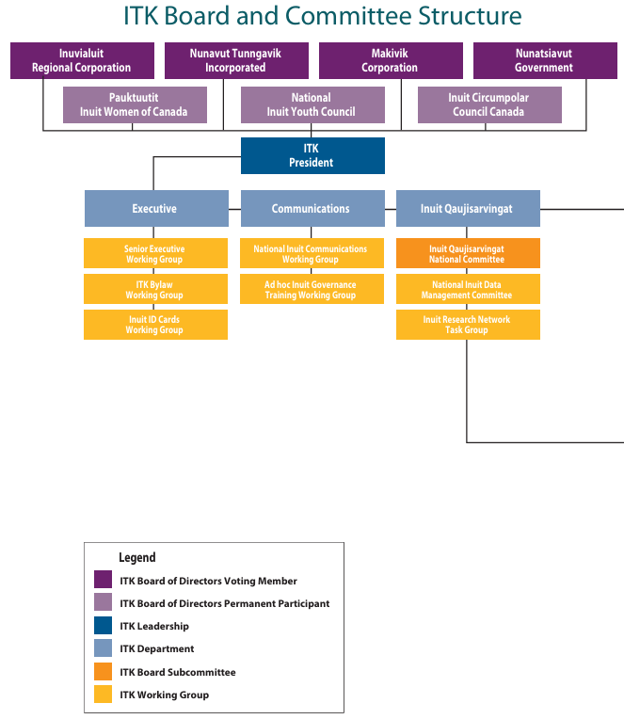
Text version
ITK Board and Committee Structure
Types of roles and bodies:
- ITK Board of Directors Voting Members
- Inuvialuit Regional Corporation
- Nunavut Tunngavik Incorporated
- Makivik Corporation
- Nunatsiavut Government
- ITK Board of Directors Permanent Participants
- Pauktuutit Inuit Women of Canada
- National Inuit Youth Council
- Inuit Circumpolar Council Canada
- ITK Leadership
- ITK President (reports to Boards of Directors)
- ITK Departments (units under ITK Leadership)
- Executive
- Communications
- Inuit Qaujisarvingat
- ITK Board Subcommittee
- Inuit Qaujisarvingat National Committee (reports to Inuit Qaujisarvingat)
- ITK Working Groups
- Senior Executive Working Group (reports to the Executive department)
- ITK Bylaw Working Group (reports to the Executive department)
- Inuit ID Cards Working Group (reports to the Executive department)
- National Inuit Communications Working Group (reports to the Communications department)
- Ad hoc Inuit Governance Training Working Group (reports to the Communications department)
- National Inuit Data Management Committee (reports to Inuit Qaujisarvingat)
- Inuit Research Network Task Group (reports to Inuit Qaujisarvingat)
Source: Inuit Tapiriit Kanatami, 2020-2021 Annual Report.
- Date modified: