
Evaluation of the Investigative Powers for the 21st Century Initiative
Appendix A: Program Profile
A.1. Governance
The IP21C Initiative is overseen by senior officials from each partner department or agency who are jointly responsible for managing its implementation, while each executes its specific activities in the criminal justice and international policy systems. Justice is responsible for leading the coordination of policy and legal advice to ensure the consistency, while respecting the independence of federal organizations within their own mandates.
A.2. Linkages
IP21C Initiative is linked with the GOC’s Cyber Security Strategy that is focussed on making cyberspace more secure for all Canadians, and to the LAI, which is focussed on ensuring that criminal and national security threats are identified and acted upon while respecting the privacy of Canadians.
A.3. Roles and Responsibilities of IP21C Partners
i) Department of Justice Canada
The Department of Justice supports the amendments enacted in the PCOCA and ensures that the provisions concerning the investigative powers associated with digital evidence are successfully integrated into the Canadian justice system. This includes developing and providing training to the law enforcement community, prosecutors and service providers; providing legal and policy advice to support implementation; and providing expertise on any Charter related issues.
The Criminal Law Policy Section provides legal and policy advice to support implementation of the new investigative powers. It was involved in the development and delivery of awareness and training activities to ensure that the PCOCA amendments were understood, interpreted and implemented consistently to minimize risk of misinterpretation or misapplication.
The Human Rights Law Section provides expertise related to the Charter as well as related litigation support.
The International Assistance Group is responsible for the review and execution of all requests made to and by Canada seeking MLA in criminal matters and extradition.
The RCMP Legal Services Unit (LSU) provides legal advice and support to the RCMP on legal and policy issues arising from the implementation and application of the IP21C provisions.
ii) Public Prosecution Service of Canada
The PPSC is responsible for responding to investigator requests for legal advice and support in the context of investigations and prosecutions as a result of amendments to sections 492.1 and 492.2 of the Criminal Code and the creation of new production and preservation orders (especially in high complexity cases and in a major proportion of medium complexity cases).Footnote 57 The PPSC Is also involved at the pre-charge stage. Moreover, the PPSC is increasingly involved at the post-charge stage due to lengthier prosecutions, resulting when there are constitutional challenges to the new legislation, and the development of new precedents. The PPSC also provides training to prosecutors and some police officers. Training occurs at the annual PPSC School for Prosecutors and in regional offices on a periodic basis. Ongoing workshops and updates to training materials for prosecutors and/or police occurred as the new provisions were implemented and interpreted by the courts.
iii) Royal Canadian Mounted Police
The RCMP has a broad mandate in addressing cybercrime, both domestically and internationally. This includes addressing crimes where the Internet and information technologies are used in the commission of a criminal offence. Under the IP21C Initiative the RCMP is responsible for the following initiatives:
- The development of a dedicated triage function to administer a new data preservation scheme, and to respond to foreign country requests for assistance related to IP21C, including the Budapest Convention. Part of this function is embedded with the RCMP’s National Child Exploitation Crime Centre as well as linked with key Federal Policing operational areas for requests that fall outside of those related to child exploitation. The RCMP’s National Operations Centre serves as the “24/7” point of contact to facilitate the provision of technical advice and legal information, preservation of data, collection of evidence and locating suspects in relation to international requests under the Budapest Convention.
- The development of new technical tools and/or solutions for warranted, real time interception of transmission data and analysis of seized data. This includes network interception tools, alternative data capture tools, processing tools, and the formatting of data for investigative, analytical and evidentiary purposes. New operational tools have been developed to collect data from tracking devices in real time to locate a person, transaction or thing. The tools support domestic and international investigations involving Canada’s major telecommunications services. Research and development activity is embedded in RCMP Special “I” programs and Integrated Technological Crime Units (ITCUs) located in Ontario, Quebec and British Columbia.
- New dedicated resources to augment criminal investigative teams and implement tools for the real time interception of transmission data and analysis of seized data related to the IP21C investigative powers, including international requests related to the Budapest Convention. This element focusses on the operational implementation and use of the new tools in criminal investigations. Resources are housed in the RCMP Special “I” programs and ITCUs located in Ontario, Quebec and British Columbia.
The RCMP’s roles and responsibilities with respect to IP21C Initiative are supported by the RCMP LSU. There has been ongoing engagement with the RCMP LSU to support RCMP training on the new investigative powers under the PCOCA, the new obligations of the RCMP arising from the ratification on the Budapest Convention, and on legal developments in this area of law affecting RCMP operations. Training also included in-house training activities with RCMP operational areas, with the engagement of the RCMP Legal Application Support Teams.Footnote 58
iv) Global Affairs Canada
GAC supports implementation of the PCOCA and the Budapest Convention by advancing international cooperation on cybercrime and ensuring that Canada’s interests related to cybercrime are reflected in Canada’s broader foreign policy. As cybercrime is international in nature, additional engagement with international partners has been undertaken. Through contribution funding, GAC provides technical assistance to foreign countries to build capacity to combat cybercrime and/or facilitate ratification and implementation of the Budapest Convention. Contribution funding is provided primarily under the terms and conditions of the Anti-Crime Capacity Building Program. The GAC Legal Affairs Bureau, specifically the Criminal, Security and Diplomatic Law Division, is responsible for ensuring that Canadian policy and law are consistent with the requirements of the Budapest Convention and Canada’s other international obligations. JLA provides advice to Justice on foreign policy issues arising in mutual legal assistance and extradition requests to and from Canada. GAC is the operational lead with respect to the Protocol of Foreign Criminal Investigations in Canada. It provides legal advice in dealing with sovereignty issues that may arise from cross-boundary cyber cooperation related to the Budapest Convention as well as legal advice on international law issues.
A.5. Logic Model
A diagram of the logic model for the IP21C Initiative is presented in Figure A1, overleaf. It illustrates the relationship between the planned activities and expected results.
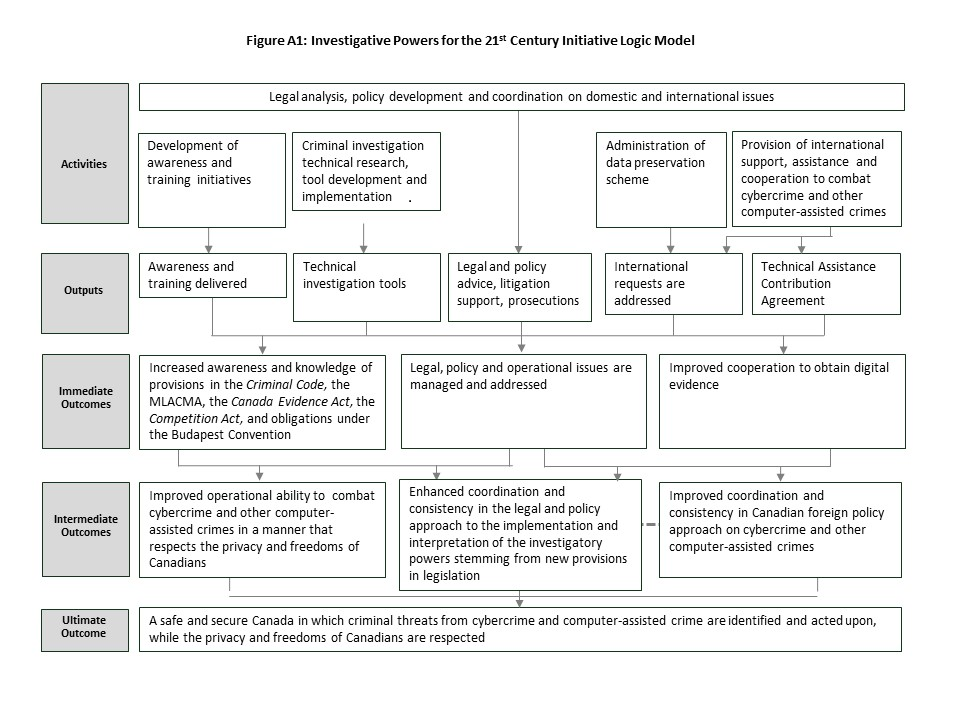
Text version: Figure A1: Investigative Powers for the 21st Century Initiative Logic Model
The activities of the Initiative include:
- Legal analysis, policy development and coordination on domestic and international issues;
- Development of awareness and training initiatives;
- Criminal investigation technical research, tool development and implementation;
- Administration of data preservation scheme;
- Provision of international support, assistance and cooperation to combat cybercrime and other computer-assisted crime.
The outputs include:
- Awareness and training delivered;
- Technical investigation tools developed;
- Legal and policy advice, litigation support, prosecutions;
- International requests are addressed;
- Technical Assistance Contribution Agreement.
The immediate outcomes are:
- Increased awareness and knowledge of provisions in the Criminal Code, the MLACMA, the Canada Evidence Act, the Competition Act, and obligations under the Budapest Convention;
- Legal, policy and operational issues are managed and addressed;
- Improved cooperation to obtain digital evidence.
The intermediate outcomes are:
- Improved operational ability to combat cybercrime and other computer-assisted crimes in a manner that respects the privacy and freedoms of Canadians;
- Enhanced coordination and consistency in the legal and policy approach to the implementation and interpretation of the investigatory powers stemming from new provisions in legislation;
- Improved coordination and consistency in Canadian foreign policy approach on cybercrime and other computer-assisted crimes.
The ultimate outcome is a safe and secure Canada in which criminal threats from cybercrime and computer-assisted crime are identified and acted upon, while the privacy and freedoms of Canadians are respected.
- Date modified: