
2. Initiative profile
2.1 Description
The SHW Initiative was launched in 2018-19 to support the federal government in its goal of “Eliminating gender-based violence and harassment”. Sexual harassment is a form of discrimination based on sex1 which can take a variety of forms2 from mild transgressions to severe behaviour.3 The Canada Labour Code defines sexual harassment as any conduct, comment, gesture, or contact of a sexual nature that is likely to cause offence or humiliation to any employee; or that might, on reasonable grounds, be perceived by that employee as placing a condition of a sexual nature on employment or on any opportunity for training or promotion.4 An individual has the right to be free from an unwelcome sexual advance or solicitation in the workplace. Over time, definitions have continued to evolve to better reflect an understanding of the way that sexual power operates in society.5
The SHW Initiative is comprised of two components, the PLEI component, and the Legal Advice for Complainants of Workplace Sexual Harassment component. The two components are complementary and together are intended to help make workplaces free of harassment by:
- increasing public awareness and knowledge about SHW; and
- providing complainants of SHW with access to legal advice when dealing with workplace sexual harassment.
Public Legal Education and Information and Outreach
This component supports the development and dissemination of public legal education and information. The target populations that could benefit from SHW Initiative-funded projects are broad and include many different vulnerable groups.6 The goal is to better inform workers, especially the most vulnerable, about their rights, and resources they can access regarding SHW. In addition to projects aimed at workers generally, this component also includes projects focussed on hospitality and service industry workplaces and male dominated industries and occupations to increase awareness and public knowledge around sexual harassment in these employment sectors.
Legal Advice for Complainants of Workplace Sexual Harassment
This component supports organizations that provide legal information, advice and ancillary services (i.e., counselling and referrals to employment agencies) across each province and territory to persons who have experienced SHW regardless of their economic status. Services are made available through various modes of delivery, such as by telephone, in-person, or online. The SHW Initiative ensures that the services are accessible to populations who may be more vulnerable to sexual harassment, such as workers in precarious jobs; those who provide personal services; women working in male dominated fields; youth; Indigenous and racialized women; persons with disabilities; those who identify as 2SLGBTQI+; and women newcomers to Canada.
2.2 Resources
In Budget 2018, the federal government proposed to invest $50.4 million over five years (2018-19 to 2022-23) to address SHW. Of this amount, approximately half ($25.4 million) was earmarked for providing legal advice to people who have experienced SHW, and the other half ($25 million) was dedicated to the development of a pan-Canadian outreach program to inform workers about their rights.
The SHW Initiative is delivered with funding through the JPIP and the Legal Aid Program. During the period covered by the evaluation, Justice Canada allocated approximately $39 million to the SHW Initiative. The breakdown per fiscal year is presented in Table 1 below.
| Categories | 2019-2020iii | 2020-2021 | 2021-2022 | 2022-2023 |
|---|---|---|---|---|
| Operational fundingi,ii | $111,714 | $128,449 | $126,898 | $105,347 |
| Legal Aid (Gs&Cs) | $2,347,327 | $5,500,000 | $5,717,557 | $5,525,077 |
| JPIP (Gs&Cs) | $4,173,377 | $4,434,776 | $5,785,065 | $5,271,355 |
| Total | $6,632,418 | $10,063,225 | $11,629,520 | $10,901,779 |
Notes:
2.3 Overview of Funded Projects
The first Call for Proposal (CFP) was issued in 2018, seeking proposals for both components, PLEI and Legal Advice.
Project proposals were received and assessed by program officials representing both JPIP and Legal Aid, and a committee comprised of SHW experts from across Canada. The final selection of projects was made to offer geographic representation across Canada as well as include projects that focused on specific population groups disproportionately affected by or affected in different ways by SHW. Key considerations such as gender-based analysis, trauma informed practices,7 multi-sectoral and multi-agency collaboration, cultural sensitivity, and support for official languages were also applied in project assessment and selection.
A second CFP was issued in 2021 that was aimed at supporting PLEI projects intervening in specific sector environments such as male dominated industries and service/hospitality workers. As a result of this CFP, 11 projects were funded and five organisations that had received project funding for the Legal Advice component through the first CFP received additional funding to provide PLEI. In total, 45 projects, delivered by 45 organizations were funded under both CFPs.
As noted in Table 2, projects cover all provinces and territories. There are also several projects funded through the SHW Initiative that are national in scope.
| Province/Territory | Legal Advice Projects | PLEI Projects | Legal Advice and PLEI Projects | Percentage of Total Approved Funding |
|---|---|---|---|---|
| Alberta | 0 | 3 | 1 | 5% |
| British Columbia | 1 | 4 | 1 | 12% |
| Manitoba | 0 | 1 | 1 | 5% |
| New Brunswick | 0 | 0 | 1 | 4% |
| Newfoundland and Labrador | 0 | 0 | 1 | 3% |
| Northwest Territories | 0 | 1 | 0 | 3% |
| Nova Scotia | 0 | 0 | 1 | 5% |
| Nunavut | 0 | 0 | 1 | 2% |
| Ontario | 1 | 8 | 2 | 24% |
| Prince Edward Island | 0 | 1 | 1 | 4% |
| Quebec | 1 | 1 | 0 | 7% |
| Saskatchewan | 0 | 2 | 1 | 7% |
| Yukon | 0 | 1 | 1 | 8% |
| National | 1 | 6 | 1 | 11% |
| Total | 4 | 28 | 13 | 100% |
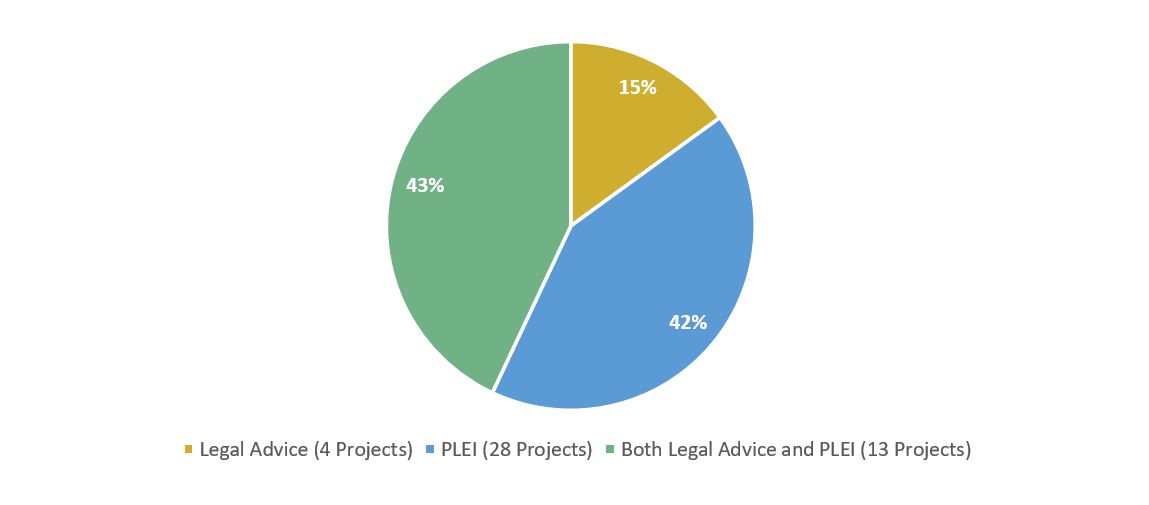
Figure 1 indicates that the largest portion of the funding was allocated almost equally to projects focussed on PLEI (42%) and a combination of PLEI and Legal Advice (43%) followed by Legal Advice (15%).
Figure 1: Distribution of Funding by Component (2019-20 to 2022-23)
Text version
| Component | Percentage of Total Funding |
|---|---|
| Legal Advice (4 Projects) | 15% |
| PLEI (28 Projects) | 42% |
| Both Legal Advice and PLEI (13 Projects) | 43% |
- Date modified: