
JustResearch no. 10
- 5.1 Minority Views on the Anti-Terrorism Act (Formerly Bill C-36): A Qualitative Study
- 5.2 Genetic Information and Privacy 19
- 5.3 A Review of the Literature on Youth
5. Research in Profile
By Dr. Fernando Mata, Senior Research Officer
5.1 Minority Views on the Anti-terrorism Act (Formerly Bill C-36): A Qualitative Study
"...the Department of Justice Canada...sought to examine how minority groups viewed the different provisions of the Antiterrorism Act."
BACKGROUND
In December 2001, Parliament of Canada proclaimed into law the Anti-terrorism Act (formerly Bill C-36). There has been a perception surrounding the enactment of the legislation, as expressed in some media reports for example, that some minority groups may be unfairly targeted as a result of the provisions contained in the legislation. Given this situation, the Research and Statistics Division of the Department of Justice Canada, and the Criminal Law Policy Team, sought to examine how minority groups viewed the different provisions of the Anti-terrorism Act. Building on the consultations undertaken with various groups prior to the enactment of the legislation, this study randomly sampled the views of minority group members from across the country. The present study was not a consultation but rather a focus-group exercise that held structured conversations with participants. While public opinion surveys can tap the Canadian public's view as a whole, ethno-cultural minority positions are more difficult to obtain for reasons such as small sample sizes and comfort in expressing views about such a sensitive topic over the phone. The Research and Statistics Division contracted with the consulting firm Créatec+ in order to conduct the focus groups.
METHODOLOGY: SELECTION OF PARTICIPANTS
"...138 individuals participated from approximately 60 ethnocultural minority backgrounds."
Focus group participants were selected using random sampling procedures based on telephone lists available for the cities chosen. They were subsequently assigned to three groups covering a wide range of ethnic and visible minority backgrounds based on Statistics Canada's classification of ethnic groups for the 2001 population census. Ethnicity was used as the key selection factor rather than religion or racial backgrounds. Group One was made up of individuals reporting Arab and West Asian ethnicities as well as those of North African and Pakistani ethnicity. Group Two was made up of individuals reporting Black, African, East Asian, South-East Asian and South Asian ethnic origins, excluding Group One members. Group Three was made up of individuals of Western, Northern, Central, Southern and Eastern European ethnic origins, including those reporting Aboriginal and Jewish backgrounds. Both immigrant and Canadian-born individuals reporting these ethnic backgrounds participated in these groups. In total, 138 individuals participated from approximately 60 ethno-cultural minority backgrounds. They ranged in age from 18-54 years. Each group was comprised of males and females, with a range of educational levels and occupations.
MODERATOR'S GUIDE
The moderator's guide for the focus group sessions tapped the following subject areas:
- awareness of the Anti-terrorism Legislation;
- reaction to the definition of terrorism;
- reaction to listing of terrorist entities;
- reaction to financing of terrorism provisions;
- reaction to investigative and preventive powers;
- reaction to some mechanisms associated with investigative and preventive powers; and,
- impact of the Anti Terrorism Act on individuals, families and communities. Special handouts were distributed for the discussion process.
SESSIONS
Créatec+ conducted the focus groups between March 10 and 21, 2003. In total, 16 two-hour focus groups were carried out in five Canadian cities (Halifax, Montreal, Toronto, Calgary, and Vancouver). Average size per focus group ranged between 8-10 participants. English discussions were conducted in 13 groups (three each in Halifax, Toronto, Calgary, and Vancouver plus one in Montreal) and three were conducted in French (in Montreal).
FINDINGS
"Overall, participants expressed general support for the provisions of the Anti-terrorism Act…"
"…while the appeal concept was highly valued, most felt that harm to the innocent could already be done before the appeal was heard."
"The sunset clause was poorly understood as a safeguard, and instead seen as a government expectation that terrorism would not be a problem after five years…"
In general, awareness of terrorist-related legislation was consistently low across all target groups and in all locations, whether it concerned the Anti-terrorism Act, the Criminal Code or any other legal measures before or after September 11th. However, participants were generally aware of new post-September 11th travel-related security measures, especially at airports and borders, including the need for passports and permanent resident cards to travel to the United States.
Overall, participants expressed general support for the provisions of the Anti-terrorism Act, with varying degrees of concern about its application. The Act was generally thought to create a sense of comfort, safety, and increased security. Participants generally assumed that Canada's anti-terrorism legislation was less severe than that of the United States and the United Kingdom.
More specifically,
- Thedefinition of terrorist activity was seen as a good idea, but was not well understood, with some concern expressed about possible misinterpretation and its effect on legitimate protests, and confusion over the criteria.
- The intention of the listing of terrorist entities provision was viewed in a positive light, but strong concerns emerged over the public nature of the listing, possible ethnic minority stereotyping, doubts about accurate and credible information, the potential for misinterpretation, and loss of privacy. In addition, while the appeal concept was highly valued, most felt that harm to the innocent could already be done before the appeal was heard.
- While thefinancing of terrorism provision made sense, people worried about potential harm to the innocent, the potential for misinterpretation, and about certain legislative aspects which placed responsibility on individuals instead of on the government.
- Overall, there was general acceptance for the newpolice investigative and preventive powers, despite the possible risks of abuse, including arrest of the innocent, targeting of ethnic minorities, possible misinterpretation, and potential police abuse. Participants generally approved of the wiretapping section, but were confused about the offence relating to the refusal to give information.
- The notion of safeguards garnered high approval and provided relief and greater confidence in the Canadian approach to combating terrorism.
- Thesunset clause was poorly understood as a safeguard, and instead seen as a government expectation that terrorism would not be a problem after five years, or as validation that police powers were dangerous.
- Thereporting obligation to Parliament was well received and well understood as a safeguard, which monitored the application of police powers. However, some doubted government transparency and preferred an independent watchdog.
Lastly, participants confused the legislative impact of the Act with the impact of September 11th events. When asked about the legislative impact of the Act, most cited discriminatory occurrences at the workplace, in daily activities (e.g. riding public transit), when trying to rent or buy a home, at schools, places of worship, and in social relationships.
CONCLUSIONS
Overall, the majority of respondents felt the risk of having the Anti-terrorism Act and its new police powers was acceptable to better protect Canadians. Most felt safer or the same with the legislation, and most hoped their reservations would not be validated. Participants adopted a "wait-and-see" approach.
A Parliamentary review of the entire Anti-terrorism Act is mandated to take place within three years of the Act receiving Royal Assent. The present research study is part of the efforts undertaken by the Research and Statistics and the Criminal Law Policy Team to help inform this review.
5.2 Genetic Information and Privacy
By Valerie Howe, Senior Research Officer
Biotechnology is the application of science and engineering in the direct or indirect use of living organisms or parts of organisms in an innovative manner to produce goods and services or to improve existing processes. In the biotechnology community, work in the area of human health is known as "red biotechnology" and agricultural and industrial uses are known as "green biotechnology". Health-related biotechnology or genetics is by far the largest area of economic and scientific activity in Canada.
THE BIO-ECONOMY IN CANADA
According to BIOTECanada[3] ",Canada's biotech sector includes more than 400 companies, ranking second in the world after the U.S. in terms of number of firms. Revenues from Canadian biotech firms increased from $813 million in 1997 to $1.9 billion in 1999 of which over $1 billion was in the field of human health or genetics[4]. Biotech revenues were expected to reach CDN $5 billion in 2002 compared to $1.9 billion in 1998
". While much of the science and hope for quality of life improvements are focused on health biotechnology, it takes longer to get health related products to market, particularly those based on new science.
GOVERNMENT INITIATIVES
"The federal government has identified biotechnology as a key area of its innovation agenda…"
The federal government has identified biotechnology as a key area of its innovation agenda and has been promoting research in "red biotechnology" through a variety of agencies including the Canadian Institutes for Health Research, the National Research Council, Genome Canada, the Canada Foundation for Innovation, and the National Centres of Excellence. The 2003 budget included new spending for genetics research through these agencies. The September 2002 Speech from the Throne noted that it would:
- increase its funding to the federal granting councils to provide young Canadians greater support for graduate studies and research. It will work with universities on the indirect costs of research and on strategies for its commercialization to create opportunities for entrepreneurs and to fuel innovation;
- strengthen government science, integrating its efforts across departments and disciplines, and focusing on the priorities of Canadians;
- move forward with a smart regulation strategy to accelerate reforms in key areas;
- adapt its intellectual property framework to enable Canada to be a world leader on emerging issues such as new life forms; and,
- work with provinces to implement a national system for the governance of research involving humans, including national research ethics and standards.
INCREASING ATTENTION TO THE GELS: ETHICAL, ECONOMIC, ENVIRONMENTAL, LEGAL AND SOCIAL IMPACTS OF GENETIC SCIENCE
The Canadian Biotechnology Strategy is a federal government initiative that "provides a common biotechnology vision, integrating the dual roles of the federal government respecting biotechnology: vigilant regulator and responsible innovator
". The Canadian Biotechnology Advisory Committee (CBAC), created in September 1999, is an expert, arms-length committee that advises the federal government on policy issues associated with the ethical, social, regulatory, economic, scientific, environmental and health aspects of biotechnology. A 20-member, voluntary committee, CBAC is supported by the Canadian Biotechnology Secretariat and reports to the Biotechnology Ministerial Coordinating Committee (BMCC). In 2001-02 the Government of Canada funded a three-year Inter-departmental Initiative on Genetic Information and Privacy through Industry Canada and the Canadian Biotechnology Advisory Committee (CBAC).
Joy Kane, Senior Assistant Deputy Minister for Policy Sector, Department of Justice Canada, is the federal government Champion for Genetic Information and Privacy; Bill Pentney, the Senior General Counsel, Public Law Policy Section, chairs and provides direction for the Genetic Information and Privacy Working Group (G I & P IWG). In the past year, the Research and Statistics Division has been supporting the Public Law Policy Section and others in the department and the government in developing a research base for a government-wide approach to policy development related to genetic science and the use of genetic information.
THE DEPARTMENT OF JUSTICE CANADA RESEARCH FOR THE GENETIC INFORMATION AND PRIVACY WORKING GROUP
The research has produced the following:
- a Genetic Futures Forum on Privacy and Human Rights;
- a report on domestic (Federal/Provincial) legal framework surrounding privacy and human rights for genetic information;
- a report on international legal framework surrounding privacy and human rights for genetic information;
- an issues Identification Report (in-progress);
- an opinion poll conducted by Earnscliffe and Gallup; and,
- a jurisprudence paper on Supreme Court of Canada trends in interpreting human rights, privacy, and disability issues.
RESEARCH FINDINGS
"…it is evident that one would have a reasonable expectation of privacy in one's genetic information, thus triggering the protections in the Charter."
"…they consider the protection of the privacy of genetic information to be the most important role for government."
In most current privacy and human rights legislation, federal and provincial, genetic information would be protected under more general references to personal information or health data. Legal research indicates that it is likely that protection for genetic information would be read into the Privacy Act as well as into provincial legislation, where it is not specifically referred to. In addition, it is evident that one would have a reasonable expectation of privacy in one's genetic information, thus triggering the protections in the Charter.
Internationally, as well as nationally, there are many different laws that would likely provide protection for genetic information. However, the laws use differing definitions and terminology and there is a need to distinguish genetic information, health information, medical information, genetic samples and so on. In addition, there are differing legal frameworks - privacy, data protection, human rights, health law and others. As well, existing protections apply to different populations (e.g. public and private sectors, international organizations, research organizations.)
IS THERE PUBLIC CONCERN?
The Genetic Information and Privacy Intergovernmental Working Group, chaired by Justice Canada, commissioned a public opinion poll. This found that the public thinks that few genetic tests are now being undertaken but they realize that such test results are likely to be preserved in a databank. About half feel that the organization that did the test would have some property rights over the sample. They are not sure what protections are in place or whether they are stringent or lax; although most feel the protections should be more stringent than for other health information. They are overwhelmingly concerned about providing access to third parties such as insurers and employers and they consider the protection of the privacy of genetic information to be the most important role for government.
NEXT STEPS
The Department of Justice and its colleagues in the Intergovernmental Working Group will be working towards the development of policy options based on the research evidence already gathered. A number of meetings, seminars and expert panels will be held to further consider and evaluate any policy and legal needs to ensure that Canadians are comfortable with the protections provided to their genetic information.
5.3 A Review of the Literature on Youth Auto-theft Offending: Characteristics, Motivations and Motor Projects
INTRODUCTION
"…youth between the ages of 12 and 17 accounted for almost half (42%) of Canadians charged for motor vehicle theft."
"…probation was used as the most significant sentence for the majority (56%) of young auto-theft offenders in Canada."
According to recent results from the International Crime Victimization Survey, Canada ranked fifth out of seventeen countries for risk of vehicle theft - a crime that is estimated to cost Canadians nearly $1 billion each year (Wallace, 2003). Young offenders are responsible for a significant proportion of this form of crime. Data from the 2001 Uniform Crime Report (UCR)
Survey indicate that youth between the ages of 12 and 17 accounted for almost half (42%) of Canadians charged for motor vehicle theft. As will be discussed in this article, while some youth steal vehicles for financial gain, these offenders are more likely to do so for joyriding purposes. Youth involvement in auto-theft, their characteristics and motivations, and Canadian statistics on young auto-theft offenders, as well as common program elements developed to deal with these offenders represent the focus of this article.
This paper offers a synopsis of the key details and findings presented in the literature. It should be noted that very little in the way of Canadian research was discovered in the literature search. Therefore, aside from a discussion of Canadian statistics based on UCR Survey and Youth Court Survey (YCS) data, the majority of the findings are from British research.
STATISTICS ON CANADIAN YOUTH AND AUTO-THEFT
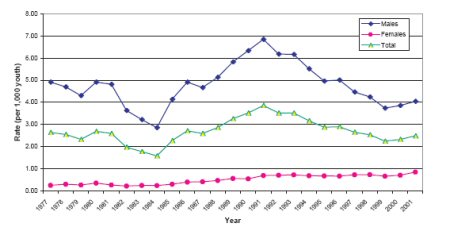
Although more females have become involved in vehicle theft in Canada over the past 25 years, UCR data reveal that auto-theft among youth is still predominantly a male crime (see Figure 1). According to 2001 YCS data,[5] the majority (54%) of young offenders convicted of vehicle theft in Canada are 15 to 16 years old. Twelve- and thirteen-year-olds accounted for only a small percentage of young auto-theft offenders (1.9% and 5.8% respectively). At a rate of 6.41 per 1,000 youth, the Territories had the highest rate of youth charged for vehicle theft in the country.[6] The Prairie region had the second highest rate at 5.58 per 1,000 youth. With 2.27 per 1,000 youth charged for auto-theft, the Atlantic region was just below the national rate of 2.49. Canada's three most populous provinces, Ontario, British Columbia and Quebec, had the lowest rates of youth auto-theft in the country, equalling 2.06, 1.69 and 1.10 per 1,000 youth respectively. YCS data from 2001 indicate that probation was used as the most significant sentence for the majority (56%) of young auto-theft offenders in Canada. Custody was used as the most significant sentence in 31% of all auto-theft cases. Community Service was used in 5% of cases as the most significant sentence. Fines, Absolute Discharges, "Other" sentences, Conditional Discharges, Compensation, and Compensation in Kind combined were used in less than 8% of all youth auto-theft sentences as the most significant sentence.
Figure 1: Rate of Canadian Youth Charged for Auto-theft[7]
OFFENDER CHARACTERISTICS
Research from other countries also indicates that the vast majority of auto-theft offenders are male and commonly become involved in vehicle offending in their early-to mid-teens. These individuals often grow-up with few positive role-models and live in disadvantaged and overcrowded neighbourhoods that lack leisure facilities. The research suggests that young auto-theft offenders are characterized by high levels of truancy and unemployment, poor self-esteem, economic deprivation, and low levels of educational attainment.
OFFENDER MOTIVATIONS
The majority of offenders steal cars for personal use (e.g., joyriding and transportation), however, theft for financial gain (e.g., selling parts of the vehicle, insurance fraud) also occurs, but to a lesser degree. Younger offenders are more likely to take cars for joyriding purposes, but as these individuals get older and become more skilled and confident in their abilities, money-making often becomes a primary interest. Two of the most commonly reported motivations for stealing vehicles are excitement and peer pressure, as the delinquent act provides an escape from boredom and a way to gain status amongst peers.
MOTOR PROJECTS
"The majority of offenders steal cars for personal use (e.g., joy-riding and transportation)…"
"…the literature suggests that programs should not only seek to challenge offenders' antisocial attitudes and behaviours, but also teach them the social skills necessary to build associations within a positive peer group."
Programs initiated to deal with vehicle offenders are commonly referred to as motor projects. Two of the most common components of these projects include: (a) automotive maintenance and driving courses; and, (b) challenging offender
attitudes and behaviours. Building upon offenders' interest in vehicles, the automotive classes and driver training are used to teach offenders about road safety and appropriate driving, how to use and spend time with vehicles in a constructive way, and to provide them with vocational skills. By challenging offenders' attitudes and behaviours, the goals are to reinforce a pro-social perspective and work towards building self-esteem by encouraging offenders to take responsibility for their behaviour and performance within the program, while educating them about the seriousness of car offending and emphasizing the impact their actions have on their victims. Given the influence of the negative peer group, the literature suggests that programs should not only seek to challenge offenders' anti-social attitudes and behaviours, but also teach them the social skills necessary to build associations within a positive peer group.
Some motor projects also involve racing (e.g., off-road motorcycling, go-karting, "banger car" racing). The racing component is grounded on the philosophy of providing offenders with the opportunity to engage in thrill-seeking behaviour in a controlled atmosphere where they will not endanger the public. While this feature has been advocated as a valuable component of motor projects (Dawes, 2001), the literature suggests that racing is not being used as frequently as it was in the late 1980s and early 1990s, as it has been criticized for contributing to re-offending. With that said, a key component of motor projects should be the provision of legal alternatives to car theft, which aim to alleviate boredom and provide youth with exciting, appropriate activities.
PROGRAM OUTCOMES
"In terms of reducing recidivism, motor projects have had mixed results."
"…the research stresses the need for diversionary and preventative tactics with this offender population at the outset of offending behaviour "
In terms of reducing recidivism, motor projects have had mixed results. Some program evaluations have found fairly high degrees of re-offending (more than 50%), with younger offenders recidivating and dropping out of programs more frequently than older offenders. However, some researchers have noted reasonable success. For example, Wilkinson's (1997) evaluation of the Ilderton motor project, which used a quasi-experimental design to compare matched groups of offenders who participated in the program with those that did not, shows that the project had quite strong results in reducing recidivism. Beyond an examination of re-offending, researchers have attributed other positive outcomes to program attendance such as improved attitudes towards driving, road safety and education. In order to provide a more complete assessment of these programs, further studies involving matched samples or random assignment of program participants and non-participants are needed.
CONCLUSION
Given the extensive criminal histories of offenders entering into motor projects, their links to a delinquent peer group and internalization of a deviant identity have been strongly established. This, in turn, further complicates the process of re-directing these youth away from a delinquent career path. As such, the research stresses the need for diversionary and preventative tactics with this offender population at the outset of offending behaviour (Hills, 1998; Light et al., 1993; Rutherford, 1992; Slobodian & Browne, 2001). Emphasizing findings from Light et al. (1993), Slobodian and Browne (2001) indicate that the nature of car crime, the influence of peers and the age of offenders underline the need for early diversionary strategies. For programs to be effective with auto-offenders, Smith (1999) argues that the needs of offenders must be carefully targeted, and programs must be well-managed and run following exacting criteria.
REFERENCES
- Dawes, G. (2001). Time to ride: Youth and the culture of joyriding in rural Queensland. Paper presented at the Character, Impact and Prevention of Crime in Regional Australia Conference, Townsville, Australia. http://www.aic.gov.au/conferences/regional/dawes.pdf
- Hills, P. (1998). Preventing car theft in Australia: "Golden opportunity" for partnerships. Australian Institute of Criminology:Trends & Issues in Crime and Criminal Justice.
- Light, R., Nee, C. & Ingham, H. (1993). Car theft: The offender's perspective. London: HMSO.
- Rutherford, A. (1992). Growing out of crime - the new era. Winchester, UK: Waterside Press.
- Slobodian, P. J. & Browne, K. D. (2001). A review of car crime in England and Wales. British Journal of Social Work, 31, 465-480.
- Smith, A. (1999). Motor projects reviewed: Current knowledge of good practice. Home Office: Policing and Reducing Crime Unit. http://www.homeoffice.gov.uk/rds/pdfs2/ah183.pdf
- Wallace, M. (January 2003). Motor vehicle theft in Canada -2001. Juristat. Ottawa, ON: Canadian Centre for Justice Statistics, Statistics Canada.
- Wilkinson, J. (1997). The impact of Ilderton Motor Project on motor vehicle crime and offending. British Journal of Criminology, 37(4), 568-581.
- Date modified: