
Open Government at Justice Canada: A Year in Review – June 2023
Open Government is an international initiative, led by the Open Government Partnership (OGP), a multilateral organization formed in 2011 with over 80 member countries. The OGP aims to make government more accessible to everyone by improving government openness and transparency, strengthening democracy and citizen participation, and driving innovation and economic opportunities for all. Canada has been a member since 2011. In Canada, direction on open government activities comes from the Treasury Board Secretariat (TBS).
At Justice Canada, the foundation of open government is based on strong leadership at the Deputy Ministerial level. Under this leadership, the Justice Canada Open Government Advisory Group (OpenGov), an internal advisory group that provides guidance and endorses the Department’s open government initiatives, was established in 2017. The following year, operations across the department were reviewed to find areas that could be leveraged to support the changes required to implement the core open government pillars identified by TBS: open information, open data, and open dialogue.
Following the review of operations, an action plan was developed that outlines the Department’s open government activities. OpenGov reports annually to senior managers within the Department on activities in the action plan through a year in review report. Learn more about past initiatives by reading the Open Government at Justice Canada: A Year in Review reports available on the Open Government Portal.
Justice Canada’s 2022-2023 open government priorities were established through the annual open government planning process, which included a consultation with OpenGov in the fall of 2022. Three areas of focus were identified as priorities: 1) open justice, 2) open information and data, and 3) training and awareness. Justice Canada has made some great progress towards these priorities:
1) Open Justice
- The National Action Plan on Open Government 2022-2024 (NAP) was published on September 22, 2022. The NAP was the culmination of multiple collaborations and consultations with other government departments, stakeholders and the public. It includes a Justice theme with 22 commitments led by Justice Canada and the RCMP.
- The National Action Plan on Open Government Tracker was launched by TBS to monitor progress on all commitments included in the 2022-24 NAP. To date, Justice Canada has completed five quarterly reporting periods. Progress has been made on all milestones this year, with three milestones already completed.
- Justice Canada provided updates on progress toward 17 of the 22 Justice theme commitments and in November 2022 and May 2023 met with the Multi-stakeholder forum on Open Government, a civil society and government forum that provides advice, input and a challenge function. These meetings have been very successful with lots of great feedback and discussion. A summary of these discussions is available on the Open Government Portal.
- The Justice theme commitments were also included as an action under Advancing Respect for Human Rights in Canada’s commitment for the Summit for Democracy in December 2021. Progress achieved on these commitments was reviewed at the second Summit for Democracy in March 2023 and information related to Canada’s progress on Summit for Democracy commitments is available to the public. Justice Canada’s Access to Justice Secretariat has also been an active member of the Rule of Law and People-Centered Justice cohort, an initiative of the Summit for Democracy Year of Action.
- Justice employees can learn more about the NAP commitment on the new “Open Justice” page on the department’s internal Open Government Community Site. The page highlights some of the Department’s work in this area including an overview of the Justice theme included in the 2022-2024 NAP and involvement in the OGP’s Coalition on Justice.
2) Open Information and Data
- The process to release information and data on the Open Government Portal is now part of ongoing Justice operations. This will allow the department to maximize the release of non-sensitive Justice information and data, and look for new opportunities to support publishing with a purpose.
- Two open government indicators will be included in the upcoming Justice Sustainable Development Strategy 2023-2027. The Justice theme indicators included in the National Action Plan on Open Government 2022-2024 and the number of open data and information assets published on the Open Government Portal per month will be used to report on the Department’s progress towards sustainable development.
- The Department is monitoring and reporting on compliance with all aspects of the Directive on Open Government,including theongoing release of information and data on the Open Government Portal, where you can find Justice Canada initiatives that support transparency, accountability and access to justice. Among other assets this year, you will find new research reports from our Research and Statistics Division, such as: Black people in criminal courts in Canada: An exploration using the relative rate index; departmental plans, such as the Accessibility Plan for the Department of Justice of Canada; as well updates to the State of the Criminal Justice System Dashboard, which includes new “Youth”-focused content.
Text Version
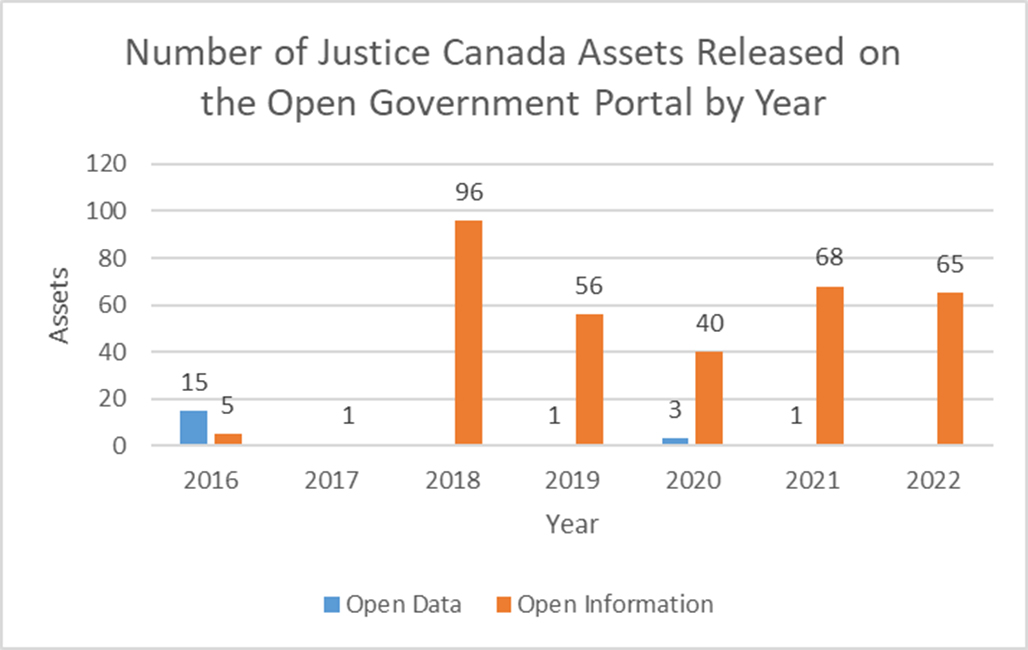
Chart 1 depicts the number of Justice Canada assets released on the Open Government Portal by Year via a vertical bar chart. The y-axis represents the number of assets released per year with a range of 0 to 120, increasing by increments of 20. The x-axis represents the year, with a range of 2016 to 2022, in increments of one year. There are two bars, side by side per year, representing the different types of assets that are released each year, open data is represented by a blue bar and open information by an orange bar.
In 2016, fifteen open data assets were released, and five open information assets were released. In 2017, no open data assets were released, and one open information asset was released. In 2018, no open data assets were released, and ninety-six open information assets were released. In 2019, one open data asset was released, and fifty-six open information assets were released. In 2020, three open data assets were released, and forty open information assets were released. In 2021, one open data asset was released, and sixty-eight open information assets were released. In 2022, no open data assets were released, and sixty-five open information assets were released.
Data source: Open Government Analytics
3) Training and Awareness
- In January 2023, representatives from Justice Canada presented at the Canada Open Government Working Group, a forum for multi-jurisdictional information sharing and collaboration on open government. The presentation focused on how collaboration between Justice’s Open Government team and Communications Branch supports all areas of open government at Justice.
- New training material on open government was developed and published on the internal Open Government Community Site for Justice employees. The new infographic highlights the essentials of open government at Justice Canada. It will be a useful tool to promote the key principles of open government and Justice Canada initiatives to new and existing employees.
- Justice Canada’s Access to Justice Secretariat has been participating in the agenda content design process for the justice-focused sessions at the upcoming 8th Open Government Partnership Global Summit taking place in Estonia this September 6-7th.
- The Justice Open Government team, Intergovernmental and External Relations Division and Communications Branch are planning the annual Open Doors at Justice Event. The 2023 event will focus on consultations and engagement. Additional information will be provided on justice.gc.ca when it is available.
We look forward to continued advancement on these priorities and participation in multiple open government events this fall.
- Date modified: