
Department of Justice Canada 2024–25 Departmental Results Report
On this page
Copyright information
Department of Justice Canada
2024–25 Departmental Results Report
The Honourable Sean Fraser, P.C., K.C., M.P.
Minister of Justice and Attorney General of Canada
© His Majesty the King in Right of Canada, as represented by the Minister of Justice and Attorney General of Canada, 2025
ISSN: 2560-9440
Aussi disponible en français sous le titre : Rapport sur les résultats ministériels 2024-2025
Department of Justice Canada’s 2024–25 Departmental Results Report
At a glance
This Departmental Results Report details the Department of Justice Canada’s actual accomplishments against the plans, priorities and expected results outlined in its 2024–25 Departmental Plan.
Key priorities
The Department identified the following key priorities for 2024–25:
- Keeping Canadians safe in our communities and online
- Supporting the needs of the courts
- Improving access to justice in Canada, and addressing systemic discrimination and racism particularly for Indigenous, Black and other racialized people, and supporting victims and survivors of crime
- Delivering on the Government of Canada’s reconciliation agenda
Highlights for the Department in 2024–25
- Total actual spending (including internal services): $1,350,941,125
- Total full-time equivalent (FTE) staff (including internal services): 5,654
For complete information on the Department’s total spending and human resources, read the Spending and human resources section of this report.
Summary of results
The following provides a summary of the results the Department achieved in 2024–25 under its main areas of activity, called “core responsibilities.”
-
Core responsibility 1: Legal Services
- Actual spending: $428,770,838
- Actual FTE staff: 4,043
The Department delivered integrated legal advisory, litigation, legislative drafting and regulatory drafting services in support of various government and client priorities, such as:
- advancing reconciliation with Indigenous peoples, including through advice on matters related to section 35 of the Constitution Act, 1982, the duty to consult, Aboriginal title, the honour of the Crown, as well as advice to departments working to further the Government of Canada’s commitment to implement the United Nations Declaration on the Rights of Indigenous Peoples Act (UN Declaration Act) and the associated Action Plan
- making life more affordable for Canadians, including through the new Canadian Dental Care Plan
- advancing the Government of Canada’s forward regulatory agenda and the implementation and evolution of the legislative framework
- reaching sustainability and environmental priorities, including those promoting climate action, sustainable jobs and reconciliation, as well as initiatives in support of Canada’s net-zero targets
- ensuring economic security and countering foreign interference, including matters related to the Public Inquiry into Foreign Interference in Federal Electoral Processes and Democratic Institutions
- developing strategic litigation positions with client departments
For more information on the Department’s Legal Services core responsibility, read the “Results – what we achieved” section of this report.
-
Core responsibility 2: Justice System Support
- Actual spending: $791,967,257
- Actual FTE staff: 374
As part of its broad responsibilities for overseeing all matters relating to the administration of justice that fall within federal jurisdiction, the Department:
- contributed to a renewed relationship with First Nations, Inuit and Métis by implementing the UN Declaration Act and its related Action Plan, and responded to the justice-related Calls for Justice of the National Inquiry into Missing and Murdered Indigenous Women and Girls and Calls to Action of the Truth and Reconciliation Commission
- supported the Government of Canada’s commitment to increasing access to justice for vulnerable groups through legislative initiatives, and by providing funding for programs and services that respond to changing conditions affecting the Canadian justice system, such as the Family Information Liaison Unit (FILU) initiative
- advanced criminal law reform and enhanced the criminal justice system response to address matters like intimate partner violence (IPV), cybercrime, and overrepresentation of Indigenous people (through the Indigenous Justice Strategy [IJS]), and of Black people (through Canada’s Black Justice Strategy [CBJS]) in the criminal justice system
- supported the passage and royal assent of Miscarriage of Justice Review Commission Act (David and Joyce Milgaard’s Law), a key step in advancing the establishment and future implementation of the Miscarriage of Justice Review Commission, a new independent commission whose review process will replace the existing wrongful conviction review process and be easier, faster, and more supportive of potentially wrongfully convicted people, communities, and victims of crime
- supported Canada’s criminal justice priorities on the international stage
- contributed to collective efforts to combat hate crimes in all its forms, including to address the public safety threat of antisemitism
For more information on the Department’s Justice System Support core responsibility, read the “Results – what we achieved” section this report.
From the Minister
I am pleased to present the Department of Justice Canada’s 2024–25 Departmental Results Report, which outlines the work the Department has done during the period of April 1, 2024, to March 31, 2025.
Throughout the last fiscal year, the Department worked to advance a range of Government of Canada priorities. It provided legal advisory services, law and policy development, litigation services, legislative drafting, and other professional services to my predecessors in their respective capacity as the Minister of Justice and Attorney General of Canada, as well as to client departments across the Government. In addition, the Department continued to administer a number of programs, such as legal aid, that support fair and timely access to justice.
As Minister of Justice and the Attorney General of Canada, one of my key responsibilities is to keep people and communities in Canada safe. I am focused on standing up for the Canadian Charter of Rights and Freedoms, section 35 of the Constitution Act, 1982 and Indigenous rights, the rule of law, equality and human rights, and building accountability and trust in our government and our justice system. I am proud of the role that the Department plays in these matters. I am also proud of the vital work the Department does to advance reconciliation with Indigenous peoples. As I am new to this role, I commend my predecessors, and everyone in the Department, for these achievements.
One of the Department’s key areas of work centred around supporting the needs of the courts, improving access to justice for Indigenous, Black and racialized people, and supporting victims and survivors of crime. In addition, the Department played a role in advancing reconciliation with First Nations, Inuit and Métis, including through its role in furthering implementation of the United Nations Declaration on the Rights of Indigenous Peoples Act, notably through preparation of guidance for all federal officials on section 5 (consistency of laws) of the Act. This guidance is now publicly available on the Department’s website. A key milestone of the past year was the Royal Assent of former Bill S-13, An Act to amend the Interpretation Act and to make related amendments to other Acts, on November 27, 2024. It ensures that all federal laws, statutes, and regulations are interpreted in a way that upholds Aboriginal and treaty rights recognized and affirmed in section 35 of the Constitution Act, 1982.
The Department also developed and published Canada’s first Indigenous Justice Strategy, in consultation and cooperation with a diverse representation of Indigenous partners and in close collaboration with the provinces and territories. The Strategy aims to address systemic discrimination and the overrepresentation of Indigenous people in our country’s criminal justice system.
The Department has also released the 10-year Implementation Plan for Canada’s Black Justice Strategy. This Plan is the Government’s response to the external Steering Group Report that provided recommendations on how to combat the systemic discrimination that has led to the overrepresentation of Black people in the criminal justice system, including as victims and survivors of crime.
Last year, the Department continued to seek ways to support victims and survivors of crime and ensure they are treated with dignity and respect in the criminal justice system. This included launching the Supporting Indigenous Victims of Crime initiative to provide funding for culturally grounded victim supports and services for Indigenous victims and survivors of crime and violence.
The Department advanced efforts to make the justice system more equitable and more responsive to the needs of all people in Canada. Of note, former Bill C-40, the Miscarriage of Justice Review Commission Act (David and Joyce Milgaard’s Law), received royal assent on December 17, 2024. This is a key step toward establishing an independent commission dedicated exclusively to miscarriage of justice reviews. This will help improve access to justice for potentially wrongfully convicted people to have their applications reviewed, including Indigenous peoples, Black persons, and members of other racialized or marginalized populations.
The Department has accomplished much over the last year, but we know there is hard work ahead. We will have a key role to play as the Government focuses on securing our borders, preventing crime and reforming our laws to keep Canadians safe. More than ever, we must commit to our core values and work to strengthen the justice system, so it better serves everyone in Canada.
Finally, I will note that the Department’s employees should rightfully take pride in the work they have done over the last year. I thank them for their professionalism and dedication to achieving these results.

Results – what we achieved
Core responsibilities and internal services
Core responsibility 1: Legal Services
Description
The Minister of Justice and Attorney General of Canada provides legal services to the federal government and its departments and agencies. The Minister is responsible for seeing that the administration of public affairs is in accordance with the law. The Minister is also responsible for examining all government bills and all government regulations for inconsistency with the Canadian Charter of Rights and Freedoms. Additionally, the Attorney General is responsible for advising the heads of departments on all matters of law and for conducting all litigation for federal departments and agencies on subjects within the authority or jurisdiction of Canada.
Quality of life impacts
Through the activities mentioned in the core responsibility description, the Department contributes to the domains and indicators related to its client priorities and commitments, such as: “Good Governance” (Indigenous self-determination) and “Environment” (Conserved areas), among others.
Progress on results
This section details the Department’s performance against its targets for the departmental result under core responsibility 1: Legal Services.
Table 1: Departments and agencies receive high quality legal services
The table below shows the target, the date to achieve the target and the actual result for each indicator under Legal Services in the last three fiscal years.
| Departmental Result Indicator | Target | Date to achieve target | Actual result |
|---|---|---|---|
| Client satisfaction mean rating on the overall quality of legal services. | 8 or greater on a 10-point scale | March 2025 | 2022–23: 8.6Footnote 1 2023–24: 8.7Footnote 2 2024–25: 8.6Footnote 3 |
| Client satisfaction mean rating on the provision of legal services against the Service Standards. | 8 or greater on a 10-point scale | March 2025 | 2022–23: 8.7Footnote 4 2023–24: 8.8Footnote 5 2024–25: 8.4Footnote 6 |
| Percentage of litigation files resolved in a fiscal year that have a successful outcome (settled or adjudicated) from the Crown’s perspective. | 75% or greater | March 2025 | 2022–23: 90% 2023–24: 93% 2024–25: 92% |
The Results section of the Infographic for the Department of Justice Canada on GC Infobase provides additional information on results and performance related to its program inventory.
Details on results
The following section describes the results for Legal Services in 2024–25 compared with the planned results set out in the corresponding Departmental Plan for the year.
Departments and agencies receive high quality legal services
Results achieved:
Indigenous rights and the path to reconciliation
Whole-of-government Approach
The Department provided whole-of-government legal services to client departments and agencies on initiatives that contributed to the Government of Canada’s reconciliation agenda in a variety of contexts. This included matters related to section 35 of the Constitution Act, 1982, the duty to consult, Aboriginal title, the honour of the Crown, and implementation of the UN Declaration Act. For example, the Department:
- provided strategic legal advice on the development and implementation of the Government of Canada’s UN Declaration Act Action Plan measures, and on the statutory obligations in the UN Declaration Act, including to consult and cooperate with Indigenous peoples to take all measures necessary to ensure that the laws of Canada are consistent with the UN Declaration
- continued to provide legal support to clients on issues related to the honour of the Crown, First Nations and Inuit policing, and changes to how the federal government supports these police services
- applied the Principles respecting the Government of Canada’s relationship with Indigenous peoples and the Attorney General of Canada’s Directive on Civil Litigation Involving Indigenous Peoples, including by identifying opportunities for early resolution and settlement and to narrow the scope of litigation
- provided ongoing litigation support to clients on complex litigation files, including in relation to safe drinking water and housing on reserve
Modern treaties and agreements
The Department provided legal support to Crown-Indigenous Relations and Northern Affairs Canada, Indigenous Services Canada and other client departments on the negotiation of modern treaties, self-government agreements and other constructive arrangements, including the:
- “Big Tide (Low Water)” Haida Title Lands Agreement, signed on December 4, 2024. This Agreement is the first-of-its-kind for the Government of Canada, as it recognizes that the Haida Nation has Aboriginal title to all terrestrial lands on Haida Gwaii. The Department also played a role in developing a strategic approach to exploratory fisheries discussions with the Haida Nation
- Kitselas Treaty, Kitsumkalum Treaty and K’ómoks Treaty, negotiations for which concluded in June 2024. In addition, novel treaty measures were negotiated on various aspects of fisheries management and if ratified, will set a new precedent for modern treaties in British Columbia. First Nation ratification votes have proceeded on two of three treaties, with high rates of approval
- Red River Métis Self-Government Recognition and Implementation Treaty, signed on November 30, 2024
- Musqueam Self-Government Agreement, initialed on March 7, 2025. Once ratified, signed and in effect, this will be the first new self-government agreement in British Columbia in more than 22 years. The agreement included novel language for First Nation law-making with concurrent jurisdiction relating to conservation, protection and management of fish and fish habitat
- consultation and accommodations on the Final Self-Government Agreement for the Tłegǫ́hłı̨ Got’įnę, which was ratified by the Tłegǫ́hłı̨ Got’įnę community on April 1, 2025
- implementation of the Supreme Court of Canada’s decision on treaty interpretation and the honour of the Crown in Ontario (Attorney General) v Restoule, 2024 SCC 27
- Nunavut Land Claim Agreement implementation contract, signed on March 8, 2025. This 10-year contract is a treaty obligation worth over $1.5 billion
Other notable initiatives
The Department provided legal support to Crown-Indigenous Relations and Northern Affairs Canada and Indigenous Services Canada on matters such as:
- the apology by the Minister of Crown-Indigenous Relations to the Nunavik Inuit for the effects of federal policies that resulted in the Nunavik Dog Slaughter from 1950 to the early 1960s
- the ongoing review, negotiation and settlement of specific claims, including support in the settlement of 69 specific claims
- the review of options for reforms to the Specific Claims Policy and Process that were co-developed with the Assembly of First Nations
- Indigenous child and family services legislation, including on:
- the participation at 17 coordination agreement tables and the implementation of 15 concluded coordination agreements pursuant to An Act respecting First Nations, Inuit and Métis children, youth and families
- coordination agreements and related funding arrangements with Inuit governing bodies in support of the exercise of Inuit jurisdiction for child and family services
- negotiations and litigation related to Indigenous child and family services, Jordan’s Principle and proceedings before the Canadian Human Rights Tribunal
- the $8.5 billion landmark Final Agreement on Long-Term Reform of the First Nations Child and Family Services Program in Ontario that was reached with the Assembly of First Nations, Chiefs of Ontario, and Nishnawbe Aski Nation in February 2025
- potential revisions to the Addition to Reserve Policy and the draft policy
- implementation of the Nunavut Lands and Resources Devolution Agreement, which calls for the full implementation of the transfer of land and resource management responsibilities to the Government of Nunavut on April 1, 2027
- ongoing work to implement the Truth and Reconciliation Commission Calls to Action, including those related to unmarked graves and burial sites. The Department also participated in the Residential Schools Documents Advisory Committee
- ongoing work to support Indigenous Services Canada’s efforts to advance safe drinking water on reserve.
Training on cultural competency and human rights of Indigenous peoples
The Department developed and coordinated training on cultural competency and the human rights of Indigenous peoples, such as:
- trauma-informed training on cultural humility, delivered to 113 participants
- a self-directed online Indigenous intercultural competency course
- training on the UN Declaration Act and UN Declaration, delivered to federal public servants
- a nationally broadcast Indigenous panel event on the UN Declaration in collaboration with the National Centre for Truth and Reconciliation, as part of the implementation of UN Declaration Act Action Plan Shared Priority 18
Economic priorities
The Department provided legal services to client departments and agencies in support of initiatives that build a stronger economy and help make life more affordable for Canadians, including to:
- the Department of Finance Canada, in relation to:
- measures that were introduced in the former Bill C-69, the Budget Implementation Act, 2024, No. 1, which received royal assent on June 20, 2024, as well as the measures announced in the 2024 Fall Economic Statement. These include legislative and policy measures on taxation such as clean economy investment tax credits, scientific research and experimental development credits, and automatic tax filing, as well as financial sector policy and legislative measures relating to the financial institutions supervisory committee, predatory lending, and consumer-driven banking
- legal advice and legislative drafting support as it prepared complex legislative amendments needed to implement the Government’s increase to the capital gains inclusion rate from one half to two thirds, as announced in Budget 2024
- the one-time tax-free $250 Working Canadians Rebate
- amendments to the Income Tax Act and the Income Tax Regulations to require registered charities that provide services, advice, or information in respect of the prevention, preservation, or termination of pregnancy to disclose where they do not provide specific services, including abortions or birth control
- the preparation and introduction of former Bill C-78, Tax Break for All Canadians, which received royal assent on December 12, 2024. This bill implemented a federal GST/HST tax break from December 14, 2024, to February 15, 2025
- the Government of Canada’s administration of the carbon pricing regime and the removal of the consumer carbon price by April 1, 2025
- Finance Canada, Health Canada, Employment and Social Development Canada, Public Services and Procurement Canada and the Canada Revenue Agency in implementing the new Canadian Dental Care Plan, which included onboarding new applicant cohorts and ensuring dental care services coverage to Canadians
- Health Canada for the new Pharmacare Act that received royal assent on October 10, 2024, which aims to improve national, universal, single-payer coverage for a range of contraception and diabetes medications
- Canada Revenue Agency in its sustained efforts to combat tax evasion and avoidance, to ensure the fairness and integrity of the tax system, and to administer several benefits for individuals and related programs such as carbon rebates for individuals and small businesses
- Global Affairs Canada, the Department of Finance Canada, the Privy Council Office, and other government departments on international trade law matters, including the United States (U.S.) tariffs imposed on Canadian imports under the U.S. International Emergency Economic Powers Act and the Trade Expansion Act of 1962
Safety and security
The Department provided legal services to client departments and agencies on priorities relating to public safety, including:
- the Department of Finance Canada on the development and design of a proposed Canada Financial Crimes Agency, standing up of the Integrated Money Laundering Intelligence Partnership; and the development, interpretation and implementation of the revised ministerial directives under the Proceeds of Crime (Money Laundering) and Terrorist Financing Act
- Innovation, Science and Economic Development Canada to promote economic security and combat foreign interference. This included providing legal support following the passage of the National Security Review of Investments Modernization Act, which amends the Investment Canada Act to strengthen the national security review process and ensure that Canada can continue to address economic security threats arising from foreign investment. The Department also helped in the preparation of new regulatory amendments that will be necessary to allow for the coming into force of the remaining amendments from the National Security Review of Investments Modernization Act
- the Privy Council Office for its participation in the Public Inquiry into Foreign Interference in Federal Electoral Processes and Democratic Institutions, and in providing corporate and back-office support. The final report of the Public Inquiry into Foreign Interference in Federal Electoral Processes and Democratic Institutions was released on January 28, 2025
- Canadian Heritage in responding to questions concerning former Bill C-63, An Act to enact the Online Harms Act, to amend the Criminal Code, the Canadian Human Rights Act and An Act respecting the mandatory reporting of Internet child pornography by persons who provide an Internet service and to make consequential and related amendments to other Acts, and examining potential amendments and related future proposed legislation. Former Bill C-63 was not passed before Parliament was dissolved
- Public Safety Canada, the Royal Canadian Mounted Police, and the Canada Border Services Agency to support the Government of Canada’s commitments on firearms and to strengthen measures to control the flow of illegal guns into Canada. The Department provided advice on the design and implementation of the Assault-Style Firearm Compensation Program and supported regulatory projects under the Firearms Act
- Public Services and Procurement Canada to support the Defence Procurement Strategy, which aims to streamline the decision-making process for military procurements to support the Canadian Armed Forces and the Canadian Coast Guard
Regulatory and legislative modernization
The Department continued to provide legal support on the Targeted Regulatory Reviews, notably to the following client departments:
- Health Canada on the modernization of health and biosciences regulations concerning biocides, food additives and compositional standards, and agile licensing of therapeutic products. For example, the Department advised Health Canada on specific amendments in the Budget Implementation Act, 2024, No. 1 to the Food and Drugs Act, which enable precise regulatory solutions to emerging or ongoing issues specific to foods, therapeutic products or activities to ensure health and safety, such as nicotine replacement therapies
- Transport Canada on regulatory initiatives in the areas of clean technology, digitalization, international standards, and efforts to support efficient and effective supply chains, including through the drafting of regulations amending the Canadian Aviation Regulation
- Natural Resources Canada on regulations that enable offshore renewable energy projects under the Canadian Energy Regulator Act, as well as two orders, published December 16, 2024 and February 25, 2025, concerning the coming-into-force of amendments to the Canada–Newfoundland and Labrador Atlantic Accord Implementation and Offshore Renewable Energy Management Act and the Canada–Nova Scotia Offshore Petroleum Resources Accord Implementation and Offshore Renewable Energy Management Act to allow joint management of offshore renewable energy projects in their respective offshore areas
The Department continued to contribute to the implementation and operationalization of legislative amendments, in addition to providing legal services on initiatives aiming to modernize Canada’s regulatory system and legislative framework to client departments such as:
- Public Services and Procurement Canada with respect to ongoing efforts to modernize Canada’s procurement system, such as the updating of contract clauses as part of the Contract Modernization Initiative, as well as a new regulation to harmonize procurement obligations found in trade agreements, regulations and policy instruments
- Employment and Social Development Canada’s Labour Program and the Office of the Chief Human Resources Officer (Treasury Board of Canada Secretariat) with respect to the implementation of the Pay Equity Act. This included amending the Pay Equity Regulations and drafting new regulations and an Order in Council to apply the Pay Equity Act to ministers’ offices. Advice was also provided on the application of the Pay Equity Act to Indigenous governing bodies
- Canadian Heritage and the Treasury Board of Canada Secretariat in the implementation of the Official Languages Act, as modernized by former Bill C-13, An Act for the Substantive Equality of Canada’s Official Languages, and of the Use of French in Federally Regulated Private Businesses Act as enacted by that former bill through the provision of training and legal and policy advice on the elaboration of the three regulations
- Global Affairs Canada with respect to Canada’s sanctions legislation, including amendments to regulations under the Special Economic Measures Act. This included providing support on the Order Respecting the Seizure of Property Situated in Canada (Aircraft RA-82078), through which the Attorney General of Canada commenced forfeiture proceeding of the currently seized Antonov 124 aircraft located at Toronto Pearson International Airport
The Department provided legal support on bills relating to regulatory modernization that did not proceed further due to the dissolution of Parliament, including former Bill S-6, An Act respecting regulatory modernization, and former Bill C-27, the Digital Charter Implementation Act, 2022.
Key infrastructure and housing projects
The Department provided legal support to Public Services and Procurement Canada, Transport Canada, and Housing, Infrastructure and Communities Canada on various initiatives relating to key infrastructure and housing projects, including:
- the High-Speed Rail procurement process. The Department also advised on governance, strategies for the impact assessment, land acquisition and expropriation, negotiations with host railways to secure access to cities, Indigenous engagement and consultations, and potential legislative measures
- the Lac-Mégantic Bypass project, particularly for the preparation of the necessary documentation to submit the project application to the Canadian Transportation Agency and the transfer of lands to the railway operator
- the development and implementation of the Public Lands for Homes Plan
- negotiations leading to the Government of Canada’s acquisition of the Québec Bridge, a National Historic Site of Canada, on November 12, 2024
- the Department of Housing, Infrastructure and Communities Act, which received royal assent on June 20, 2024. The Act establishes said department and outlines the powers and responsibilities of the Minister of Infrastructure and Communities and the Minister of Housing
- inquiries related to the Gordie Howe International Bridge Project, which is currently under construction and anticipated to open in late 2025
Employment equity and diversity
The Department provided legal support to the Treasury Board of Canada Secretariat and other client departments and agencies on various initiatives related to employment equity and diversity, equity and inclusion, including:
- the global strategy on the elimination of harassment, discrimination and violence in the public service, the Government of Canada’s Action Plan to support Black public servants, and the Government of Canada’s action plan following the release of the Study on the Black Executive Community in the Federal Public Service undertaken by Dr. Rachel Zellars
- policy initiatives such as the government-wide initiative on self-identification and self-declaration by public servants
- the resolution of harassment and discrimination complaints with sensitivity to the experiences of equity-seeking groups in the public service
Sustainable development and environmental priorities
The Department provided legal services to client departments and agencies on matters related to Canada’s climate and environmental priorities, such as:
- the Department of Finance Canada in the preparation of a $2 billion issuance of a 7-year Canadian-dollar-denominated green bond, due to mature on March 1, 2032
- Treasury Board of Canada Secretariat’s strategic review of government programs and policies with a focus on examining how major programs and policies contribute to meeting challenges such as achieving net-zero emissions by 2050, improving fairness and equality and promoting quality of life and growth for everyone, and reviewing all departmental proposals to refocus spending. The Department also provided legal risk assessments for all government initiatives and programs that require Treasury Board approval, including transfer payments to businesses to reduce greenhouse gas emissions, funding for Indigenous programs, and funding to protect environmentally sensitive areas
- Fisheries and Oceans Canada with respect to the management of Canadian fisheries and aquaculture. This included ongoing support for the operationalization of the new Possession and Export of Elvers Regulations, as well as ongoing support on Indigenous consultations in British Columbia regarding aquaculture licence renewals and proposed amendments to the Pacific Aquaculture Regulations
- Environment and Climate Change Canada in the development of regulatory initiatives that will significantly reduce Canada’s greenhouse gases emissions, such as the Clean Electricity Regulations, published in the Part II of the Canada Gazette on December 13, 2024, as well as the proposed Oil and Gas Sector Greenhouse Gas Emissions Cap Regulations, published for public consultations in Part I of the Canada Gazette on November 9, 2024
- Natural Resources Canada in commercial, Indigenous and regulatory law on the engagement on clean growth projects and programs, such as the Energy Innovation Program and the Electric Vehicle Infrastructure Demonstration Program. The Department also supported the development and implementation of the Indigenous Loan Guarantee Program of up to $5 billion in Indigenous loan guarantees to unlock access to the capital needed for Indigenous groups to make major economic investments in natural resource and energy projects
- Natural Resources Canada in the structuring, negotiation, and drafting of the preliminary agreement of up to $304 million to support the development and modernization of a new large-scale, natural uranium-fueled Canadian nuclear reactor
- Fisheries and Oceans Canada and Environment and Climate Change Canada to ensure that the Government of Canada meets its ecological conservation goals and for the creation of protected areas. For example, the Department provided legal advice and negotiation support on the Great Bear Sea Project Finance for Permanence, the SINAA / Qikiqtani Project Finance for Permanence, and the Order No. 2 Designating the Tuvaijuittuq Marine Protected Area
- Environment and Climate Change Canada in implementing the Species at Risk Act, including measures that require decisions by the Minister of the Environment and the Governor in Council when there are imminent threats to species at risk or their critical habitat
Litigation strategies and positions
The Department continued to develop strategic litigation positions on high-profile and high-volume cases, including various class actions and labour matters, in collaboration with client departments and used a whole-of-government approach where appropriate. For example, the Department collaborated with and provided strategic advice and support to various Cabinet and interdepartmental committees on litigation management. Collaboration with these committees fostered better risk management and alignment of priorities and strengthened interdepartmental coordination.
Other legal services and support
The Department provided legal services and support to:
- the Clerk of the Privy Council and the Privy Council Office, as well as other federal departments on questions involving Cabinet confidences and on matters related to Governor in Council appointments
- the Treasury Board of Canada Secretariat on its efforts to advance Canada’s Digital Ambition, such as the development of a trusted digital identity platform and the revision of the Policy on Service and Digital and the Directive on Service and Digital
- Canadian Heritage on the Canadian Handbook on the International Holocaust Remembrance Alliance Working Definition of Antisemitism, which was published in October 2024
- Canadian Heritage and the office of Canada’s Special Representative on Combatting Islamophobia in the preparation of the Canadian Guide to Understanding and Combatting Islamophobia, which was published in March 2025
- Canadian Heritage with respect to developing legislative reforms associated with amending CBC/Radio-Canada’s governance structure, funding, and mandate
- Global Affairs Canada on a wide variety of legal issues in preparation for Canada’s 2025 Presidency of the Group of Seven (G7) and hosting of the 2025 G7 Leaders’ Summit
- the Impact Assessment Agency of Canada on the Government of Canada’s response to the Supreme Court of Canada’s decision in Reference re Impact Assessment Act, 2023 SCC 23. For example, the Department provided legal support in developing proposed legislative amendments to the Impact Assessment Act and supported the ensuing implementation
- Immigration, Refugees and Citizenship Canada in its strategic immigration review exercise by providing support on the development of amendments to the Immigration and Refugee Protection Act to improve asylum integrity and processing, protect the integrity of Canada’s visa system, and strengthen information sharing
- the Competition Bureau with respect to competition law reform. Examples of the Department’s work include investigating and litigating on restrictive real estate clauses in the Canadian grocery sector and litigating on behalf of the client department on the first constitutional challenge to the “greenwashing” amendment to the Competition Act
- Department of National Defence to resolve individual claims on consent resulting from the Quebec Court of Appeal’s decision in Spieser c. Procureur général du Canada (Sa Majesté du Chef du Canada), 2024 QCCS 2561, and the narrowing of remaining legal issues in the individual claims process
- Canada Revenue Agency to defend eligibility decisions for emergency benefits related to COVID-19
In partnership with Global Affairs Canada, the Department successfully finalized negotiations on the first international convention on artificial intelligence (AI), human rights, democracy and rule of law in the Council of Europe. Canada signed the convention on February 11, 2025, joining the European Union and Canada’s G7 partners.
Key risks
External relationships
Cultivating and maintaining productive relationships with client departments and agencies, partners and stakeholders is important in ensuring that the Department can achieve its expected results.
As legal practices, client priorities, and demands for legal services continue to evolve, the Department could face new challenges in meeting its client departments and agencies’ expectations in some areas and delivering effective and fiscally sustainable services. To mitigate such risks, the Department advanced its priority of strengthening client-centric partnerships by continuing to improve business processes and provide meaningful legal risk assessments, and by acting as a trusted and collaborative partner. Notably, the Department:
- continued to focus on collaboration and joint planning with client departments and partners in central agencies to meet Government and client department and agency priorities. For instance, the Department co-chaired a Deputy Minister-level interdepartmental committee, which provided a forum for senior officials to work collaboratively with respect to the policy, financial and legal implications of litigation involving the Government of Canada
- continued to proactively engage client departments in discussions to meet their legal requirements, and considered the client environment, position and needs when providing legal advice based on legal risk management best practices. For example, the Department continued to deliver training to enable participation of its client departments and agencies in the conduct and resolution of their legal files in a more comprehensive manner. Training materials were consistently updated and designed to reflect the latest court rules and the Department’s priorities
- implemented a new Justice Legal Risk Framework, which supports the Department’s counsel in the provision of high-quality, clear and meaningful legal risk advice that is responsive to the needs of client departments and agencies and supports informed decision-making
- continued to capture feedback through the Legal Services Client Feedback Survey, now in its fifth cycle, with a renewed version of the survey aligned to needs of its client departments and agencies and Service Standards
- continued to seek ways of working better. For example, the Department explored the pairing of legal counsel and group assignments on major litigation files to leverage the strengths, knowledge and talents of its employees. In the area of tax law, the Department developed templates to enable client departments and agencies to provide necessary information to the Court in particular situations, thus streamlining the process
Resources required to achieve results
Table 2: Snapshot of resources required for Legal Services
The table below provides a summary of the planned and actual spending and FTEs required to achieve results.
| Resource | Planned | Actual |
|---|---|---|
| Spending | $230,876,958 | $428,770,838 |
| FTEs | 3,918 | 4,043 |
The variance between planned spending and actual spending is primarily explained by retroactive and lump-sum salary payments, as well as increases in salaries and related employee benefit plan expenditures resulting from the ratification of various collective agreements and an increased workforce.
The Finances section of the Infographic for the Department of Justice Canada on GC Infobase and the People section of the Infographic for the Department of Justice Canada on GC Infobase provide complete financial and human resources information related to its program inventory.
Related government priorities
This section highlights government priorities that are being addressed through this core responsibility.
Gender-based Analysis Plus
The Department continued to apply the guiding principles of Gender-based Analysis Plus (GBA Plus) outlined in the departmental Policy on GBA Plus across all areas of its work. The implementation of an intersectional GBA Plus approach in the Department’s legal services to client departments and agencies helped foster inclusive outcomes that were responsive to the needs of diverse groups of people.
For more information, see the 2024–25 Departmental Results Report GBA Plus Supplementary Information Table on the Department’s website.
UN 2030 Agenda for Sustainable Development and the Sustainable Development Goals
The Department continued to lead Canada’s efforts to advance Sustainable Development Goal (SDG) 16: Peace, Justice, and Strong Institutions and other SDGs, including through the International Assistance Group as Canada’s central authority for extradition and mutual legal assistance. Its work included:
- supporting the Anti-Money Laundering and Anti-Terrorist Financing Regime by participating in the Financial Action Task Force
- participating in international discussions and cooperation (G7, Organization of American States [OAS], UN Office on Drugs and Crime, Commonwealth Secretariat, etc.), including handling all requests for international assistance through bilateral and multilateral instruments
- supporting negotiations between Canada and the European Commission for a bilateral agreement (Horizon Europe)
- participating in the negotiation of the UN Convention against Cybercrime, which was adopted by the UN General Assembly on December 24, 2024
- implementing the UN Convention against Corruption through mutual legal assistance, extradition requests and treaties
- supporting negotiations with the U.S. related to the U.S. federal CLOUD Act
- supporting negotiations on mutual legal assistance in criminal matters treaties with Jamaica and Japan
- contractually requiring domestic and foreign legal agents of the Minister of Justice to abide by Canada’s anti-corruption and anti-bribery legal framework in Canada and abroad
- continued anti-corruption efforts through a designated coordinator
More information on the Department’s contributions to Canada’s Federal Implementation Plan on the 2030 Agenda and the Federal Sustainable Development Strategy can be found in its Departmental Sustainable Development Strategy.
Innovation
The Department explored innovative technologies to improve the delivery of legal services, such as by:
- piloting the use of AI tools, per the guiding principles for the use of AI in government, to streamline administrative and legal support processes. Early findings show that AI-generated summaries significantly reduce the time needed to review case law and prepare internal briefings, without compromising relevance
- developing tools that support litigation teams by improving reporting to client departments and agencies and the digitization and management of physical records
- applying guidance provided by the Action Committee on Modernizing Court Operations on the use of AI while complying with court responsibilities
Additional information on the Department’s digital and data capabilities can be found in the Internal Services section.
Program inventory
The Legal Services core responsibility is supported by the following programs:
- Advisory Services
- Litigation Services
- Legislative Services
Additional information related to the program inventory for Legal Services is available on the Results page on GC InfoBase.
Core responsibility 2: Justice System Support
In this section
Description
The Department plays an essential role in ensuring a fair, relevant and accessible Canadian justice system. This is a shared responsibility among a broad range of players, including Parliament, the judiciary, federal departments and agencies, partners in provincial, territorial and municipal governments, a broad range of non-governmental organizations and stakeholders, and, ultimately, all Canadians.
Quality of life impacts
This core responsibility contributes to the “Good Governance” domain of the Quality of Life Framework for Canada and the subdomains “Justice and Human Rights,” “Safety and Security,” and “Democracy and institutions” through the Department’s work in matters relating to the administration of justice within the federal domain.
Progress on results
This section details the Department’s performance against its targets for each departmental result under core responsibility 2: Justice System Support.
Table 3.1: Justice Canada laws and policies abide by the rule of law and promote respect for rights and a fair, accessible and relevant legal framework in Canada
The table below shows the target, the date to achieve the target and the actual result for each indicator under this departmental result in the last three fiscal years.
| Departmental Result Indicator | Target | Date to achieve target | Actual result |
|---|---|---|---|
| Canada’s international ranking with respect to the rule of law | Top 10% | March 2025 | 2022–23: Top 8.5% (12th/142)Footnote 7 2023–24: Top 8.5% (12th/142)Footnote 8 2024–25: Not availableFootnote 9 |
| Percentage of Canadians who have confidence that the Canadian criminal justice system is fair to all people | 70% or greater | March 2025 | 2022–23: 50% of Canadians have moderate to high confidence that the criminal justice system is fairFootnote 10 2023–24: Not availableFootnote 11 2024–25: 51% of Canadians have moderate to high confidence that the criminal justice system is fairFootnote 12 |
| Percentage of Canadians who have confidence that the Canadian criminal justice system is accessible to all people | 70% or greater | March 2025 | 2022–23: 58% of Canadians have moderate to high confidence that the criminal justice system is accessibleFootnote 13 2023–24: Not availableFootnote 14 2024–25: 59% of Canadians have moderate to high confidence that the criminal justice system is accessible to all peopleFootnote 15 |
| Number of constitutional challenges in the provincial and territorial courts of appeal and the Supreme Court of Canada | Not applicableFootnote 16 | Not applicable | 2022–23: Provincial/territorial courts of appeal: 35 Federal Court of Appeal: 4 Supreme Court of Canada: 3 2023–24: Provincial/territorial courts of appeal: 35 Federal Court of Appeal: 0 Supreme Court of Canada: 5 2024–25: Provincial/territorial courts of appeal: 30 Federal Court of Appeal: 3 Supreme Court of Canada: 5 |
Table 3.2: The criminal justice system supports alternative ways of responding to the causes and consequences of offending
The table below shows the target, the date to achieve the target and the actual result for each indicator under this departmental result in the last three fiscal years.
| Departmental Result Indicator | Target | Date to achieve target | Actual results |
|---|---|---|---|
| Number of restorative justice programs available | 400 or greaterFootnote 17 | March 2025 | 2022–23: 431Footnote 18 2023–24: 394Footnote 19 2024–25: 395Footnote 20 |
| Percentage of adult court cases which received a non-custodial sentence | Between 52% and 56% | March 2025 | 2022–23: 61%Footnote 21 2023–24: Not availableFootnote 22 2024–25: Not availableFootnote 23 |
| Percentage of youth court cases which received a non-custodial sentence | 85% or greater | March 2025 | 2022–23: 92%Footnote 24 2023–24: Not availableFootnote 25 2024–25: Not availableFootnote 26 |
| Number of youths receiving specialized treatment through the Intensive Rehabilitative Custody and Supervision (IRCS) programFootnote 27 | 90 or greater | March 2025 | 2022–23: 113Footnote 28 2023–24: 124 2024–25: 131 |
Table 3.3: Canadians in contact with the justice system have access to appropriate services enabling a fair, timely and accessible justice system
The table below shows the target, the date to achieve the target and the actual result for each indicator under this departmental result in the last three fiscal years.
| Departmental Result Indicator | Target | Date to achieve target | Actual results |
|---|---|---|---|
| Percentage of federal funds accessed by provinces, territories, non-governmental organizations and other stakeholders to deliver targeted services consistent with federal priorities | Between 97% and 100% | March 2025 | 2022–23: 99%Footnote 29 2023–24: 99% 2024–25: 98.4% |
| Number of Indigenous people who received services from an Indigenous courtworker | 68,000 or greater | March 2025 | 2022–23: 82,054 2023–24 (partial data): 64,167Footnote 30 2024–25: Not availableFootnote 31 |
| Number of times duty counsel provides assistance in criminal matters | 1,000,000 or greater | March 2025 | 2022–23: 1,109,380Footnote 32 2023–24: 1,261,107Footnote 33 2024–25: Not availableFootnote 34 |
| Number of full-service criminal legal aid applications approved | 190,000 or greater | March 2025 | 2022–23: 222,708Footnote 35 2023–24: 260,318Footnote 36 2024–25: Not availableFootnote 37 |
| Percentage of Office of the Federal Ombudsperson for Victims of Crime client inquiries or complaints that are assessed and acted upon | 100% | March 2025 | 2022–23: 100% 2023–24: 100% 2024–25: 98.8%Footnote 38 |
The Results section of the Infographic for the Department of Justice Canada on GC Infobase provides additional information on results and performance related to its program inventory.
Details on results
The following section describes the results for Justice System Support in 2024–25 compared with the planned results set out in the corresponding Departmental Plan for the year.
Justice Canada laws and policies abide by the rule of law and promote respect for rights and a fair, accessible and relevant legal framework in Canada
Results achieved:
Indigenous justice, laws and policies
The Department continued to contribute to a renewed relationship with First Nations, Inuit and Métis, including through ongoing cooperation with Indigenous peoples and their representative organizations and collaboration with federal, provincial, and territorial government partners.
By accelerating policy, program and legislative work in key initiatives detailed in this report, such as the implementation of the UN Declaration Act and its related Action Plan, including development and release of the IJS, the Department:
- advanced the implementation of the Truth and Reconciliation Commission Calls to Action
- continued to support Crown-Indigenous Relations and Northern Affairs Canada in the development, delivery and implementation of a responsive and evergreen Missing and Murdered Indigenous Women, Girls, and 2SLGBTQQIA+ People National Action Plan to end the systemic causes of violence against Indigenous women, girls and 2SLGBTQI+ people, in response to the related Calls for Justice; this included the Minister of Justice’s active participation in the third annual National Indigenous-Federal-Provincial-Territorial Meeting on Missing and Murdered Indigenous Women, Girls and 2SLGBTQI+ People held in January 2025
Amendments to the federal Interpretation Act
The Minister of Justice successfully advanced An Act to amend the Interpretation Act and to make related amendments to other Acts (former Bill S-13) to royal assent on November 27, 2024. This bill amended the Interpretation Act to ensure that all federal legislation is interpreted in a way that upholds, and does not diminish, Aboriginal and treaty rights protected by section 35 of the Constitution Act, 1982. This bill also advanced implementation of Shared Priority 2 in the UN Declaration Act Action Plan.
UN Declaration Act
The third annual UN Declaration Act progress report was tabled on June 18, 2024. It is the first to report on progress to implement the UN Declaration Act Action Plan’s 181 measures. The perspectives of 56 First Nations, Inuit and Métis rights holders and representative organizations, and reporting from 43 federal government departments and agencies form the foundation of the 2023–24 report.
The Department supported Indigenous capacity for sustained contributions to the implementation of the UN Declaration Act through the Indigenous Partnership Fund. In 2024–25, a total of $11.5 million was allocated to 126 Indigenous national and regional representative organizations, as well as individual First Nations, modern treaty and self-governing partners, national Indigenous women’s and urban and off-reserve organizations, Métis governments and Tribal Councils.
In March 2025, the Minister of Justice announced the establishment of the UN Declaration Act Action Plan Advisory Committee (APAC). The newly formed Indigenous-led Committee will provide valuable expertise and advice as the Minister implements the Shared Priorities measures in the Action Plan, in consultation and cooperation with Indigenous peoples and with other federal ministers. The formation of the APAC fulfills the commitment made in Shared Priority 22 in the Action Plan.
The Department published the interim Guide for Officials on How to Assess Consistency with the United Nations Declaration on the Rights of Indigenous Peoples online to increase openness and transparency. The Department also published Section 35-pedia, which is a new legal information resource on section 35 of the Constitution Act, 1982, contributing to the response to Call to Action 51.
The Department’s UN Declaration Act Implementation Secretariat hosted its second interdepartmental workshop to discuss and coordinate the implementation of the UN Declaration Act and the Action Plan across the federal government. Over 500 officials from 42 federal departments and agencies attended virtually or in-person.
Indigenous Justice Strategy
Canada’s first-ever federal IJS, released on March 10, 2025, sets out a vision and priority areas for transformative reforms to address systemic discrimination and the overrepresentation of Indigenous people in contact with the criminal justice system. The IJS was developed in consultation and cooperation with First Nations, Inuit, and Métis partners, and in consultation with provinces and territories and includes three co-developed distinction-based chapters. In 2024-25, the Department funded 16 Indigenous organizations to support their engagement and contributions to the development of the IJS.
The Department also published a fact sheet summarizing the trends in overrepresentation of Indigenous people at all stages of the criminal justice system.
Administration of Justice Agreements
In response to UN Declaration Act Action Plan Shared Priority 28, the Truth and Reconciliation Call to Action 42 and Call to Action 50, and modern treaty obligations, the Department, working closely with Crown-Indigenous Relations and Northern Affairs Canada and Public Safety Canada:
- provided support on the ongoing negotiation of Administration of Justice Agreements that meet the unique needs of Indigenous communities and increase access to justice for Indigenous peoples
- increased the number of negotiation tables with Indigenous communities at which administration of justice is being discussed from 21 to 25
- continued to work with other federal departments to determine the best way forward on potential new tables and funding to support discussions on justice and community safety
Ontario First Nations Prosecution Pilot
The Department and the Ontario Ministry of the Attorney General announced that the jointly funded Ontario First Nations Prosecution Pilot would be extended for the 2025–26 fiscal year. The pilot, through which 27 First Nations received funding, provided valuable information to facilitate enforcement of First Nations laws, contributing in turn to increased community safety. In October 2024, the first pilot funding recipient successfully concluded a prosecution under its laws before the Ontario Court of Justice.
Office of the Special Interlocutor
The Department supported the Minister of Justice in the lead-up to the release of the Final Report of the Special Interlocutor for Missing Children and Unmarked Graves and Burial Sites associated with Indian Residential Schools in October 2024. For example, the Department supported National Gatherings, which contributed to healing among survivors and families and to combatting residential school denialism. This support also fulfilled Shared Priority 107 in the UN Declaration Act Action Plan.
Criminal justice system reforms
The Department advanced criminal law reform and strengthened the criminal justice system response to offending to promote public safety, to protect the vulnerable, while also ensuring that the criminal justice system remains fair and accessible. These measures included:
- new Criminal Code offences, enacted by way of the Budget Implementation Act, 2024, No. 1, related to auto theft involving the use of violence or links to organized crime, possession or distribution of an electronic or digital device for the purposes of committing auto theft, and laundering proceeds of crime for the benefit of a criminal organization. In addition, these changes included a new aggravating factor applicable at sentencing where there is evidence that the offender used or involved a person under the age of 18 in the commission of any offence
- legislative amendments to national security and criminal laws through the Countering Foreign Interference Act (former Bill C-70), which received royal assent on June 20, 2024. It bolsters Canada’s ability to detect, disrupt and counter foreign interference threats to all people in Canada, including members of diaspora communities. Former Bill C-70 also modernized foreign interference offences in the Foreign Interference and Security of Information Act, the sabotage offence in the Criminal Code, and the Canada Evidence Act to establish a standardized regime for handling sensitive information in administrative proceedings
- the study and exploration of Criminal Code amendments addressing IPV, such as those concerning coercive control, modernizing the criminal harassment offence, and femicide. The Department supported amendments to former Bill C-332, An Act to amend the Criminal Code (coercive control of intimate partner) and former Bill S-250, An Act to amend the Criminal Code (sterilization procedures), which were not passed before Parliament was dissolved
- amendments to the Criminal Code to establish the independent commission to review potential wrongful convictions through former Bill C-40, the Miscarriage of Justice Review Commission Act (David and Joyce Milgaard’s Law), which received royal assent on December 17, 2024. Under David and Joyce Milgaard’s Law, the current process will be replaced with a new, independent commission whose review process will be easier, faster, and more supportive of potentially wrongfully convicted people, communities, and victims of crime. On March 6, 2025, the Miscarriage of Justice Review Commission was established. The Governor in Council designated Winnipeg, Manitoba as the head office of the Commission
Canada’s Black Justice Strategy
The CBJS aims to address anti-Black racism and the systemic discrimination that has led to the overrepresentation of Black people in the criminal justice system, including as victims of crime. The CBJS will help ensure that all people in Canada receive equal treatment before and under the law.
With respect to the CBJS, the Department:
- released the external Steering Group Report on June 27, 2024. The report sets out 114 recommendations to achieve transformative change in the criminal justice and other related systems that has led to the overrepresentation of Black people in Canada’s criminal justice system, including as victims and survivors of crime
- worked with more than 12 federal departments and agencies, and with provincial and territorial partners, to examine possible responses to the recommendations of the external Steering Group
- released the CBJS Implementation Plan on February 25, 2025, as the federal government’s response to the external Steering Group Report. The 10-year Implementation Plan is supported by proposed investments in the 2024 Fall Economic Statement of $87.4 million to eight federal departments and agencies for Black-specific programs and services
Youth criminal justice
The Department provided legal and policy advice on the interpretation of the Youth Criminal Justice Act, analyzed the administration and implementation of the Act, and supported improvements to the youth criminal justice system with various partners and stakeholders. This work also involved supporting the IJS and CBJS on issues of systemic discrimination and overrepresentation as it relates to youth who come into contact with the criminal justice system. In addition, the Department:
- worked closely with provincial and territorial partners through the Coordinating Committee of Senior Officials Youth Justice, a forum on the youth criminal justice system that supports the development of policy and programs, discusses and reviews data and research, facilitates sharing best practices and works to identify persistent challenges such as addressing systemic discrimination and overrepresentation
- provided training to the Royal Canadian Mounted Police and other criminal justice system actors on the Youth Criminal Justice Act
- coordinated research related to youth and the criminal justice system and made research publicly available. For example, in 2024, the Department published “Emerging Adults: A look at how the needs of young (“emerging”) adults are being addressed in Canada’s criminal justice system” (2022); and “Emerging Adults in the Justice System: Brief Literature Review and Environmental Scan” (2021)
- provided litigation support on youth criminal justice matters. For example, the Department supported the Attorney General of Canada’s intervention in two sentencing appeals heard together by the Supreme Court of Canada pertaining to the interpretation of the Youth Criminal Justice Act provisions that permit the imposition of adult sentences on youth
International cooperation on criminal justice
The Department continued to support Canada’s criminal justice priorities, including the rule of law, reinforcing democratic values, access to justice and mainstreaming gender perspectives in a number of international forums including those within the UN, the OAS, the Organisation for Economic Co-operation and Development (OECD), the Commonwealth, the G7, and the Five Eyes/Quintet of Attorneys General. For example, the Department:
- continued to support the implementation of the Equal Access to Justice for All resolution (A/RES/78/227). Notably, the Department worked in close cooperation with Brazil and the UN Office on Drugs and Crime to convene an expert group meeting to share information on lessons learned, best practices and enabling factors needed to enhance the functioning of criminal justice systems to ensure equal access to justice for all. The meeting included representation from 30 countries from all regional groups of Member States
- participated in the 33rd session of the UN Commission on Crime Prevention and Criminal Justice
- acted as a subject matter expert and member of the Canadian delegation to the OECD Working Group on Bribery
- participated in the resumed 78th session of the UN General Assembly 6th Committee that focused on the International Law Commission’s draft articles on Crimes Against Humanity
- supported the Minister of Justice’s participation in the July 2024 Canada-US Cross Border Crime Forum. Topics for discussion included improving law enforcement cooperation and information-sharing in the context of narcotics, fentanyl and firearms investigations, human smuggling and sex offender travel
- supported the Minister of Justice’s participation in the Meeting of G7 Justice Ministers hosted by Italy during its 2024 G7 Presidency
- chaired the G7-Roma Lyon Group’s Criminal and Legal Affairs Subgroup, which advances the shared G7 transnational organized crime and counterterrorism agendas
Cybercrime
The Department supported the Government of Canada’s leadership and engagement in international cooperation to prevent, investigate, and prosecute cybercrime, including by:
- participating as Vice Chair of the Bureau of the Council of Europe Cybercrime Convention Committee (T-CY), and as chair of the T-CY Working Group on cybercrime, electronic evidence and AI. The Department also participated in the T-CY 30th Plenary
- leading Government of Canada’s substantive participation in the UN Ad Hoc Committee to Elaborate a Comprehensive International Convention on Countering the Use of Information and Communications Technologies for Criminal Purposes
Justice system initiatives
The Department continued to support a variety of ongoing initiatives that inform policy and program development, implementation and delivery. For example, the Department:
- implemented the second phase of the new Release of Information for Family Orders and Agreements Enforcement Assistance Regulations made under Part I of the Family Orders and Agreements Enforcement Assistance Act (FOAEAA), which came into force on November 15, 2024. In addition to tracing and locating debtors owing family support obligations, the FOAEAA amendments now allow the release of financial information to court officials and certain provincial entities when parties do not comply with their income disclosure obligations under federal, provincial or territorial family laws. These changes help with the determination of child support amounts that reflect the parents’ true ability to pay and ensure that children and families receive the amount of support that they are entitled to in a timely manner. These changes will also benefit both the family justice system and parents going through a family breakdown by reducing the time spent in court and the associated financial costs, which will help to reduce poverty for children and parents going through separation and divorce
- led on a collaborative project with Statistics Canada, who completed a prototype of the criminal justice simulation prototype that estimates the impact of social and justice sector interventions on criminal justice system involvement, overrepresentation and cost
- hosted the National Forum on Combatting Antisemitism on March 6, 2025, with the Associate Minister and Minister of Public Safety and the Minister of Justice and Attorney General of Canada. The Forum brought together federal, provincial and municipal leadership, along with law enforcement and prosecutors, to discuss the growing public safety threat of antisemitism. Representatives of federal, provincial, territorial and municipal governments, as well as law enforcement agencies across Canada, endorsed the Statement of Intent on Combatting Antisemitism
- held discussions on justice and public safety, with federal, provincial and territorial Attorneys General and ministers of Justice and Public Safety October 17-18, 2024. In a separate meeting on October 16, 2024, federal, provincial and territorial ministers also engaged with representatives from the Assembly of First Nations, Inuit Tapiriit Kanatami, and the Métis National Council. Discussions allowed participants to share their perspectives on several key issues, such as Indigenous policing, the federal government’s proposed Indigenous Justice Strategy and the federal United Nations Declaration on the Rights of Indigenous Peoples Act
- hosted the OECD Global Roundtable on Equal Access to Justice in October 2024 in collaboration with Canada’s International Development Research Centre. More than 160 participants from over 30 countries met in Ottawa to discuss how to advance people-centred justice, and strengthen democracy and public trust
The criminal justice system supports alternative ways of responding to the causes and consequences of offending
Results achieved:
Specialised programs and services
The Department continued to provide funding support to provinces, territories and non-governmental organizations for the delivery of services and programs in areas related to the Canadian justice system. Such funding mechanisms include the following:
- the Youth Justice Services Funding Program, which continued to support provinces and territories in providing a wide range of youth justice programs and services that target youth who come into contact with the criminal justice system. Through this funding, youth were able to access a wide range of programming and therapeutic interventions to support their rehabilitation and reintegration into their communities
- the Intensive Rehabilitative Custody and Supervision (IRCS) Program, which supported provinces and territories in providing specialized assessments and treatment services to 131 youth with the objective of increasing their chances of successful rehabilitation and community reintegration
- the Youth Justice Fund, which supported 24 active projects that provided youth who came in contact with the criminal justice system with access to new and enhanced diversion, rehabilitative, and reintegration programs
- the Drug Treatment Court Funding Program, which continued to address crime committed in relation to substance use disorder by promoting and strengthening the use of alternatives to incarceration for eligible adult offenders. Funding was provided to provinces and territories for the operation of 21 Drug Treatment Courts and 46 therapeutic justice programs, including an Indigenous-specific Drug Treatment Court that was established in Thunder Bay, Ontario in May 2024
- the Indigenous Justice Program, which continued to support 214 Indigenous community-based justice programs that offer culturally relevant alternatives to mainstream justice processes in appropriate circumstances and restorative justice alternatives at various points of the justice continuum, including prevention, diversion and reintegration. For example, the Program funded 53 community-based justice programs for Gladue aftercare programming needs and services by assisting individuals who have had a Gladue report meet the conditions of their sentence and implement their report recommendations. The Indigenous Justice Program also funded 34 projects for Civil and Family Mediation. This funding supports conflict resolution in Indigenous communities (including those involving at-risk youth) and provided opportunities for parents to resolve their disputes, including custody arrangements, more peacefully
Canadians in contact with the justice system have access to appropriate services enabling a fair, timely and accessible justice system
Results achieved:
Access to justice in both official languages
As part of the Government of Canada’s Action Plan for Official Languages 2023-2028: Protection-Promotion-Collaboration, the Access to Justice in Both Official Languages Support Fund continued to provide approximately $16.8 million in funding to 102 projects to increase the supply of legal information and socio-legal support services for Canada’s Official Language Minority Communities and support the bilingual capacity of the justice system. In total, almost 60 different entities received funding, including not-for-profit organisations, provinces and territories, and colleges and universities.
The Department also provided $4.3 million ($1.7 million from the Canadian Family Justice Fund and $2.6 million from the Access to Justice in Both Official Languages Support Fund) in financial support to seven provinces to support their implementation of the official languages provision in the Divorce Act and bilingual service delivery. This enabled provinces to acquire equipment for simultaneous interpretation and support the recruitment and retention of bilingual personnel.
Through the Contraventions Act Fund, the Department continued to provide funding to provinces and municipalities where the Contraventions Act regime is implemented and administered on behalf of the federal government. This funding enables provinces and municipalities to implement concrete measures meant to ensure that offenders’ language rights are respected in relation to the administration and enforcement of federal contraventions. The Department provided funding to six provinces (Newfoundland and Labrador, Nova Scotia, Prince Edward Island, Ontario, Manitoba, and British Columbia) and one municipality (Mississauga) where there are no provincial obligations to fulfill the offenders’ official language rights.
Family justice programs and services
Through the $15 million allocated annually in the Canadian Family Justice Fund, the Department supported access to appropriate family justice programs and services for families undergoing separation and divorce. In addition, the Canadian Family Justice Fund provided $1 million in funding to support projects such as the expansion of the Justice Education Society of British Columbia’s website (FamiliesChange.ca) to offer jurisdiction-specific information for all 10 provinces.
The Department provided funding to support supervised parenting time services in cases of separation and divorce in Manitoba, Ontario, Quebec, Nova Scotia, Prince Edward Island and Newfoundland and Labrador through the $28.4 million over five years (starting in 2021–22) allocated by Budget 2021, thus helping to protect the safety and well-being of children and families.
Legal aid programs and services
Legal aid is integral to creating fairness in the administration of justice and protecting public confidence in the justice system. Through the Legal Aid Program, the Department provided funding for legal aid services, supporting access to justice for economically disadvantaged persons, such as:
- criminal legal aid, through which all provinces received increased funding to address the over-representation of vulnerable groups before the criminal courts, in particular Indigenous people, members of Black and other racialized communities and individuals with mental health and substance use issues
- immigration and refugee legal aid, which supports fair, effective and efficient decision-making on asylum and certain immigration claims. Multi-year contribution agreements were put in place to support the delivery of immigration and refugee legal aid services in British Columbia, Alberta, Manitoba, Ontario, Quebec, New Brunswick, Nova Scotia, and Newfoundland and Labrador. Increased funding was provided to address pressures and ensure continued access to immigration and refugee legal aid services for asylum seekers and individuals involved in certain immigration proceedings
Access to justice for racialized and Indigenous communities
Through the Justice Partnership and Innovation Program, the Department provided funding to:
- 30 projects across Canada, increasing access to justice for racialized and Indigenous communities through the provision of culturally appropriate legal information and resources and to pilot legal advice services for racialized communities, through the $21.5 million in funding over five years announced in Budget 2021. In 2024–25, projects reported that they developed 300 public legal education and information products for over 100 racialized communities, including 156 products translated into more than 10 languages. Twenty pilot sites offered legal advice and have reported providing legal advice services to 5,584 clients
- Community Justice Centre pilots in British Columbia, Ontario and Manitoba through $28.6 million investment over five years announced in the 2020 Fall Economic Statement. The centres bring together justice, health, employment, education and social services to collectively address the root causes of crime, break the cycle of offending and improve public safety and community well-being. The pilot project with the Manitoba Métis Federation, launched in 2024, is based on the Justice Navigation Model. It will provide Red River Métis citizens with a wrap-around, interdisciplinary support system, allowing citizens to receive legal information, help navigating the justice system, referrals to services and comprehensive outreach
Victims and survivors of crime
The Department’s Federal Victims Strategy continued to undertake a range of policy actions and programmatic investments to give victims and survivors of crime a more effective voice in the criminal justice system.
This included working with a wide range of partners to support the design and implementation of action plans, strategies and commitments that have a victim or survivor of crime pillar, such as Canada’s Action Plan on Combatting Hate, the CBJS, the federal Gender-Based Violence Strategy, the National Strategy to Combat Human Trafficking, the Government of Canada’s response to the Mass Casualty Commission’s final report and recommendations, the IJS, and the continued implementation of the victim-focused recommendations for action outlined in the co-developed Missing and Murdered Indigenous Women, Girls, and 2SLGBTQQIA+ People National Action Plan.
The Department continued to work with other federal partners and provincial and territorial governments to further strengthen the implementation of the Canadian Victims Bill of Rights through the Federal/Provincial/Territorial Working Group on Victims of Crime.
Funding agreements through the Victims Fund
Multi-year federal funding agreements with provincial and territorial governments, provided through the Victims Fund, have supported the development of restitution programs, victim impact statements, testimonial aids, and access to information and legal advice and representation for victims of sexual violence.
Through the Victims Fund and the Justice Partnership and Innovation Program, funds were made available to eligible recipients to address sexual assault and IPV through:
- pilot initiatives that provide independent legal advice and representation (18 projects across 11 jurisdictions) to victims of IPV
- projects to enhance or develop independent legal advice and representation for victims of sexual assault in 13 jurisdictions
- additional supports for victims of IPV in the family justice system, resulting in 48 new family justice resources being offered across 110 communities
The Department continued to address the ongoing and emerging needs of victims and survivors of hate crime by providing the following funding:
- $28 million over six years, starting in 2024–25, for financial assistance programs and compensation for victims of hate-motivated crime and time-limited projects to support victims of hate-motivated crime
- $1.5 million over five years, starting in 2024–25, for the development of specialized training to Crown prosecutors and awareness raising in the judiciary about the unique dynamics of hate crime
The Department also provided direct support to victims through the Financial Assistance for Canadians Victimized Abroad component of the Victims Fund. In 2024–25, 126 Canadians who experienced serious violent crime outside of Canada received financial assistance to reimburse travel expenses incurred to participate in criminal proceedings held in another country or to return to Canada, or to reimburse costs such as hospital and medical expenses, including professional counselling.
The Department also provided direct support to victims through the Attending Parole Board of Canada Hearings component of the Victims Fund. In 2024–25, 139 victims of crime in Canada received financial assistance to reimburse travel expenses incurred to attend a Parole Board of Canada hearing, typically in the province where the offender is incarcerated.
Awareness of victim and survivor issues
The Department continued federal efforts to increase awareness of ongoing and emerging victim issues and enhance the capacity of criminal justice and allied professionals to better meet the needs of the victims and survivors of crime through a wide range of actions. For example, the Department:
- continued to lead National Victims and Survivors of Crime Week, hosting a week-long federal virtual symposium, which included nine workshops on a range of issues, including abuse in sports, child sexual exploitation, human trafficking and restorative justice. Through the Victims Fund, 186 Victims and Survivors of Crime Week projects were approved for a total investment of over $1.4 million
- continued to share practices with international partners and agencies to increase access to justice for victims of crime and implement victims’ rights, as well as to support reporting on progress to international bodies
- advanced research and data collection to increase knowledge and awareness about victims’ rights and victims’ experiences. The Department continued to undertake research on key victims’ issues, including qualitative research on the impact of independent legal advice and independent legal representation projects, research on the use of virtual testimony rooms by Child and Youth Advocacy Centres, and victim-focused restorative justice
Indigenous victims and survivors of crime
Through the ongoing investment in the Supporting Indigenous Victims of Crime initiative, the Department supported Indigenous families in accessing information about their missing and murdered loved ones and enhanced victim services to support their healing journeys. Indigenous-led and jointly developed programs and activities that received funding through the initiative aim to reduce the harm that Indigenous victims and survivors experience when in contact with the system and to strengthen victims’ rights. By March 2025, 45 multi-year projects were approved for a total investment of over $36 million over five years.
Departmental officials worked with provincial, territorial and community partners to strengthen FILU operations through funding agreements and the creation of opportunities for inter-jurisdictional policy collaboration and information sharing across FILU teams. FILUs continued to ensure that families have access to all the available information they are seeking related to their missing or murdered loved one, as well as providing access to supports to help them with their grief and loss. The Department approved new multi-year agreements with each of the 13 provincial and territorial governments, for a total investment of over $37.2 million over five years.
The Department provided $22.4 million in funding to 32 multi-year projects through the Community Support and Healing for Families initiative. These multi-year agreements with Indigenous community agencies, organizations and Indigenous governments increased access to culturally-grounded victim supports and services (for example, family-centered workshops, family support networks, and access to cultural advisors and Elders) for families of missing or murdered Indigenous people, including specialized supports for women, men, children, youth and 2SLGBTQI+ people.
Other programs and services
The Department continued to support activities that respond to changing conditions affecting Canadian justice policy through various funding mechanisms, including:
- the Indigenous Courtwork (ICW) Program, which helped Indigenous people in contact with the justice system to obtain fair, just, equitable and culturally-relevant treatment. The Department had cost-shared agreements with all provinces and territories with the exception of Newfoundland and Labrador. In addition to supporting Indigenous courtwork services in criminal matters, the ICW Program worked with nine provincial and territorial partners to support Gladue report writing, as well as five provincial and territorial partners to support family courtwork services
- Access to Justice Services Agreements, which supported the Yukon, Nunavut and the Northwest Territories in the delivery of criminal and civil legal aid, Indigenous courtwork (Inuit courtwork in Nunavut) and public legal education and information services through consolidated funding arrangements tailored to the needs of northern jurisdictions
- funding to support the implementation and development of Impact of Race and Culture Assessments (IRCA). The Department provided funding for IRCA preparation in two more jurisdictions for a total of seven (Nova Scotia, Ontario, British Columbia, Manitoba, Newfoundland and Labrador, New Brunswick and the Yukon). The Department also funded the ongoing development of training curricula, as well as training for IRCA writers in French and in English, and the continuing professional development education for justice system professionals
- funding to address workplace sexual harassment, for which the Department launched an anticipatory call for proposals and approved a total of 35 projects for funding over three fiscal years (2024 to 2027). This funding sought applications to support access to legal information and advice, particularly for vulnerable populations and those who have experienced sexual harassment in the workplace, regardless of their economic status
Office of the Federal Ombudsperson for Victims of Crime
The Office of the Federal Ombudsperson for Victims of Crime (OFOVC), a federal agency operating at arms-length from the Department, is an independent resource for victims and survivors in Canada. The OFOVC opened 1,741 cases, a 68% increase from the previous fiscal year and nearly triple that of the year before. This includes complaints from victims, consultations related to the OFOVC’s systemic investigation on the treatment of survivors of sexual violence in the criminal justice system, requests for information and referrals to victim-serving agencies.
As part of its systemic investigation on the treatment of survivors of sexual violence in the criminal justice system, the OFOVC completed 105 individual survivor interviews, facilitated nearly 40 consultation tables, received 1000 responses to its survivor survey and more than 450 to its stakeholder survey, and met with more than 300 stakeholders, with over 75 sending the OFOVC a written submission. This investigation looks into survivors’ interactions with law enforcement and the justice system from the point of initial contact through to post-sentencing. The input gathered and subsequent recommendations will be reflected in a report to be published in 2025.
The Ombudsperson appeared before parliamentary committees and provided submissions to elected officials. The full list of the OFOVC’s remarks and recommendations made to government can be found on the OFOVC website. The OFOVC also published its Strengthening Access to Justice for Victims of Hate Crime in Canada report in December 2024.
Key risks
External relationships
Actively maintaining productive relationships with essential justice system partners and stakeholders is important in ensuring that the Department can meet its priorities and achieve its expected results.
To mitigate the risk to these relationships, the Department continued to take a people-centered and evidence-based approach to ensure that consultation and engagement activities are more accessible, inclusive and respectful. This approach informs departmental decision-making that responds to today’s challenges with increasingly forward-looking and innovative laws, policies and programs.
For instance, work on Indigenous-related matters relies heavily on establishing and maintaining productive relationships with external partners. To help move the Government of Canada forward on the path of reconciliation with First Nations, Inuit and Métis, the Department regularly consulted and cooperated with national and regional Indigenous organizations, treaty nations, Indigenous governments and representative organizations, including those representing Indigenous women and 2SLGBTQI+ people, as well as federal, provincial, and territorial partners, industry partners and other stakeholders.
Notably, the consultation and cooperation with Indigenous partners in the development of the IJS allowed for the use of a people-centered and evidence-based approach to ensure their perspectives and input were at the heart of the work. The inclusion of First Nations, Inuit and Métis chapters in the IJS ensured that the diverse representation of Indigenous voices of various distinctions from across the country, including those with lived experience in the justice system, were reflected. Given the diversity of these voices, co-developing the separate chapters ensured that their strategic ideas and priorities were respected and reflective of their needs.
Further, following the release of the third annual progress report on the implementation of the UN Declaration Act in June 2024, the Department met with Indigenous partners to ensure that future reporting and supporting materials are adapted to their needs. While more needs to be done to ensure government efforts are coordinated and mitigate engagement fatigue, the Department has been able to address many of the concerns partners had related to reporting. The Department will continue to build on the relationships created over the course of the Action Plan’s development with key Indigenous rights holders and their representative organizations, as well as with Indigenous diversity groups, including women, youth, Elders, 2SLGBTQI+ and urban and off-reserve organizations, to implement Action Plan measures.
In addition, the external Steering Group of nine experts and leaders from Black communities across Canada continued to provide the Department with advice on the development of the CBJS.
The Department also took a people-centered approach to international engagements and regular federal-provincial-territorial meetings described in this report.
Resources required to achieve results
Table 4: Snapshot of resources required for Justice System Support
The table below provides a summary of the planned and actual spending and FTEs required to achieve results.
| Resource | Planned | Actual |
|---|---|---|
| Spending | $602,493,696 | $791,967,257 |
| FTEs | 394 | 374 |
The variance between planned spending and actual spending is primarily explained by an increase in grants and contributions spending related to new funding for programs and initiatives, mainly under the Criminal Legal Aid and the Immigration and Refugee Legal Aid Program.
The Finances section of the Infographic for the Department of Justice Canada on GC Infobase and the People section of the Infographic for the Department of Justice Canada on GC Infobase provide complete financial and human resources information related to its program inventory.
Related government priorities
This section highlights government priorities that are being addressed through this core responsibility.
Gender-based Analysis Plus
The Department continued to apply the guiding principles outlined in its Policy on GBA Plus to ensure that federal government legislation, policies, programs and other initiatives are responsive, inclusive and reflective of diverse realities, and consider the different lived experiences and circumstances of people from various backgrounds. For example, the Department:
- integrated GBA Plus considerations in the anticipatory call for proposals process. The assessment criteria included the degree to which project applications incorporated an intersectional GBA Plus approach into their proposed activities
- promoted the inclusion of provisions on gender mainstreaming in the UN Convention against Cybercrime and in the implementation of the Equal Access to Justice for All Resolution
- promoted gender-sensitive approaches to the UN Commission on Crime Prevention and Criminal Justice resolutions and for the Declaration of the upcoming 15th UN Congress on Crime Prevention and Criminal Justice
The Department consulted and cooperated with Indigenous peoples, their representative organizations, and other Indigenous groups, as well as diverse groups within Indigenous communities who have been identified in the UN Declaration Act as requiring special measures to ensure the protection and exercise of their collective and individual rights such as Indigenous women, youth, Elders, 2SLGBTQI+, urban and off-reserve people, and persons with disabilities, particularly with respect to:
- the UN Declaration Act Action Plan, the Truth and Reconciliation Commission Calls to Action, and the IJS
- the new conceptual framework for Indigenous groups to assume a greater role in the administration of justice within their communities. Administration of Justice Agreements aim to help reduce the victimization of certain groups through the development of community-led and community-focused justice agreements
- the collection and analysis of disaggregated data on clients who accessed supports provided by funding recipients aimed to determine gender and diversity impacts and to identify potential gaps and barriers in accessing services
Throughout the year, the OFOVC met with Ministers and federal government departments such as Public Safety Canada, Indigenous Services Canada, National Defence, Women and Gender Equality Canada, and Statistics Canada to discuss victim issues and concerns from a GBA Plus perspective. Detailed information can be found in the OFOVC’s annual reports.
For more information, see the 2024–25 Departmental Results Report GBA Plus Supplementary Information Table on the Department’s website.
UN 2030 Agenda for Sustainable Development and the Sustainable Development Goals
The Department continued to champion a people-focused approach to justice and the advancement of the overall 2030 Agenda. Notable examples of departmental activities under Justice System Support include:
- the implementation of the UN Declaration Act, the IJS, and the Truth and Reconciliation Calls to Action, which support various SDGs relating to sustainable development, addressing injustices, and promoting greater prosperity for all (SDG 5, 10, 13, 16)
- administration of justice agreements, which aim to address the inequality that Indigenous peoples face in the Canadian justice system (SDG 10 and 16)
- the Federal Victims Strategy, which aims to increase access to justice for victims and survivors of crime (SDG 16)
- the accomplishment of all 17 indicators that formed the justice-themed commitment in Canada’s 2022–2024 National Action Plan on Open Government. This commitment advanced open government principles by sharing data, research, and promising practices, supporting legal literacy initiatives, and fostering partnerships and collaboration (SDG 16)
- the ongoing work of the G7 Anti-Corruption Task Force for Ukraine (SDG 16)
- a study visit hosted by the U.S. Department of Justice’s Office for Access to Justice. The study visit offered a valuable opportunity to enrich collaboration and knowledge-sharing on advancing a people-centred approach to access to justice. The meeting included exchanges on the U.S. Department of Justice’s “Access DOJ” project, the U.S. Legal Aid Interagency Roundtable, and Canada’s national Action Committee on Access to Justice in Civil and Family Matters (SDG 16)
More information on the Department’s contributions to Canada’s Federal Implementation Plan on the 2030 Agenda and the Federal Sustainable Development Strategy can be found in its Departmental Sustainable Development Strategy.
Innovation
The Department piloted the use of AI to help with the analysis of information to support the development of the 2024–25 UN Declaration Act progress report. By working with the AI tool, the Department was able to identify common themes from narrative submissions from both Indigenous partners and government departments, thus allowing more time for drafting and consulting with partners.
The Department also took significant steps towards the full use of the Enterprise Grants and Contributions System (EGCS), a new web-based application for grants and contributions information management. All programs were onboarded to the new system and data for all active projects were migrated. Widespread use of EGCS has improved system and data collection efficiency and supports the effective delivery of programs and services to Canadians.
Program inventory
The Justice System Support core responsibility is supported by the following programs:
- Legal Policies, Laws and Governance
- Legal Representation
- Contraventions Regime
- Drug Treatment Court Funding Program
- Victims of Crime
- Youth Justice
- Family Justice
- Indigenous Justice
- Justice System Partnerships
- Ombudsperson for Victims of Crime
Additional information related to the program inventory for Justice System Support is available on the Results page on GC InfoBase.
Internal services
In this section
Description
Internal services refer to the activities and resources that support a department in its work to meet its corporate obligations and deliver its programs. The 10 categories of internal services are:
- Management and Oversight Services
- Communications Services
- Legal Services
- Human Resources Management
- Financial Management
- Information Management
- Information Technology
- Real Property
- Materiel
- Acquisitions
Progress on results
This section presents details on how the Department performed to achieve results and meet targets for its internal services.
Anti-racism, equity, diversion and inclusion
In response to the Call to Action on Anti-Racism, Equity and Inclusion in the Federal Public Service and to create a more representative, accessible, and barrier-free workplace, the Department:
- launched the first phase of its Culture Change Initiative, designed to measure inclusion in the workplace through surveys and focus groups that gather disaggregated data on employee experiences related to anti-racism, equity, diversity, inclusion, accessibility and reconciliation
- launched its Sponsorship Program to support equity group employees who aspire to leadership positions with mentoring and sponsorship relationships with senior leaders. The program framework was developed through consultations with the Department’s Employment Equity Advisory Committees and other internal partners
- updated its employment equity dashboards with data from the new Self-Identification and Voluntary Self-Declaration Questionnaire. Internal representation from Indigenous, Black and other racialized groups was compared to more current internal benchmarks set by the Department using Statistics Canada’s Demosim projection model. The Department used these internal benchmarks as targets to support recruitment decisions and address gaps in representation
- implemented a new governance structure to enhance decision-making and information sharing, including by modernizing committees and creating new committees such as one focusing on people, culture and employment equity. Membership nominations for all committees were reviewed to support representation of the Department’s diversity. The Department developed a guide to help ensure an intersectional anti-racism, equity, diversity and inclusion lens is applied to all decision-making items throughout departmental governance
- participated in the Better Accommodation Project, led by Employment and Social Development Canada in collaboration with the Office of Public Service Accessibility (Treasury Board Secretariat of Canada). The Project aims to implement measures for broad and sustainable improvements in how federal employees with disabilities are accommodated
- produced and distributed its “Organizational Ombuds” video, explaining the Ombuds and Informal Resolution Services Office’s critical role in the Department. This video was distributed across all federal departments and shared on the International Ombuds Association website
- contributed towards a more accessible workplace by giving employees options in their departure form to self-identify and the option to complete an anonymous exit interview with the Department’s Ombuds office, which can help identify and better understand the reasons why the employee is leaving the organisation, including possible barriers to inclusion. This is detailed in the “Understanding why Persons with Disabilities leave their jobs” section of the Getting to Work: Accessible Employment in Canada report from the Chief Accessibility Officer
- supported employees who wanted to use the current version of the Government of Canada Workplace Accessibility Passport
- established an IT Accessibility Centre of Expertise and ensured that the IT team has the required training and certifications to provide guidance. The self-service model of the Centre directs clients to resources and links, with follow-up support available if needed
- launched its 2024–2027 Mental Health Action Plan, which builds on findings from various audits, employee surveys and a recently conducted workplace assessment. The Department supported employees’ mental health and wellbeing by providing added resources, tools and training
- launched a dedicated workload improvement initiative based on guidance provided by an advisory group. This initiative included the implementation of workload improvement plans, and employee engagement through the Workload Improvement Network which provided employees with a dedicated digital workspace and learning sessions
Human resources management
With respect to human resources management, the Department:
- identified its human resources priorities for the next three years through the new 2025–2028 Human Resources Management Framework, aligning departmental plans and key human resources initiatives into one cohesive structure
- launched its Strategic Recruitment Plan, which focuses on expanding outreach and attracting external talent, with ongoing efforts to address representation gaps for equity groups. As part of the Strategic Recruitment Plan, the Department increased participation in recruitment events throughout Canada and boosted entry-level talent pipelines, including through the Legal Excellence Program
Compensation and Phoenix
The Department continued to implement strategies to minimize employee compensation-related issues and address the backlog resulting from the pay system, by using a new pay file reconciliation tool, and providing managers and employees with information on ways to prevent pay issues.
To stay current on pay processing solutions, the Department continued to actively work with the Pay Centre and the Treasury Board of Canada Secretariat. The Department also implemented measures in support of the public service-wide Unified Actions for Pay to improve the accuracy and reliability of human resources and pay data. This helped the Pay Centre receive accurate, timely and complete paperwork and prevented transactions from falling into the backlog.
Digital and data capabilities
The Department leveraged digital and data capabilities in support of collaboration through:
- the rapid deployment of a classified enterprise digital service on Canada’s Top-Secret Network, in collaboration with the Communication Security Establishment. This groundbreaking achievement exemplified exceptional digital collaboration and innovation in support of the Public Inquiry into Foreign Interference in Federal Electoral Processes and Democratic Institutions, which was paramount in safeguarding trust in our institutions
- the completion of a multi-year project to provide direct access to its network to all departmental employees embedded in other government departments. This connection promotes digital information sharing between the Department and the host by providing access to information resources and digital tools available on its network. In addition, the Department used the Shared Services Canada Whole Building Approach to complete the installation of Wi-Fi in two headquarters buildings. The wide availability of Wi-Fi ensures that employees are equipped to work collaboratively in a digital environment
- the departmental Cloud project, which has resulted in Cloud-based digital tools that make collaboration from any location easier with new digital tools for videoconferencing, digital collaboration, and accessing departmental information resources from departmental devices
- the expansion of its work point booking system. As of March 2025, usage increased to approximately 2,430 active users and 1,550 bookable work points available on the system
In keeping with the guiding principles for the use of AI in government, the Department increased its data and AI capacity and literacy by:
- continuing the Data Awareness Program for Managers, which delivers internal presentations highlighting use cases of data and AI in law, policy and corporate decisions
- launching its AI Awareness and Culture Activity Roadmap, which included four new AI courses and five weekly sessions exploring AI-related topics
- launching the AI and Data Governance Committee to provide guidance, leadership, and prioritization for AI and data governance initiatives in the Department
- establishing a Centre for Process Automation, which increases corporate capacity to use Robotic Process Automation to reduce repetitive tasks, frees up resources for higher value analytical work and streamlines business processes and program delivery. For example, the Department is currently working on developing a tool that will automate the creation of list of documents and books of documents for litigation before the Tax Court of Canada
- continuing to implement new AI tools such as Microsoft Copilot, which helps employees with unclassified tasks such as drafting content, summarizing information, and answering general inquiries, as well as the JUSTranslate tool, which provides unofficial translation services
Inclusive and digital-by-design communications with Canadians and employees
The Department continued to provide accessible and inclusive communications on the priorities of the Government of Canada and the Minister of Justice’s priorities in plain language. The Department met the public’s diverse information needs using a variety of communications tools such as social media platforms, speeches for the Minister of Justice and senior departmental leadership, and innovative features on the public-facing internet.
The Department also improved the accessibility of internal communications by ensuring alignment with web accessibility standards and by enhancing usability for all employees.
Sustainable development
Under the Justice Sustainable Development Strategy, the Department committed to publishing a minimum of two releasable data and information assets in accessible formats per month to the Open Government Portal, with an annual target of at least 24 publications. This performance metric was established to encourage the consistent and timely release of information. In 2024–25, the Department significantly exceeded the annual publication goal by releasing 58 information assets. The Department met the monthly publication target in 9 out of 12 months, a 75% success rate for regular monthly releases.
Key Risks
Cybersecurity
The Department’s Security Awareness Program and comprehensive IT Security Program reduces its exposure to new cyber threats, losses, or disruption through attacks on, or breaches of, technological infrastructure.
The Department led key response activities related to cybersecurity, including developing the 2025–2028 Departmental Security Plan. The Department continues to increase its security posture and has implemented additional insider threat and data loss prevention safeguards.
Other key risks
The strategies and plans detailed in the internal services section of this report also contributed to mitigating risks related to employee wellness and sustaining a skilled workforce that is representative of the Canadian population. These risk responses include the 2024–2027 Mental Health Action Plan, workload improvement efforts, the 2025–2028 Human Resources Management Framework and the Strategic Recruitment Plan. The Department also continued to manage risks related to data and information and the workplace of the future through previously mentioned priorities and strategies, such as the new AI and Data Governance Committee, increased capacity to use Robotic Process Automation, and improved access to secure integrated Cloud services.
Resources required to achieve results
Table 5: Resources required to achieve results for internal services this year
The table below provides a summary of the planned and actual spending and FTEs required to achieve results.
| Resource | Planned | Actual |
|---|---|---|
| Spending | $94,541,217 | $130,203,030 |
| FTEs | 1,144 | 1,237 |
The variance between planned spending and actual spending is primarily explained by expenditures related to various information technology, information management and accommodations projects, and expenditures for various evolving governmental and departmental pressures and priorities.
The Finances section of the Infographic for the Department of Justice Canada on GC Infobase and the People section of the Infographic for the Department of Justice Canada on GC Infobase provide complete financial and human resources information related to its program inventory.
Contracts awarded to Indigenous businesses
Government of Canada departments are required to award at least 5% of the total value of contracts to Indigenous businesses every year.
The Department’s results for 2024–25:
Table 6: Total value of contracts awarded to Indigenous businesses
As shown in the table below, the Department awarded 6.4% of the total value of all contracts to Indigenous businesses for the fiscal year.
| Contracting performance indicators | 2024–25 results |
|---|---|
| Total value of contractsFootnote 39 awarded to Indigenous businessesFootnote 40 (A) | $3,219,232.24 |
| Total value of contracts awarded to Indigenous and non-Indigenous businesses (B) | $49,980,465.98 |
| Value of exceptions approved by deputy head (C) | $0.00 |
| Proportion of contracts awarded to Indigenous businesses [A / (B−C) × 100] | 6.4% |
The values shown are derived from values of contracts as awarded to prime contractors. The Department’s reports do not capture subcontract information.
In its 2025–26 Departmental Plan, the Department estimated that it would award 5% of the total value of its contracts to Indigenous businesses by the end of 2024–25.
The Department took a multi-faceted approach to achieve the planned target. For example, the Department increased Indigenous procurement awareness among the stakeholders involved in procurement processes, including procurement business owners. Notably, Indigenous procurement considerations were integrated into the Procurement Review Board for key procurement file approval processes. Additionally, during the early stages of procurement planning, procurement officers conducted preliminary searches using various Public Services and Procurement Canada or Shared Services Canada procurement tools to identify potential Indigenous suppliers. These collective efforts promoted a proactive approach, encouraging business owners and procurement officers to consider setting aside procurement for Indigenous suppliers from the outset, in line with provisions in the Government of Canada’s Procurement Strategy for Indigenous Business.
The Department also implemented quarterly Indigenous procurement monitoring and reporting activities to ensure that it is on track to meet the planned targets.
Spending and human resources
In this section
Spending
This section presents an overview of the Department’s actual and planned expenditures from 2022–23 to 2027–28.
The graph below presents how much the Department spent in 2024–25 to carry out core responsibilities and internal services.
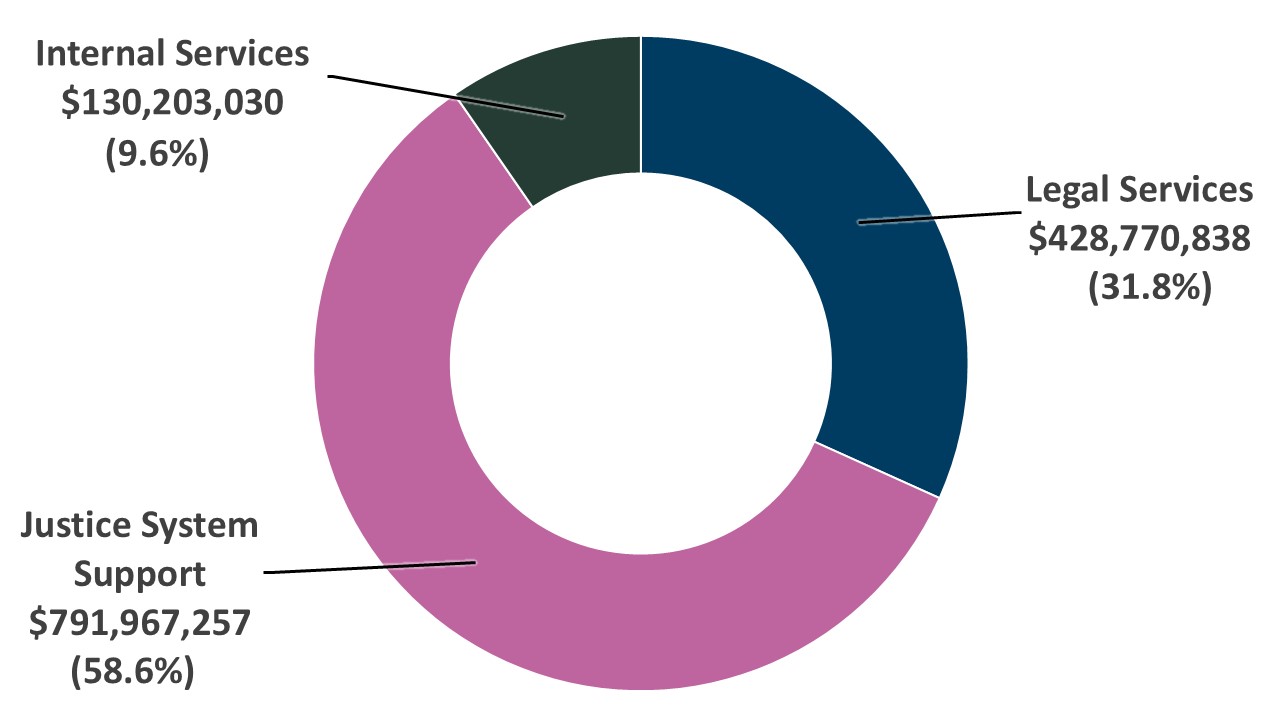
Text version of graph 1
Graph 1 shows that $791,967,257 (or 58.6%) of net actual spending is allocated to the Justice System Support core responsibility, $428,770,838 (or 31.8%) of net actual spending is allocated to the Legal Services core responsibility and $130,203,030 (or 9.6%) of net actual spending is allocated to support internal services. This represents a total actual spending for 2024–25 of $1,350,941,125.
Analysis of actual spending by core responsibility
The 2024–25 actual spending by core responsibility is in line with expectations as it is consistent with the forecasted spending as published in the 2025–26 Departmental Plan.
As the primary provider of legal services to federal government departments and agencies, the Department has a Vote-Netted Revenue (VNR) authority to collect and spend revenue (respendable revenue) received from the provision of such services. For departmental reporting, this respendable revenue reduces total departmental authorities and operating expenditures.
The Legal Services core responsibility actual spending of $428.8 million is net of legal services revenues of $423.6 million (see Table 9).
The Justice System Support core responsibility actual spending of $792.0 million (see Table 9) includes both operating spending of $74.4 million and grants and contributions spending $717.6 million.
Internal services actual spending of $130.2 million is net of legal services revenues of $59.1 million (see Table 9).
Refocusing Government Spending
In Budget 2023, the Government committed to reducing spending by $14.1 billion over five years, starting in 2023–24, and by $4.1 billion annually, ongoing.
To meet this commitment, the Department identified the following spending reductions:
- 2024–25: $6,654,000
- 2025–26: $9,692,500
- 2026–27 and per year ongoing: $15,114,000
During 2024–25, the Department worked to realize these reductions through the following measures:
- Reductions to professional services and travel
- Reductions to operations and grants and contributions
Professional services and travel
Under this category, the Department focused on reducing discretionary spending by optimizing its existing workforce and seizing new opportunities to carry out its work. Reductions in professional services focused mainly on funding alternative ways of achieving results. For example, the Department piloted a new translation tool to reduce its dependency on external service providers. The use of new and emerging technologies has been implemented, allowing employees to continue to work differently and virtually. This enabled the Department to reduce travel costs while also benefiting from technology-enabled participation in events, engagements and learning, which was not possible in the past.
Operations and grants and contributions
Further operating reductions were identified in areas where efficiencies could be realized, allowing the Department to minimize the impact on front-line services and refocus spending on the Government’s core priorities for Canadians. The Department took advantage of new digital tools and the hybrid work environment to reduce office space requirements gradually and strategically across Canada.
The grant and contribution reductions focused on programs such as the Contraventions Act Program, the Integrated Market Enforcement Teams Reserve Fund, the Special Advocates Program, and the State-Funded Counsel Program. The Department is confident that these reductions in grants and contributions will not have an adverse impact on services to Canadians.
Budgetary performance summary
Table 7: 2024–25 authorities and actual three-year net spending on core responsibilities and internal services (dollars)
The table below shows the budget available for 2024–25 and the money that the Department spent in each of the past three years on its core responsibilities and on internal services.
| Core responsibilities and internal services | 2024–25 Main Estimates | 2024–25 total authorities available for use | Actual spending over three years (authorities used) |
|---|---|---|---|
| Legal Services | $230,876,958 | $428,770,838 |
|
| Justice System Support | $602,493,696 | $808,768,457 |
|
| Subtotal | $833,370,654 | $1,237,539,295 |
|
| Internal services | $94,541,217 | $130,203,031 |
|
| Total | $927,911,871 | $1,367,742,326 |
|
Analysis of the 2024–25 authorities and past three years of spending
In 2024–25, the Main Estimates totaled $927.9 million and the total authorities available for use amounted to $1.37 billion, which represents an increase of $439.8 million (47.4%). The total authorities available for use include:
- $246.0 million of funding received in relation to compensation adjustments, operating budget carrying forward of prior year authorities, statutory adjustments and other adjustments to authorities
- $193.8 million of funding received through Supplementary Estimates processes, of which $187.4 million was for grants and contributions programs
Actual spending in 2024–25 ($1.35 billion) is $16.8 million (-1.2%) lower than the total authorities available for use ($1.37 billion). This difference is comprised of:
- $11.5 million in unspent grants and contributions funding mainly under the following programs:
- Victims Fund
- Indigenous Justice Program
- Access to Justice in Both Official Languages Support Fund
- $5.3 million in unspent operating funding mainly related to:
- Lower operating and maintenance spending on day-to-day operations
Overall, the Department shows an increasing trend in spending over the past three years. Spending grew by 21.7% from 2023–24 ($1.11 billion) to 2024–25 ($1.35 billion) and 12.9% from 2022–23 ($983.3 million) to 2023–24 ($1.11 billion). The $240.9 million increase from 2023–24 to 2024–25 is largely explained by one-time retroactive payments, increases in salary spending and an associated increase in the employee benefit plan (statutory) resulting from the ratification of various collective agreements, and an increase of funding in grants and contributions.
The Finances section of the Infographic for the Department on GC Infobase offers more financial information from previous years.
Table 8: Three-year planned net spending on core responsibilities and internal services (dollars)Footnote 42
The table below shows the Department’s planned spending for each of the next three years on its core responsibilities and on internal services.
| Core responsibilities and internal services | 2025–26 planned spending | 2026–27 planned spending | 2027–28 planned spending |
|---|---|---|---|
| Legal Services | $280,270,671 | $279,246,192 | $279,188,118 |
| Justice System Support | $793,916,044 | $723,580,171 | $700,930,396 |
| Subtotal | $1,074,186,715 | $1,002,826,363 | $980,118,514 |
| Internal services | $95,922,583 | $92,568,510 | $92,397,985 |
| Total | $1,170,109,298 | $1,095,394,873 | $1,072,516,499 |
Analysis of the next three years of planned spending
The Department’s planned spending shows a decrease from $1.17 billion in 2025–26 to $1.07 billion in 2027–28. This $97.6 million decrease is due to changes in funding for grants and contributions.
The decreases in grants and contributions planned spending are explained by funding reprofiles, reductions to funding profiles and the sunsetting of temporary funding mainly in the following programs:
- Justice Partnership and Innovation Program
- Immigration and Refugee Legal Aid
- Victims Fund
- Indigenous Justice Program
- Canadian Family Justice Fund
- Legal Advice for Complainants of Workplace Sexual Harassment
- Indigenous Partnership Fund
Additionally, planned spending for future years reflects spending reductions related to Refocusing Government Spending announced in Budget 2023.
The Finances section of the Infographic for the Department on GC Infobase offers more detailed financial information related to future years.
Table 9: Budgetary actual gross spending summary (dollars)
The table below reconciles gross spending with net spending for 2024–25.
| Core responsibilities and internal services | 2024–25 actual gross spending | 2024–25 actual revenues netted against expenditures | 2024–25 actual net spending (authorities used) |
|---|---|---|---|
| Legal Services | $852,344,790 | $423,573,952 | $428,770,838 |
| Justice System Support | $791,967,257 | $0 | $791,967,257 |
| Subtotal | $1,644,312,047 | $423,573,952 | $1,220,738,095 |
| Internal services | $189,299,605 | $59,096,575 | $130,203,030 |
| Total | $1,833,611,652 | $482,670,527 | $1,350,941,125 |
Analysis of budgetary actual gross spending summary
This table reflects the Department’s actual gross spending for 2024–25, which includes the VNR collected of $482.7 million. The revenue collected is distributed between the Legal Services core responsibility and internal services.
The Finances section of the Infographic for the Department on GC Infobase offers information on the alignment of the Department’s spending with Government of Canada’s spending and activities.
Table 10: Departmental Vote-Netted Revenue
The table below shows the legal services respendable revenue that the Department collected in each of the past three years as well as the vote-net revenue authority (planned VNR).
| Vote-netted Revenue | 2024–25 Main Estimates | Planned VNRFootnote 43 | Actual revenues over three years |
|---|---|---|---|
| Legal Services | $442,000,000 |
|
|
In 2024–25, $482.7 million of VNR was generated, representing an increase of $11.6 million compared to 2023–24 ($471.1 million). This is primarily due to an increase in demand for legal services from client departments and agencies in such areas as combatting tax evasion and avoidance including COVID-19 eligibility decisions, support for responses to immigration and refugee issues, defending Canadians’ interests at home and abroad, Indigenous-related matters, and international trade law matters.
The Finances section of the Infographic for the Department on GC Infobase offers more detailed financial information related to future years.
Funding
This section provides an overview of the Department’s voted and statutory funding for its core responsibilities and for internal services. Consult the Government of Canada budgets and expenditures for further information on funding authorities.
The graph below summarizes the Department’s approved voted and statutory net actual spending and planned spending from 2022–23 to 2027–28.
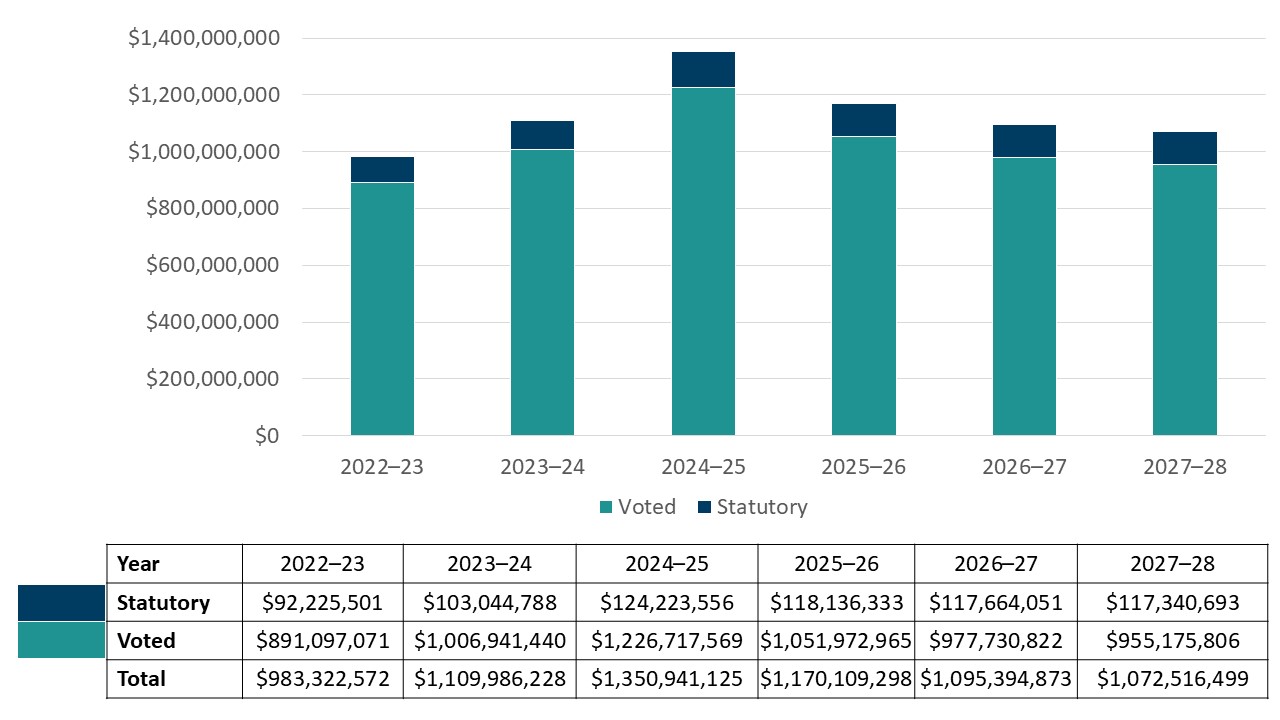
Text version of graph 2
This stacked column graph represents departmental spending trends for six fiscal years for the Department. The graph presents a timeline (in fiscal years) on the horizontal axis and the amount of dollars (in millions of dollars) on the vertical axis. The timeline on the horizontal axis shows six columns: one for each fiscal year from 2022–23 on the left through to 2027–28. The columns for fiscal years 2022–23 to 2024–25 show actual spending, while the columns for fiscal years 2025–26 to 2027–28 show planned spending.
The amount of dollars on the vertical axis ranges from 0 on the bottom to 1,400,000,000 on the top. Each column displays an accumulated total of departmental spending for two categories of funding: statutory and voted. These two categories of funding are also displayed numerically below each column to indicate the precise amount of spending (in millions of dollars) for each of the six fiscal years presented.
The first column of the timeline, representing fiscal year 2022–23, displays $92,225,501 in statutory spending and $891,097,071 in voted spending, for a total actual spending of $983,322,572.
The second column of the timeline, representing fiscal year 2023–24, displays $103,044,788 in statutory spending and $1,006,941,440 in voted spending, for a total actual spending of $1,109,986,228.
The third column of the timeline, representing fiscal year 2024–25, displays $124,223,556 in statutory spending and $1,226,717,569 in voted spending, for a total actual spending of $1,350,941,125.
The fourth column of the timeline, representing fiscal year 2025–26, displays $118,136,333 in statutory spending and $1,051,972,965 in voted spending, for a total planned spending of $1,170,109,298.
The fifth column of the timeline, representing fiscal year 2026–27, displays $117,664,051 in statutory spending and $977,730,822 in voted spending, for a total planned spending of $1,095,394,873.
The sixth and final column of the timeline, representing fiscal year 2027–28, displays $117,340,693 in statutory spending and $955,175,806 in voted spending, for a total planned spending of $1,072,516,499.
Analysis of statutory and voted net actual and planned spending over a six-year period
As illustrated in the graph above, the Department’s actual spending shows an increasing trend. Actual spending in 2024–25 ($1.35 billion) represents a $240.9 million (21.7%) increase compared to 2023–24 ($1.11 billion), mainly due to the following:
- One-time retroactive payments, increases in salary spending and an associated increase in the employee benefit plan (statutory) resulting from the ratification of various collective agreements and an increase in the size of the workforce, mainly under the Legal Services core responsibility and internal services
- An increase in grants and contributions spendingFootnote 45 resulting from new and additional investments as announced in Budget 2023 and Budget 2024, with the most significant increases being under the following programs/funds:
- Criminal Legal Aid Program
- Immigration and Refugee Legal Aid Program
- Victims Fund
- Indigenous Partnership Fund
- Access to Justice in Both Official Languages Support Fund
Consult the Public Accounts of Canada for further information on the Department’s voted and statutory expenditures.
Financial statement highlights
The Department’s Financial Statements (Unaudited) for the Year Ended March 31, 2025
Table 11: Condensed Statement of Operations (unaudited) for the year ended March 31, 2025 (dollars)
The table below summarizes the expenses and revenues for 2024–25 which net to the cost of operations before government funding and transfers.
| Financial information | 2024–25 actual results | 2024–25 planned results | Difference (actual results minus planned) |
|---|---|---|---|
| Total expenses | $1,955,098,796 | $1,464,002,337 | $491,096,459 |
| Total revenues | $482,751,758 | $442,000,197 | $40,751,561 |
| Net cost of operations before government funding and transfers | $1,472,347,038 | $1,022,002,140 | $450,344,898 |
Analysis of expenses and revenues for 2024-25
Total expenses of $1,955.1 million in 2024–25 included $1,112.9 million (56.9%) of salaries and employee benefits and $709.5 million (36.3%) of transfer payments. Total expenses for 2024–25 exceeded planned results by $491.1 million mainly due to:
- An increase in personnel expenditures and related employee benefit plan amounts for in-year retroactive and lump-sum payments resulting from ratified collective agreements and further increased by the rise in demand for legal services from several clients
The 2024–25 planned results information is provided in the Department’s Future-Oriented Statement of Operations and Notes 2024–25.
Table 12: Condensed Statement of Operations (unaudited) for 2023–24 and 2024–25 (dollars)
The table below summarizes actual expenses and revenues and shows the net cost of operations before government funding and transfers.
| Financial information | 2024–25 actual results | 2023–24 actual results | Difference (2024–25 minus 2023–24) |
|---|---|---|---|
| Total expenses | $1,955,098,796 | $1,681,945,192 | $273,153,604 |
| Total revenues | $482,751,758 | $471,112,909 | $11,638,849 |
| Net cost of operations before government funding and transfers | $1,472,347,038 | $1,210,832,283 | $261,514,755 |
Analysis of differences in expenses and revenues between 2023-24 and 2024-25
Total expenses increased by $273.2 million (16.2%) from 2023–24. This variance is mainly attributable to the following:
- An increase in salary and employee benefits expenses ($241.8 million or 27.8%), related to an increase in the workforce and yearly compensation adjustments after the ratification of various collective agreements
- An increase in expenses for grants and contributions spending ($38.8 million or 5.8%), related to increased contribution spending to various initiatives, mainly Immigration and Refugee Legal Aid, Criminal Legal Aid and Victims Fund
- Offset by a decrease in expenses ($7.4 million) mostly attributable to the following categories: professional and special services; utilities, materials and supplies; and Travel and relocation
The graph below outlines the Department’s expenses by core responsibility.
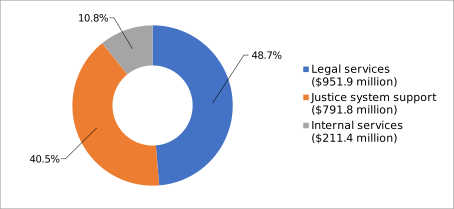
Text version of Graph 3
The Department’s expenses by core responsibility are as follows:
- $951.9 million for Legal Services (48.7%)
- $791.8 million for Justice System Support (40.5%)
- $211.4 million for Internal services (10.8%)
Revenues by type
Total revenues amounted to $482.8 million in 2024–25 and were mostly derived from the provision of advisory, litigation and legislative services provided by the Department to other government departments and agencies. Total revenues for 2024–25 exceeded the planned results by $40.8 million (9.2%). This is mainly attributable to an increase in the provision of legal services to client departments and agencies.
Total revenues increased by $11.6 million (2.5%) from 2023–24. This variance is mainly explained by an increase in legal services revenues resulting from increased demand, which was met through an increase in the workforce.
The graph below presents the Department’s gross revenues by type and excludes revenues earned on behalf of GovernmentFootnote 46 in the amount of $111.8 million.
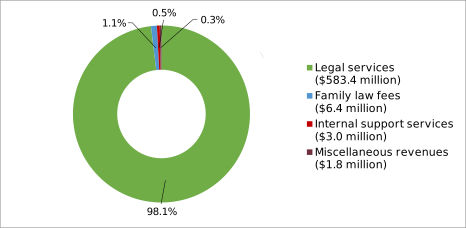
Text version of Graph 4
The Department’s expenses by type are as follows:
- $583.4 million for legal services (98.1%)
- $6.4 million for family law fees (1.1%)
- $3.0 million for internal support services (0.5%)
- $1.8 million for miscellaneous revenues (0.3%)
Table 13: Condensed Statement of Financial Position (unaudited) as at March 31, 2025 (dollars)
The table below provides a brief snapshot of the amounts the Department owes or must spend (liabilities) and its available resources (assets), which helps to indicate its ability to carry out programs and services.
| Financial information | Actual fiscal year (2024–25) | Previous fiscal year (2023–24) | Difference (2024–25 minus 2023–24) |
|---|---|---|---|
| Total net liabilities | $638,220,024 | $506,279,773 | $131,940,251 |
| Total net financial assets | $584,493,712 | $459,483,799 | $125,009,913 |
| Departmental net debt | $53,726,312 | $46,795,974 | $6,930,338 |
| Total non-financial assets | $19,819,802 | $19,483,765 | $336,037 |
| Departmental net financial position | $(33,906,510) | $(27,312,209) | $(6,594,301) |
Analysis of department’s liabilities and assets since last fiscal year
From 2023–24 to 2024–25, the Departmental Net Financial Position decreased by $6.6 million due to a number of factors, which are reflected in the information presented below.
Liabilities
The net liabilities were $638.2 million at the end of 2024–25, which represents an increase of $131.9 million (26.1%) from 2023–24. The variance is mainly explained by an increase in salary payable resulting from ratified collective agreements, increases in FTEs and an increase in transfer payments payable due to additional funding obtained through Budget 2024 and off-cycle requests.
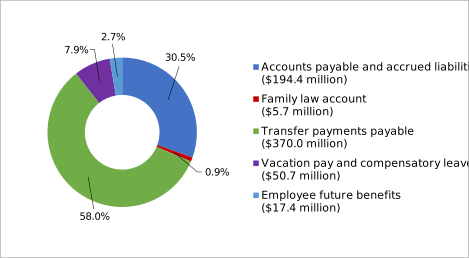
Text version of Graph 5
The Department’s liabilities by type are as follows:
- $194.4 million for accounts payable and accrued liabilities (30.5%)
- $5.7 million for family law account (0.9%)
- $370.0 million for transfer payments payable (58.0%)
- $50.7 million for vacation pay and compensatory leave (7.9%)
- $17.4 million for employee future benefits (2.7%)
Financial and non-financial assets
The total net financial assets increased by $125.0 million (27.2%) in 2024–25 as compared to 2023–24. This variance is mainly explained by an increase in the amount due from the Consolidated Revenue Fund, as a result of the increase in accrued salaries and wages and transfer payments payable at year-end.
Total non-financial assets increased by $0.3 million (1.7%) in 2024–25 compared to 2023–24. This variance is primarily due to increased spending on assets under construction related to leasehold improvements.
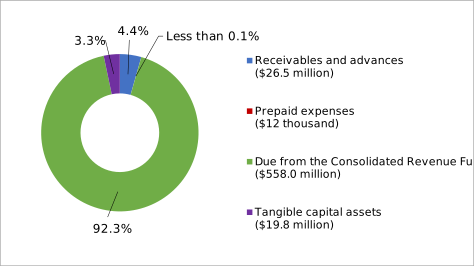
Text version of Graph 6
The Department’s assets by type are as follows:
- $26.5 million for receivables and advances (4.4%)
- $12 thousand for prepaid expenses (Less than 0.1%)
- $558.0 million due from the Consolidated Revenue Fund (92.3%)
- $19.8 million for tangible capital assets (3.3%)
Human resources
This section presents an overview of the Department’s actual and planned human resources from 2022–23 to 2027–28.
Table 14: Actual human resources for core responsibilities and internal services
The table below shows a summary of human resources, in FTEs, for the Department’s core responsibilities and for its internal services for the previous three fiscal years.
| Core responsibilities and internal services | 2022–23 actual FTEs | 2023–24 actual FTEs | 2024–25 actual FTEs |
|---|---|---|---|
| Legal Services | 3,676 | 3,897 | 4,043 |
| Justice System Support | 366 | 390 | 374 |
| Subtotal | 4,042 | 4,287 | 4,417 |
| Internal services | 1,116 | 1,156 | 1,237 |
| Total | 5,158 | 5,443 | 5,654 |
Analysis of human resources over the last three years
The table above shows an increasing trend in human resources. The actual number of FTEs increased by 211 from 2023–24 (5,443) to 2024–25 (5,654). The most significant increase was an additional 146 FTEs in the Legal Services core responsibility, as the demand for legal services has increased over the years. There was also an increase of 81 FTEs for internal services. The majority of this increase is due to additional resources needed to support the operational needs for the Department.
Table 15: Human resources planning summary for core responsibilities and internal services
The table below shows information on human resources, in FTEs, for each of the Department’s core responsibilities and for its internal services planned for the next three years.
| Core responsibilities and internal services | 2025–26 planned FTEs | 2026–27 planned FTEs | 2027–28 planned FTEs |
|---|---|---|---|
| Legal Services | 4,051 | 4,051 | 4,051 |
| Justice System Support | 377 | 377 | 377 |
| Subtotal | 4,428 | 4,428 | 4,428 |
| Internal services | 1,258 | 1,249 | 1,249 |
| Total | 5,686 | 5,677 | 5,677 |
Analysis of human resources for the next three years
The Department’s planned FTEs for the next three years are forecasted as of October 31, 2024. Due to the timing of forecasts and the information available, the planned FTEs do not include the impact of the following:
- Future government spending reduction initiatives
- Forecasted demand for legal services
- Any new initiatives announced in the 2024 Fall Economic Statement and upcoming federal Budgets
The 2025–26 internal services planned FTEs includes temporary positions for the creation of the Miscarriage of Justice Review Commission. These FTEs are not included in the planned FTEs for future years, which accounts for the slightly lower internal services planned FTEs in 2026–27.
Supplementary information tables
The following supplementary information tables are available on the Department’s website:
Federal tax expenditures
The tax system can be used to achieve public policy objectives through the application of special measures such as low tax rates, exemptions, deductions, deferrals and credits. The Department of Finance Canada publishes cost estimates and projections for these measures each year in the Report on Federal Tax Expenditures. This report also provides detailed background information on tax expenditures, including descriptions, objectives, historical information and references to related federal spending programs as well as evaluations and GBA Plus of tax expenditures, which helps advance the government’s gender and diversity priorities.
Corporate information
Departmental profile
Appropriate minister:
The Honourable Sean Fraser, P.C., K.C., M.P.
Institutional head:
Shalene Curtis-Micallef
Ministerial portfolio:
Justice
Enabling instrument:
Year of incorporation / commencement:
1868
Departmental contact information
Mailing address:
Department of Justice Canada
284 Wellington Street
Ottawa, Ontario
Canada K1A 0H8
Telephone:
613-957-4222
TTD/TTY:
1-800-465-7735
Email:
Website:
Definitions
List of terms
- appropriation (crédit)
- Any authority of Parliament to pay money out of the Consolidated Revenue Fund.
- budgetary expenditures (dépenses budgétaires)
- Operating and capital expenditures; transfer payments to other levels of government, departments or individuals; and payments to Crown corporations.
- core responsibility (responsabilité essentielle)
- An enduring function or role of a department. The departmental results listed for a core responsibility reflect the outcomes that the department seeks to influence or achieve.
- Departmental Plan (plan ministériel)
- A report that outlines the anticipated activities and expected performance of an appropriated department over a 3-year period. Departmental Plans are usually tabled in Parliament in spring.
- departmental priority (priorité)
- A plan, project or activity that a department focuses and reports on during a specific planning period. Priorities represent the most important things to be done or those to be addressed first to help achieve the desired departmental results.
- departmental result (résultat ministériel)
- A high-level outcome related to the core responsibilities of a department.
- departmental result indicator (indicateur de résultat ministériel)
- A quantitative or qualitative measure that assesses progress toward a departmental result.
- departmental results framework (cadre ministériel des résultats)
- A framework that connects the department’s core responsibilities to its departmental results and departmental result indicators.
- Departmental Results Report (rapport sur les résultats ministériels)
- A report outlining a department’s accomplishments against the plans, priorities and expected results set out in the corresponding Departmental Plan.
- Full-time equivalent (équivalent temps plein)
- Measures the person years in a departmental budget. An employee’s scheduled hours per week divided by the employer’s hours for a full-time workweek calculates a full-time equivalent. For example, an employee who works 20 hours in a 40-hour standard workweek represents a 0.5 full-time equivalent.
- Gender-based Analysis Plus (GBA Plus) (analyse comparative entre les sexes plus [ACS Plus])
- An analytical tool that helps to understand the ways diverse individuals experience policies, programs and other initiatives. Applying GBA Plus to policies, programs and other initiatives helps to identify the different needs of the people affected, the ways to be more responsive and inclusive, and the methods to anticipate and mitigate potential barriers to accessing or benefitting from the initiative. GBA Plus goes beyond biological (sex) and socio-cultural (gender) differences to consider other factors, such as age, disability, education, ethnicity, economic status, geography (including rurality), language, race, religion, and sexual orientation.
- government priorities (priorités pangouvernementales)
- For the purpose of the 2024–25 Departmental Results Report, government priorities are the high-level themes outlining the government’s agenda as announced in the 2021 Speech from the Throne.
- horizontal initiative (initiative horizontale)
- A program, project or other initiative where two or more federal departments receive funding to work collaboratively on a shared outcome usually linked to a government priority, and where the ministers involved agree to designate it as horizontal. Specific reporting requirements apply, including that the lead department must report on combined expenditures and results.
- Indigenous business (entreprise autochtones)
- For the purposes of a Departmental Result Report, this includes any entity that meets the Indigenous Services Canada’s criteria of being owned and operated by Elders, band and tribal councils, registered in the Indigenous Business Directory or registered on a modern treaty beneficiary business list.
- non-budgetary expenditures (dépenses non budgétaires)
- Net outlays and receipts related to loans, investments and advances, which change the composition of the financial assets of the Government of Canada.
- performance (rendement)
- What a department did with its resources to achieve its results, how well those results compare to what the department intended to achieve, and how well lessons learned have been identified.
- performance indicator (indicateur de rendement)
- A qualitative or quantitative measure that assesses progress toward a departmental-level or program-level result, or the expected outputs or outcomes of a program, policy or initiative.
- plan (plan)
- The articulation of strategic choices, which provides information on how a department intends to achieve its priorities and associated results. Generally, a plan will explain the logic behind the strategies chosen and tend to focus on actions that lead to the expected result.
- planned spending (dépenses prévues)
- For Departmental Plans and Departmental Results Reports, planned spending refers to the amounts presented in Main Estimates. Departments must determine their planned spending and be able to defend the financial numbers presented in their Departmental Plans and Departmental Results Reports.
- program (programme)
- An individual, group, or combination of services and activities managed together within a department and focused on a specific set of outputs, outcomes or service levels.
- program inventory (répertoire des programmes)
- A listing that identifies all the department’s programs and the resources that contribute to delivering on the department’s core responsibilities and achieving its results.
- result (résultat)
- An outcome or output related to the activities of a department, policy, program or initiative.
- statutory expenditures (dépenses législatives)
- Spending approved through legislation passed in Parliament, other than appropriation acts. The legislation sets out the purpose and the terms and conditions of the expenditures.
- target (cible)
- A quantitative or qualitative, measurable goal that a department, program or initiative plans to achieve within a specified time period.
- voted expenditures (dépenses votées)
- Spending approved annually through an appropriation act passed in Parliament. The vote also outlines the conditions that govern the spending.
- Date modified: